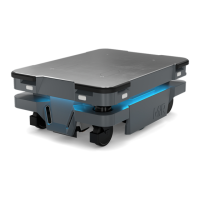
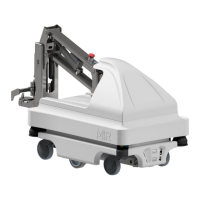
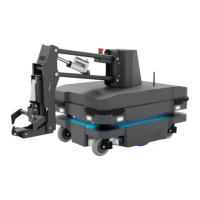
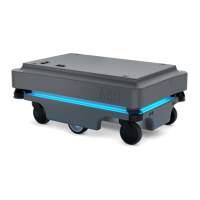
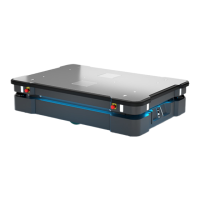
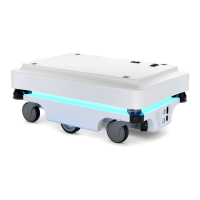
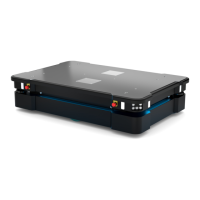
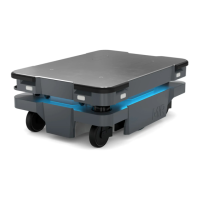
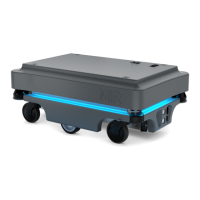
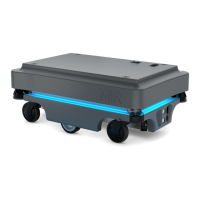
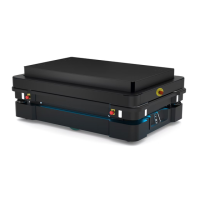
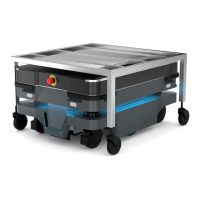
The MiR250 Hook is an autonomous mobile robot designed for indoor transportation of loads up to 500 kg within production facilities, warehouses, and other restricted industrial locations. It is a MiR250 robot equipped with a MiR Hook 250 top module.
Function Description
The MiR250 Hook autonomously picks up, transports, and places carts. It identifies different cart types using ID tags (QR codes or AprilTags) and creates navigation routes that account for the cart's size and shape. The robot's internal computer controls all hook-related tasks, including reading ID tags, precise hook placement, and controlling the hook actuators. Users operate the robot via a web-based interface accessible through a browser on a PC, smartphone, or tablet. The robot can execute fixed routes, respond to on-demand calls, or perform complex missions. It navigates using a map of its work area, which can be created from a CAD drawing or by manually driving the robot. While operating, it avoids unmapped obstacles like people and furniture.
Main Features:
- Driving in a populated workspace: Designed to operate safely and efficiently among people in dynamic environments.
- Overall route planning and local adjustments: Navigates autonomously, finding efficient paths and adjusting them for unmapped obstacles.
- Efficient transport of carts: Automates transportation of loaded carts up to 500 kg.
- Sound and light signals: Continuously signals its driving intentions and current status (e.g., waiting, driving, destination reached) with lights and sounds.
- User-friendly and flexible: Web-based interface allows easy operation and monitoring, with programmable missions and tailored dashboards for different user groups.
- Alert for 'lost': Stops, activates an orange-purple error light, and can trigger custom Try/Catch actions if unable to find a path.
- Automatic deceleration for objects: Built-in sensors slow the robot when obstacles are detected.
- Internal map: Uses a floor plan or a manually created map for navigation, allowing users to add positions and features.
Accessories:
- MiR Fleet: Centralized control for multiple robots across a facility.
- MiR Charge 48V: Fully automatic chargers for recharging batteries, enabling automated charging with MiR Fleet.
Technical Specifications (MiR250 Hook):
- Mass unloaded: 188 kg
- Rated speed: 2 m/s
- Nominal power: 2×637 W
- Max. slope: 1%
- Type: Driverless truck
- Coupling height: 80–350 mm
- Lithium ion battery nominal voltage: 48 V
- Rated ampere-hour capacity: 34.2 Ah
- Hook hardware version: 2.0 (as of 2023-01-19)
Cart Specifications:
- Cart width: 400 mm to 1500 mm
- Cart length: 500 mm to 2400 mm
- Cart height: Maximum 1800 mm
- Distance between gripper bar and floor: 80 mm to 350 mm
- Gripper bar length: Minimum 350 mm
- Gripper bar width: 15 mm to 25 mm
- Wheel configuration: Two rigid and two swivel wheels (front or back rigid wheels affect turning radius and stability).
- Payload: Up to 500 kg (total weight of loaded cart).
- ID tags: QR markers (70-100 mm recommended, max 16 characters) or AprilTags (80x80 mm recommended, 80-300 mm accepted) for cart identification. Must have at least 25 mm of empty white space around them.
Safety Features:
- Personnel detection: Safety laser scanners (270° field of view, 360° protection) stop the robot if an object is detected within the active Protective field. Field size varies with speed (e.g., 0-40 mm at 0.0-0.10 m/s, up to 2850 mm at 1.70-2.10 m/s forward).
- 3D cameras: Detect objects up to 1800 mm above the floor at 1200 mm distance in front of the robot, with a 114° horizontal and 54.5° vertical field of view. Used for navigation, not safety.
- Proximity sensors: Detect low objects around robot corners, primarily when standing still or moving at low speeds. Used for navigation, not safety.
- Overspeed avoidance: Prevents driving if motor encoder data indicates speed exceeds safety limits.
- Stability: Prevents driving if motor encoder data shows speed difference between motors exceeds predefined limits.
- Emergency stop buttons: One button on the hook, when pressed, triggers an Emergency stop, cutting power to motors and top module.
- MiR Hook 250 safety functions: Monitors hook motor encoder data for discrepancies, triggering a Protective stop if errors indicate unreliable control.
- Safety stop: Uses STO (Safe Torque Off) and SS1 (Safe Stop 1) contactors for controlled braking and power cut in Protective or Emergency stop. Mechanical brakes engage after stopping.
- Muted Protective fields: Can be enabled for docking to markers, reducing field size and speed to 0.3 m/s, flashing yellow signal lights, and emitting warning sounds.
- Operating hazard zones: Areas where Protective fields are muted or clearance is inadequate must be visibly marked.
Usage Features:
- Operating modes: Manual mode (joystick control) and Autonomous mode (executes missions).
- Connecting to robot interface: Connects via Wi-Fi access point (MiR_20XXXXXXX) and web browser (mir.com).
- Creating maps: Drive the robot to gather sensor data, then edit the map to remove noise and dynamic obstacles, and add zones (Unpreferred, Forbidden, Critical, Directional, Sound and light, Limit-robots).
- Creating markers: Define X-Y coordinates for precise docking locations (V-markers, VL-markers, L-markers, Bar-markers).
- Creating positions: Define X-Y coordinates for general travel destinations (e.g., Robot position, Cart positions).
- Creating carts: Define cart dimensions and calibration settings (Entry height, Lock height, Drive height) for each cart type.
- Creating missions: Program sequences of actions (move, logic, docking, sounds) using variables for flexibility and Try/Catch actions for error handling.
- Creating footprints: Define the robot's occupied space, including top modules and loads, to ensure correct path planning and obstacle avoidance.
- System settings: Configure planner parameters (Robot height, Cart reverse speed, Centripetal force limitation, Default robot footprint, Linear acceleration rate, Max distance from path, Maximum planning time, Path timeout, Maximum path deviation, Maximum allowed speed, Desired speed), docking parameters (Undock from markers, Docked at marker reverse distance, Docked at marker side threshold), safety system sounds, and enable/disable features (Hook, Email address, PLC registers, Universal Robots Interface, Fleet, Modbus, I/O modules, Mute protective fields).
Maintenance Features:
- Regular weekly checks:
- Clean robot exterior and maintenance hatches with a damp cloth.
- Remove dirt from caster and drive wheels, check for entanglement, and wipe away grease from roller bearings.
- Check status lights for intactness and even lighting.
- Clean 3D cameras on the hook for dust.
- Check signal lights for correct blinking and light display.
- Regular checks and replacements:
- Robot top cover: Check mounting monthly, replace as needed.
- Safety PLC: Check monthly and after commissioning for correct SICK configuration.
- Robot hardware: Check monthly and after commissioning for warnings.
- Caster wheels: Check bearings, tighten, check for wear weekly. Replace if diameter < 122 mm.
- Drive wheels: Check surfaces for wear, measure diameter every six months. Replace in pairs if diameter < 197.5 mm. IMU must be calibrated after replacement.
- Safety laser scanners: Check for visual defects monthly. Replace as needed. Clean optics covers with anti-static products.
- 3D cameras: Check for visual defects monthly. Calibrate or replace as needed.
- ESD capability: Check electrical resistance yearly or every 4000 km. Clean or replace drive wheels if resistance is out of bounds.
- Safety marking on the floor: Check intactness and visibility every six months, replace as needed.
- Safety stickers and nameplate: Check intactness and visibility every six months, replace as needed.
- Hook pins: Check mounting and set screws monthly. Apply thread-locking adhesive if needed.
- Hook gripper and vertical console: Check for cracks, bending, and springs monthly.
- Hook cables: Check for jamming, damage, and insulation monthly.
- Angle encoder: Check monthly by loosening brake and swinging arm.
- Hook brake: Check resistance and function monthly, clean brake pad.
- Hook: Check gripper function and perform homing monthly.
- Hook mounting bolts: Check if tightened to 18 Nm monthly.
- Battery maintenance: Generally maintenance-free, but clean with a dry, soft cloth if dirty. Store in a non-condensing environment at room temperature, disconnected from the robot. Regularly check and recharge if the state of charge is low.
- Software updates: MiR continuously provides software updates. Update hook software before robot software. Create backups before updates or major site changes.

 Need help?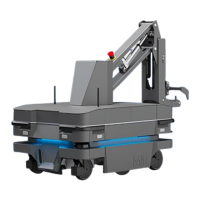

 To Next Page
 General