12. Commissioning
MiR250 Hook User Guide (en) 01/2023 - v.1.2 ©Copyright 2021-2023: Mobile Industrial Robots A/S. 156
Directional lanes
Issue: In some areas, such as long corridors, robots driving towards each other may have a hard
time passing each other efficiently.
Solution: If there is not enough space for the two robots to pass each other, you can create a
two-way lane using Directional zones in combination with Forbidden or Unpreferred zones.
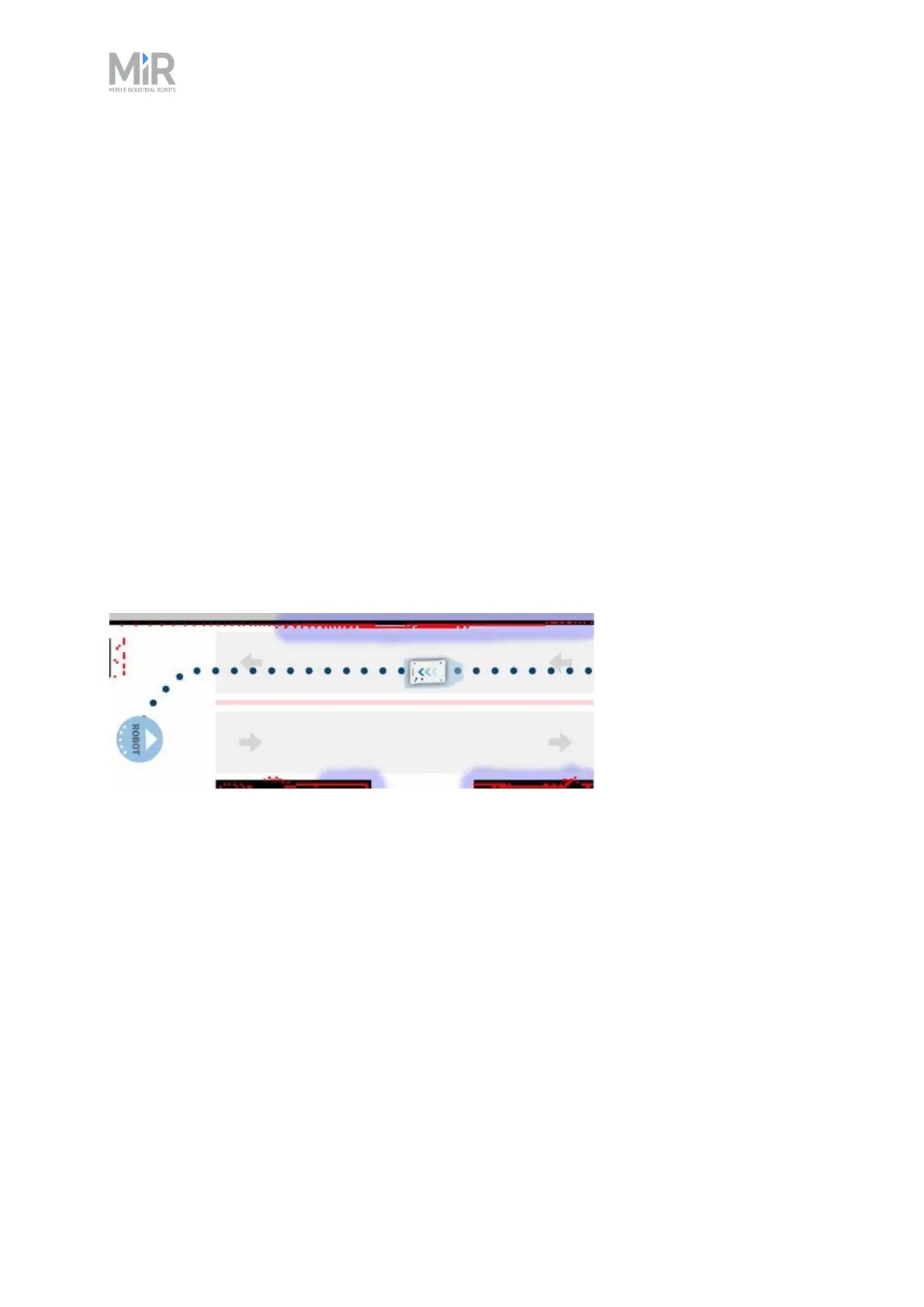
• Create a thin Forbidden zone (red) in the middle of the corridor parallel to the corridor walls.
This is the lane separator.
• Create Directional zones (gray with arrows) on both sides of the Forbidden zone. Make the
directions of the zones opposite.
With such a configuration, robots going in the opposite directions use different lanes and do not
get in each others' way. Replacing the Forbidden zone with an Unpreferred zone gives robots
more space for maneuvers, for example, if a robot needs to cross the lane separator to drive
around an obstacle.
Figure 12.10 The robot drives down a two-way lane. The two Directional zone lanes are separated by a
Forbidden zone.
If there isn't enough space for robots to pass each other, you can use a Limit-robots zone to
specify that only one robot may drive down the corridor at a time.
To use Limit-robots zones, your robots must be connected to MiRFleet.
12.7 Creating user groups and users
All users of the robot must have a user profile in the system. Users are administered in the Users
section where you set up, edit, and delete system users.
Users must be assigned to a user group. For each user group, you must define which parts of the
interface the users in that group have permission to edit.


 To Next Page