12. Commissioning
MiR250 Hook User Guide (en) 01/2023 - v.1.2 ©Copyright 2021-2023: Mobile Industrial Robots A/S. 172
The section "Usage" on page194 provides several examples of how to create simple missions
with different types of mission actions and describes how you add a mission to the mission
queue to test it. Whenever you create a mission, it is very important that you test it to ensure the
robot performs as expected.
For more information on creating missions, see MiRRobotInterfaceGuide and the
Making your first missions-course in MiR Academy on the MiR website. Contact your
distributor for access to MiR Academy.
Checklist
• You have made missions for all of the tasks you want you MiR robot to execute.
• You have tested each mission to ensure the robot performs as expected.
• You have made the mission appropriately robust for your integration level.
• You have considered how to best reuse missions by nesting them and applying variables.
12.11 Creating a footprint
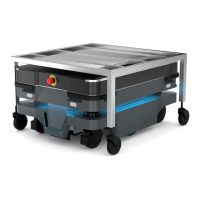
The footprint specifies how much space the robot occupies, including any loads or top modules.
The footprint is defined by a number of points relative to the robot's center coordinate system
and the total height of the robot application.
If your robot drives with loads or top modules that exceed the width or length of the robot, you
must define new footprints for the robot to ensure that the robot plans its route correctly and
avoids colliding with obstacles with its top module or load.
When a MiR robot is towing a cart, the footprint does not need to be increased. The robot will
navigate with the cart using the dimensions provided in the cart type—see "Creating a cart " on
page202.


 To Next Page