2. Product presentation
MiR250 Hook User Guide (en) 01/2023 - v.1.2 ©Copyright 2021-2023: Mobile Industrial Robots A/S. 31
Pos. Description Pos. Description
11 Encoder (angular), placed
beneath plate
12 Power supply
13 Relay
2.4 How MiR Hook 250 works
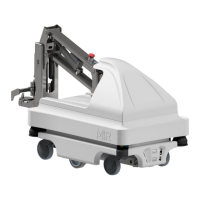
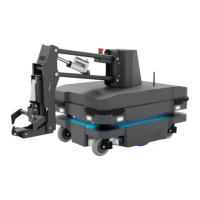
The MiR250 Hook can autonomously pick up, transport, and place carts. The carts can be
transported to user defined positions where they can be placed or reversed into a position.
The MiR250 Hook distinguishes between different types of carts by identifying them using ID tags
(QR code or AprilTag) and creates navigation routes that take size and shape of the cart into
account.
MiR250 Hook has its own computer which controls all hook-related tasks such as reading ID tags,
correct placement of the hook, and controlling the hook actuators.
With MiR250 Hook, you must provide the measurements of the carts as described in "Cart
specifications" on page139.
The MiR250 Hook has its own menu in the robot interface. To see the menu options for MiR250
Hook, the hook feature must be enabled—see "Enable the MiR250 Hook feature" on page81.
MiR Hook 250 is connected to MiR250 through the Ethernet, Power, and Auxiliary emergency stop
interfaces. If any of these connections are disconnected, MiR Hook 250 is not able to operate.
The robot uses Cart position to identify places where it can pick up and place carts—see
"Positions" on page167 and "Creating positions" on page199.
For more information about how much space is required for the hook maneuvers,
see the space requirements best practice guide for your robot on the Support Portal.


 To Next Page