radEAGLE User Manual Welcome
Several models of the radEAGLE are available (see E.1, p. 135 for details), all of which
are covered in this document. The few cases where a feature of a certain model
differs from the main stream are marked in the text.
1.5 The
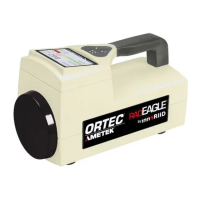
radEAGLE
The radEAGLE is a new generation radio-isotope identification device (RIID). It consists of
the following components:
• Scintillation detector using either a sodium iodide NaI(Tl), a lanthanum bromide
LaBr
3
(Ce), or a cerium bromide CeBr
3
crystal.
• Geiger-Müller detector
3
He Neutron detector
• Multi-Channel Analyzer (MCA) for spectral data readout of the scintillation detector
• Computational subsystem that includes LCD screen, keyboard, status LEDs, vibrator
and speaker
GPS Receiver
1.5.1 Detectors
Each component has a dedicated purpose. The scintillator is the primary detector of the
instrument and would be used for multiple purposes including pulse height analysis and dose
rates.
1.5.1.1 Scintillation Detector
The scintillation detector is used to collect the pulse height spectrum of the gamma photons
that interact with the scintillation crystal. The different radioisotopes each have specific
decay schemes and some emit gamma photons that can be analyzed and used to determine
the radiation source. (ÞScintillation Detector)
1.5.1.2 Geiger-Müller Detector
The dose rate is determined by either the scintillation detector or the internal Geiger-Müller
tube. When the dose rate at the scintillator surface exceeds 200 µSv/h, the Geiger-Müller
tube will perform the dose rate measurement. This tube is suited for measuring dose rates
up to 1 Sv/h. (ÞGeiger-Müller detector)
If the Geiger-Müller detector kicks in, you are already in an extremely dangerous level
of radiation. You should increase distance and shielding between yourself and the
source. Additionally, you should restrict the time you stay within this field to an abso-
lute minimum.
© innoRIID GmbH • 2019-04-11 Software 3.2.12 • Document 3.3.0o 13/147


 To Next Page