Page 25 of 292
2.9 Technical Description
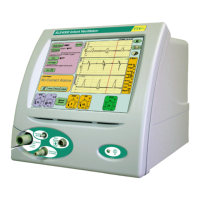
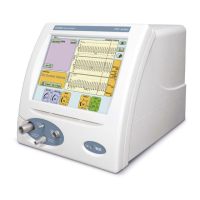
The ventilator is a computer controlled ventilator. The computer is broken down into three
electronic subsystems that are housed in the upper (electronic) section of the ventilator.
The three sub systems are user interface, monitor and control.
The interface subsystem controls the user interface, the display and the touch screen. The
controller subsystem regulates the pneumatic systems of the ventilator. The monitor
subsystem collects and processes flow data and generates the alarms. Each subsystem
communicates with the other two in a peer to peer protocol, i.e. no subsystem is in complete
control.
The ventilator is fitted with an auto-ranging power supply that is capable of working with
mains supplies of 100v to 250v 50-60 Hertz. (Fuse ratings must change between the supply
voltages, 100v to 110v 2amp and 220 to 250v 1amp.)
The ventilator carries an onboard back up power supply, which consists of sealed lead/acid
batteries, that can power the ventilator in the event of a mains power fail. The batteries are
charged from the ventilators power supply. Both the battery supply and mains power supply
are monitored by the ventilators other subsystems. In normal modes of ventilation and with a
fully charged battery, in a mains power fail situation the ventilator will continue to operate for
45 minutes to 60 minutes depending on ventilation mode.
The pneumatic system consists of the following:
An electronic oxygen blender supplying blended gas to a mixing chamber. The blended gas
is then controlled via solenoid valves to supply the conventional ventilation system and the
oscillatory system.
For conventional ventilation the gas is then controlled by two pressure regulators that
produce positive and negative gas flows via the forward and reverse jets.
For oscillatory ventilation the gas flow is controlled by four in-line high speed solenoid valves
that produce the oscillatory gas flow via the forward and reverse jets.
The exhalation block mounts onto two jet ports one forward/reverse and one mean pressure.
Pressure is monitored via the proximal airway port through a pair of pressure transducers
with data being sent to the monitor subsystem.
Flow is monitored by a dual hot wire anemometer mounted at the ET manifold with the flow
data being sent to the monitor subsystem.


 To Next Page