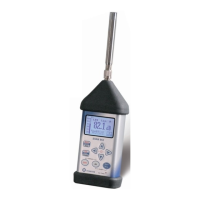
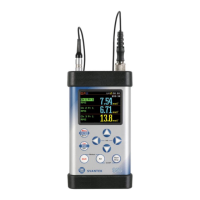
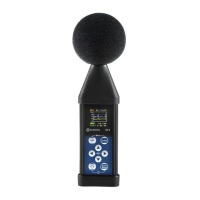
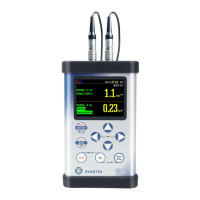
SVAN 977A User Manual - Appendixes
APPENDIX A. REMOTE CONTROL
The USB 1.1 interface is the serial one working with 12 MHz clock. Its speed is relatively high, and it ensures
the common usage of USB in all produced nowadays Personal Computers.
The RS 232 interface is also available but as an option. In order to activate this option, the user has to buy a
special cable with a programmed processor. This interface complies with CCIT V.24 standard. Practically all
Personal Computers can be linked to the instrument by means of this interface. The maximum available
transmission speed is equal to 115200 bits/sec.
Note: For reliable operation of the RS 232, proper synchronisation of the transmission by CTS
and RTS lines (according to their definitions) is required.
The functions, which are developed in order to control data flow in the serial interfaces, ensure:
- bi-directional data transmission,
- remote control of the instrument.
The user, in order to programme the serial interface, has to:
1. send "the function code",
2. send an appropriate data file
or
3. receive a data file.
The following basic input/output transmission types (called functions) are available:
#1 input / output of the control setting codes,
#2 read out of the main measurement results,
#3 read out of the measurement results in 1/x OCTAVE or FFT mode,
#7 special control functions,
#D read / write the data files from the external memory (SD-card).
A.1. FUNCTION #1 – INPUT/OUTPUT OF THE CONTROL SETTING CODES
#1 function enables the user to send the control setting codes to the instrument and read out a file containing
the current control state. A list of the control setting codes is given in Tab. A.1. The format of #1 function is
defined as follows:
#1,Xccc,Xccc,(...),Xccc;
or
#1,Xccc,X?,Xccc,(...),X?,Xccc;
where:
X - the group code, ccc - the code value,
X? - the request to send the current X code setting.
The instrument outputs in this case a control settings file for all requests X? in the following format:
#1,Xccc,Xccc,(...),Xccc;
In order to read out all current control settings the user should send to the device the following sequence of
characters:
#1;


 To Next Page