SVAN 977A User Manual - Appendixes
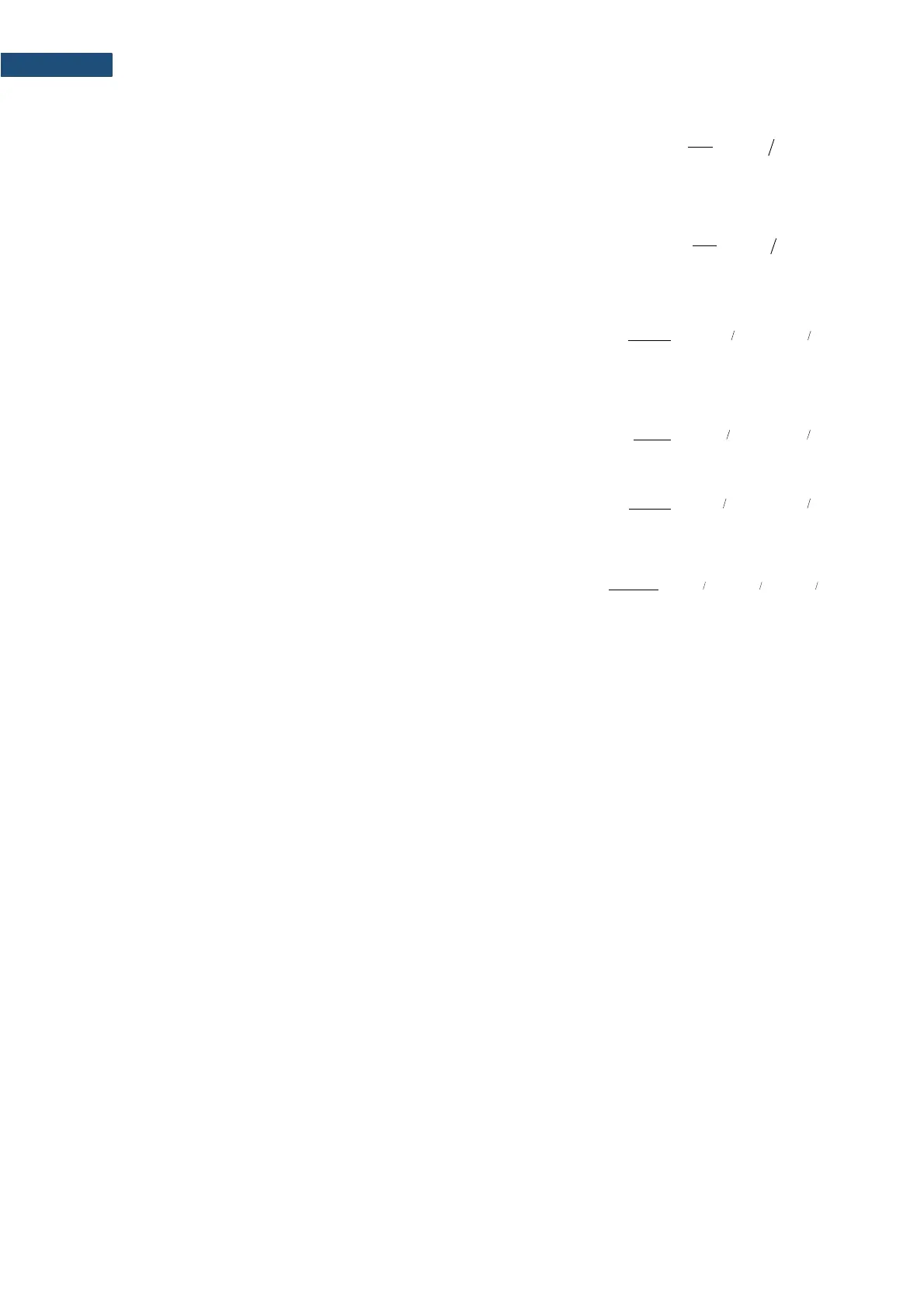
Le is calculated for: T
d
= 0, T
e
≠ 0, T
n
= 0.
( )
( )
+=
e
T
2
0W
e
dtptr
T
1
log01dB5Le
Ln is calculated for: T
d
= 0, T
e
= 0, T
n
≠ 0.
( )
( )
+=
n
T
2
0W
n
dtptr
T
1
log01dB10Ln
Lde is calculated for: T
d
≠ 0, T
e
≠ 0, T
n
= 0.
( )
+
+
=
10Le10Ld
1041012
412
1
log10Lde
Len is calculated for: T
d
= 0, T
e
≠ 0, T
n
≠ 0.
( )
+
+
=
10Ln10Le
108104
84
1
log10Len
Lnd is calculated for: T
d
≠ 0, T
e
= 0, T
n
≠ 0.
( )
+
+
=
10Ld10Ln
1012108
128
1
log10Lnd
Lden is calculated for: T
d
≠ 0, T
e
≠ 0, T
n
≠ 0.
( )
++
++
=
10Ln10Le10Ld
1081041012
4812
1
log10Lden
Expected value. Calculated on the basis of
100ms RMS results.
Standard deviation. Calculated on the basis
of 100ms RMS results.
Noise Rating, measured noise level that
takes into account the frequency content of
the noise.
NR is calculated if 1/1 Octave function is
active.
To calculate the NR value, the noise level in
each 1/1 octave band (from 31.5Hz to 8kHz)
is compared to the “NR curves” for each
corresponding band. The NR curve number
which applies to each frequency band is the
highest numerical value that is not exceeded
in that band. The overall NR value is the
highest of the individual NR values for the
frequency bands.
Noise Criterion, measured noise level that
takes into account the frequency content of
the noise.
NC is calculated if 1/1 Octave function is
active.
To calculate the NC value, the noise level in
each 1/1 octave band (from 63Hz to 8kHz)
is compared to the “NC curves” for each
corresponding band. The NC curve number
which applies to each frequency band is the
lowest numerical value that is not exceeded
by each individual frequency band. The
overall NC value is the highest of the
individual NC values for the frequency
bands.


 To Next Page