92 | PGC5000 GEN 2 | 892 J006 MNAH
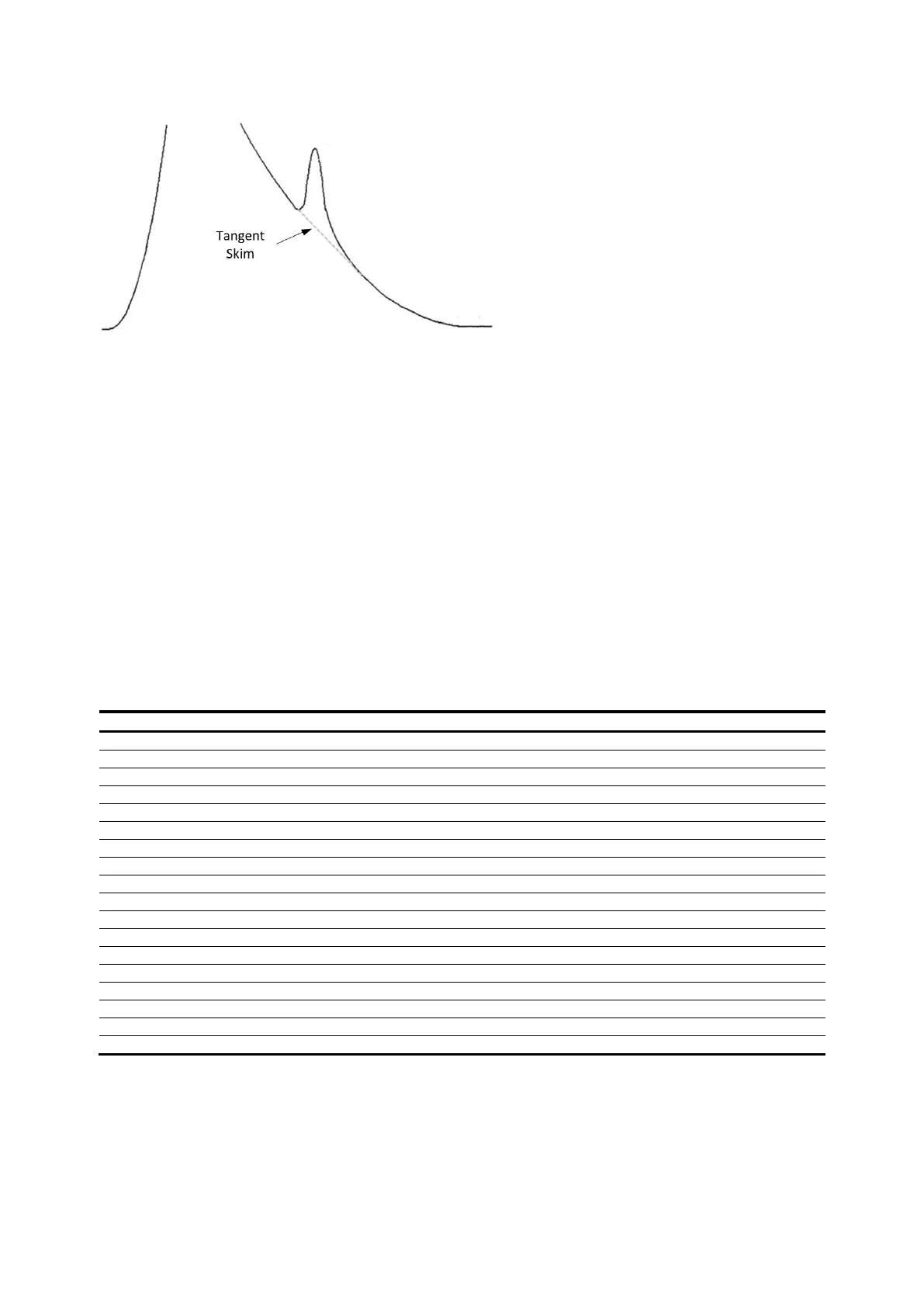
Figure 5-10: Tangent skim
In the case of a shoulder where there is no valley, tangential points can still be located until the
shoulder decreases to a critical size in which it is impossible to separate it from the larger peak. The
smaller peak is also referred to as a dependent peak and the peak on which it is attached, the parent
or independent peak.
5.4.6 Baseline drift
Baseline drift happens when the signal flat-lines at a level outside the threshold. Flat-lining is detected
with the signal’s value and its first derivative. If the derivative falls to 0 and the signal is outside the
threshold, the baseline is re-anchored when this condition exceeds 100 consecutive signal samples
(one second). The peak detection threshold is now relative to the new baseline. The baseline can shift
higher or lower.
5.5 Time coded functions
A Time Coded Function (TCF) defines an action performed at a specified time in an analysis. The TCF
parameters are the specifications available to the function. TCFs are added to analyses, methods or
sequence scopes when creating an analysis using the LUI or RUI. Results of some TCFs may not be
reported until the end of an analysis.
Entering a TCF in an analysis, method or script defines an action to perform (e.g. Valve ON) at a
specific time in the analysis. The following table identifies the TCFs for each scope.
Table 5-2: TCFs
The following sections list the functions (alphabetically) with descriptions. They include tables with the
Parameter name, acceptable range, and units of measure values. This information is intended as a
guide in properly configuring TCFs.



 To Next Page