Installer manual AlphaVision ML Rev. 3.60 01-01-2015 44
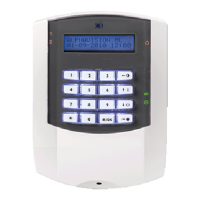
When enrolling proximity tag’s and the system asks to enter a 6-digit code, present the proximity tag to the
integrated proximity reader on the LCD/PROX keypad. The system will automatically create a 6-digit code. It
is also possible that 6-digit code is keyed in instead of presenting the proximity tag.
►!
When using proximity tag’s it is advised to only use 6-digit user codes !
►!
If the programming option 4-digit codes is selected (Installer menu / System Options / User Codes)
then the last 2 digits of the user code is ignored.
Each user must be assigned to a user-level. The available levels are as follows:
Level 0 codes/tags are codes or tags which have been programmed but are not active (for example
temporarily blocked).
Level 1 is used only for proximity tag’s and is used exclusively for granting access to the premises via the
external proximity reader. User codes with level 1 cannot arm/disarm section (s) of the control panel. If a
user with a level 1 tag presents his/her proximity tag to the external proximity reader the system will first
check if the section (s) that are linked to this user code are disarmed. Only if the section (s) that are
associated to the user code are disarmed then the o.c. output of the external proximity reader will be
activated for 3 seconds and thus unlock the door.
►
! From software v2.04 and higher a PIN-code with level 1 can be used to activate the ‘trigger output’
when entered on a keypad.
Level 2 is assigned to user codes that can only arm section(s). If the user code is assigned to more than 1
section you must take into consideration that the sections are linked, for example if sections 1, 2 and 3 are
assigned, these can only be armed simultaneously. If for example, section 3 was already armed, then
Sections 1 and 2 are also armed. Level 2 user codes cannot use the external proximity reader.
Level 3 is assigned to user codes that can arm and disarm sections simultaneously. The sections are linked,
for example the sections 1, 2 and 3 are assigned, these can only be armed and disarmed at the same time.
Level 3 codes can also access the ‘Information present’ menu to read and clear information. When
presenting a level 3 tag to the external proximity reader the sections that are assigned to the user code (tag)
must be disarmed before the o.c. output of the proximity reader will be activated.
Level 4 is especially meant for proximity tag’s that can arm and disarm sections simultaneously without
having to press the <# or *> button on the keypad. For level 4, it is also possible to assign multiple sections.
For example, when a proximity tag is assigned to sections 1, 2 and 3, then if all sections are disarmed
everything will be armed simultaneously. If one or more sections are already armed, then only the armed
sections will be disarmed. The already disarmed sections remain disarmed until the proximity tag is
presented again, all sections will now be armed. Level 4 codes can also access the ‘Information present’
menu to read and clear information. When presenting a level 4 tag to the external proximity reader the
sections that are assigned to the user code (tag) will be disarmed and the o.c. output of the proximity
reader to provide easy access control.
Level 5 user codes can arm and disarm the assigned sections separately. The user can select which of the
assigned sections are to be armed or disarmed. Level 5 codes can also access the ‘Information present’
menu to read and clear information. When presenting a level 5 tag to the external proximity reader the
sections that are assigned to the user code (tag) must be disarmed before the o.c. output of the proximity
reader will be activated.
Level 6 is not present in the ML.


 To Next Page