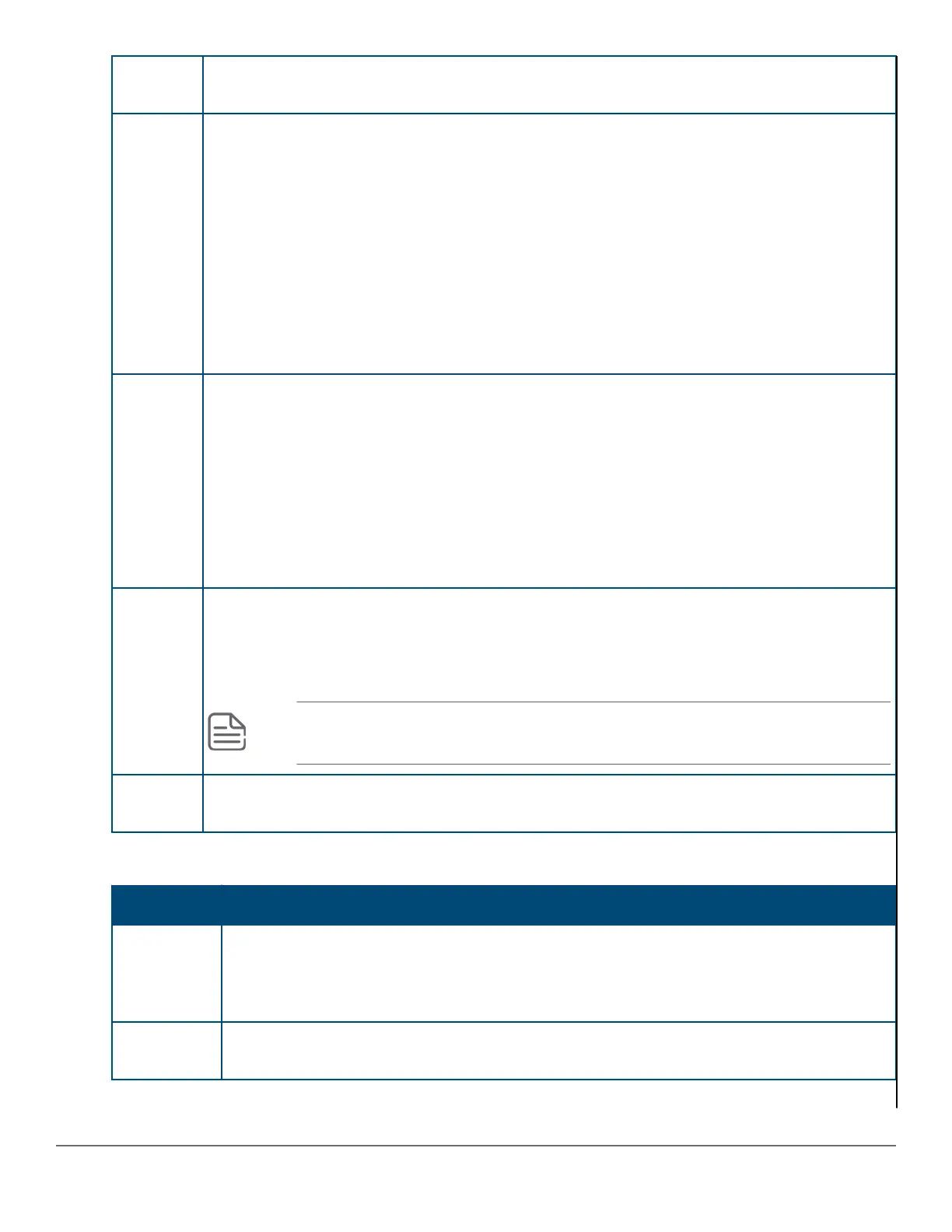
Port Type
The port Type field represents the IEEE or other industry protocol in operation on that port. For
example, 1000Base-SX is a gigabit protocol for gigabit operation over fiber optic cable.
Status of
Ports
A port can be enabled or disabled:
• Yes: Enabled, the default. This indicates the port is ready for a network connection.
• No: Disabled, the port will not operate, even if properly connected to a network. Use the setting,
For example, to shut the port down for diagnostic purposes or while you are making topology
changes.
The status of a port can be up or down (Read-only):
Up: The port senses a link beat.
Down: The port is not enabled, has no cables connected, or is experiencing a network error. For
troubleshooting information, see the installation and getting started guide for your switch.
Flow
Control
With the port mode set to Auto (the default) and flow control on (enabled), the switch negotiates
flow control on the indicated port. If the port mode is not set to Auto, or if flow control is off
(disabled) on the port, then flow control is not used. Flow control must be enabled on both ends of
a link.
• On: Enabled. The port uses 802.3x Link Layer Flow Control, generates flow control packets,
and processes received flow control packets.
• Off: Disabled (default).The port does not generate flow control packets, and drops any flow
control packets it receives.
Broadcast
Limit
The broadcast limit specifies the percentage of the theoretical maximum network bandwidth that
can be used for broadcast and multicast traffic. Any broadcast or multicast traffic exceeding that
limit will be dropped. Zero (0) means the feature is disabled.
The broadcast-limit command operates at the port context level to set the broadcast limit for a
port on a switch.
NOTE: This feature is not appropriate for networks that require high levels of IPX or
RIP broadcast traffic.
Modes
The mode is the port’s speed and duplex (date transfer operation) setting. The following table
shows possible modes available, depending on the port type (copper or fiber) and port speed.
Table 3: Supported Modes
Mode Speed and Duplex Settings
Auto-MDIX Senses speed and negotiates with the port at the other end of the link for port operation (MDI-X
or MDI). To see what the switch negotiates for the Auto setting, use the CLI show interfaces
brief command or the menu commands “1. Status and Counters”, “3. Port Status”.This
features applies only to copper port switches using twisted-pair copper Ethernet cables.
MDI Sets the port to connect with a PC using a crossover cable (Manual mode— applies only to
copper port switches using twisted-pair copper Ethernet cables).
Table Continued
56 Aruba 2530 Management and Configuration Guide for
ArubaOS-Switch 16.05




 To Next Page