Configuring Spanning Tree Protocol (STP) and IronSpan Features
December 2005 © Foundry Networks, Inc. 7 - 35
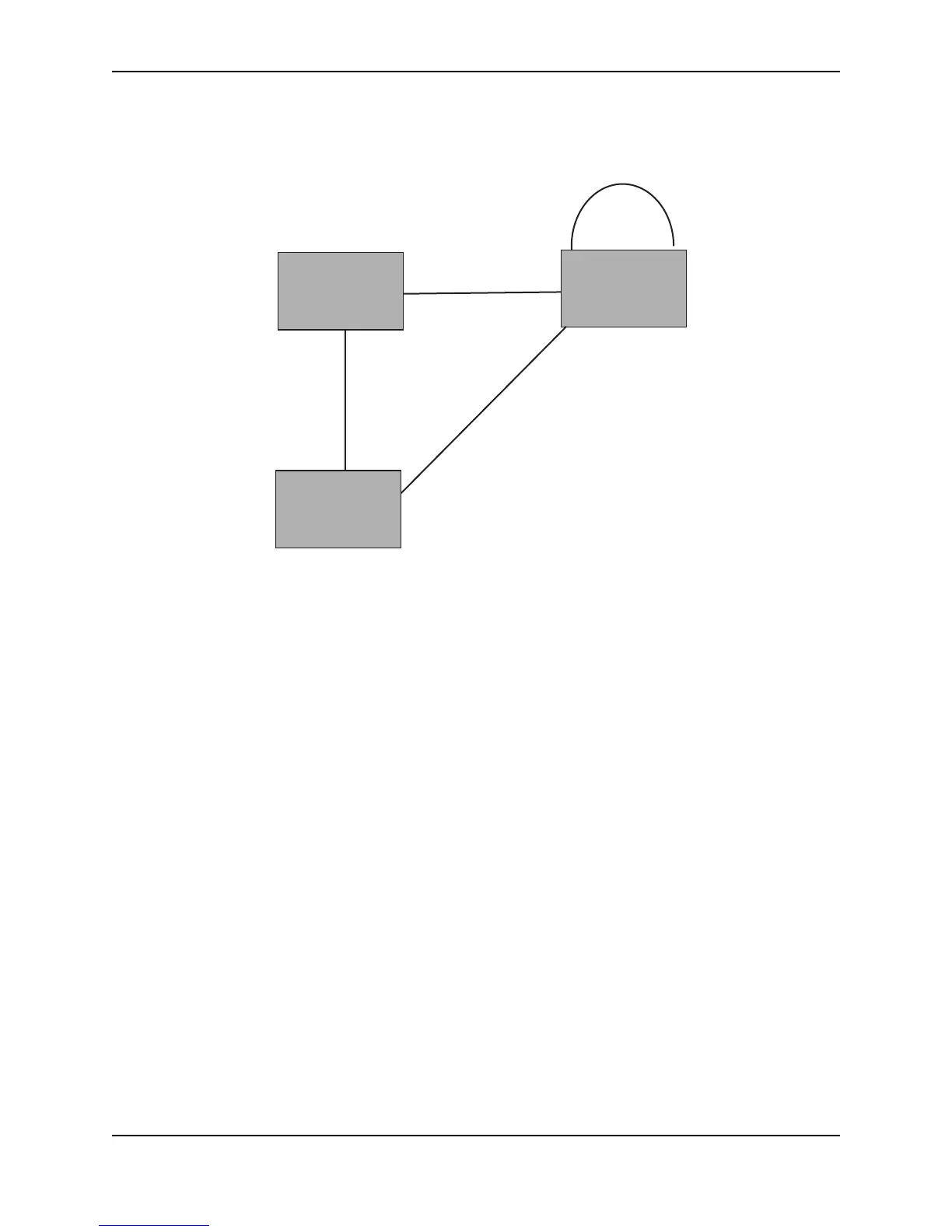
Next, Switch 1 is powered up (Figure 7.15).
Figure 7.15 Simple Layer 2 Topology
The point-to-point connections between the three bridges are as follows:
• Port2/Switch 1 and Port2/Switch 2
• Port4/Switch 1 and Port4/Switch 3
• Port3/Switch 2 and Port3/Switch 3
Ports 3 and 5 on Switch 1 are physically connected together.
At start up, the ports on Switch 1 assume Designated port roles, which are in discarding state. They begin sending
RST BPDUs with proposal flags to move into a forwarding state.
When Port4/Switch 3 receives these RST BPDUs 802.1W algorithm determines that they are better than the RST
BPDUs that were previously received on Port3/Switch 3. Port4/Switch 3 is now selected as Root port. This new
assignment signals Port3/Switch 3 to begin entering the discarding state and to assume an Alternate port role. As
it goes through the transition, Port3/Switch 3 negotiates a new role and state with its peer port, Port3/Switch 2.
Port4/Switch 3 sends an RST BPDU with an agreed flag to Port4/Switch 1. Both ports go into forwarding states.
Port2/Switch 2 receives an RST BPDU. The 802.1W algorithm determines that these RST BPDUs that are
superior to any that any port on Switch 2 can transmit; therefore, Port2/Switch 2 assumes the role of a Root port.
The new Root port then signals all ports on the bridge to start synchronization. Since none of the ports are Edge
ports, they all enter the discarding state and assume the role of Designated ports. Port3/Switch 2, which
previously had a Designated role with a forwarding state, starts the discarding state. They also negotiate port roles
and states with their peer ports. Port3/Switch 2 also sends an RST BPU to Port3/Switch 3 with a proposal flag to
request permission go into a forwarding state.
The Port2/Switch 2 bridge also sends an RST BPDU with an agreed flag Port2/Switch 1 that Port2 is the new Root
port. Both ports go into forwarding states.
Now, Port3/Switch 3 is currently in a discarding state and is negotiating a port role. It received RST BPDUs from
Port3/Switch 2. The 802.1W algorithm determines that the RST BPDUs Port3/Switch 3 received are superior to
those it can transmit; however, they are not superior to those that are currently being received by the current Root
port (Port4). Therefore, Port3 retains the role of Alternate port.
Port2
Root port
Port2
Designated
port
Port3
Designated
port
Port5
Backup port
Port4
Designated port
Port3
Designated
port
Port3
Alternate
port
Port4
Root port
Bridge priority = 1000
Bridge priority = 2000
Bridge priority = 1500
1Switch
Switch 2
3Switch


 To Next Page