7 - 26
(b) Calculation equation
In channel registration to the cell, assignment is made for each test in decreasing
order of analysis time. This means that the test assigned after all the others is not
necessarily output last. Accordingly, the last output test is searched and the
expected end time is calculated from the analysis start time and analysis time for the
test.
Expected analysis end time (min) =
initialization time + start time (Note 1) + analysis time (Note 2) +
wash time required after completion of analysis
NOTES: 1. Start time: 18.0 (sec) × (number of samples up to last output test [35
samples max.] - 1)
2. Analysis time: Reaction time for last output test
(any of 10 min, 5 min, 4 min and 3 min)
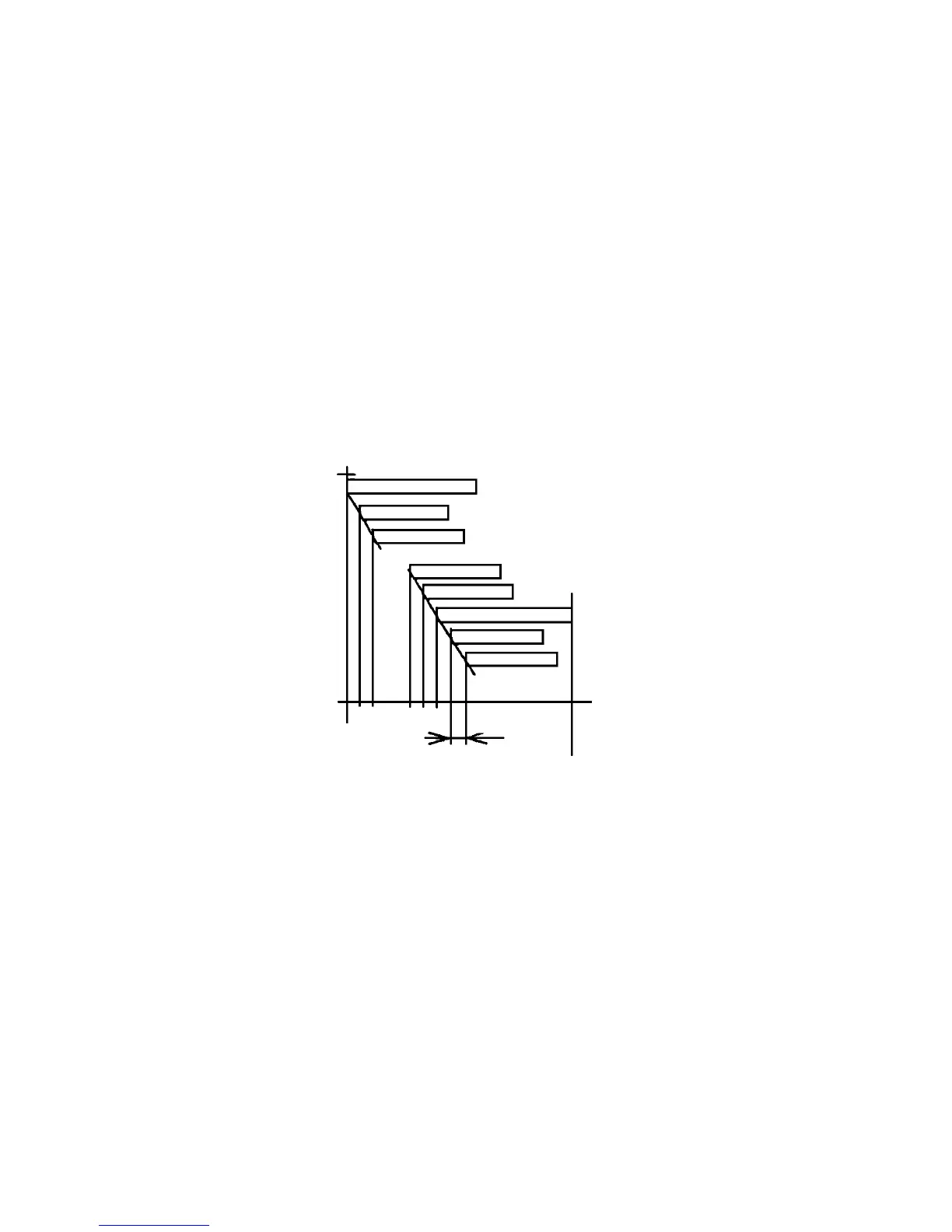
3. When carryover evasion is specified:
Example: When (n-2) th analysis is last output test:
(3) Difference from Actual Analysis Time
The expected analysis end time differs from the actual one in the following cases.
(a) When unusable cell was on reaction disk (excluding execution of cell wash)
Case in which an unusable cell was fround on reaction disk through cell blank check
before analysis
(b) Presence/absence of test for which carry-over evasion is specified
The processing time changes when wash for carry-over evasion is carried out.
(For details, refer to the description of carry-over evasion.)
(c) Upon occurrence of insufficient sample alarm
(d) Upon occurrence of insufficient reagent alarm
(e) Upon occurrence of error related to analysis such as ID error
(f) Upon occurrence of error related to instrument
1st
(n-3) th
(n-2) th
nth
Analysis end time
18.0 (s)
0.0
Start time = 18.0 (sec) × [(n-2) - 1]
Analysis time = Analysis time for ((n-2) th test)


 To Next Page