Need help?
Do you have a question about the Hypertherm Powermax30 AIR and is the answer not in the manual?
 General
| Brand | Hypertherm |
|---|---|
| Model | Powermax30 AIR |
| Category | Welding System |
| Language | English |
Guidelines for achieving electromagnetic compatibility with CE-marked equipment.
User responsibility for installation and use to ensure electromagnetic compatibility.
Evaluating potential electromagnetic problems in the surrounding area.
Techniques to minimize electromagnetic interference from the system.
Connecting equipment to mains supply and precautions for interference.
Routine maintenance according to manufacturer's recommendations for EMC.
Positioning and keeping cutting cables short to reduce emissions.
Bonding metallic components to reduce risk and interference.
Methods to reduce emissions by earthing the workpiece.
Selective screening and shielding for cables and equipment to alleviate interference.
Importance of using genuine Hypertherm parts for warranty coverage.
Hypertherm warrants products against defects for specific periods.
Hypertherm’s obligation to defend against patent infringement claims.
Exclusion of incidental, consequential, and other damages.
Governing codes take precedence over manual instructions.
Aggregate liability limited to the amount paid for the products.
Requirement to maintain adequate insurance coverage.
Conditions for transferring warranty rights to a successor.
Read the separate Safety and Compliance Manual for important safety information.
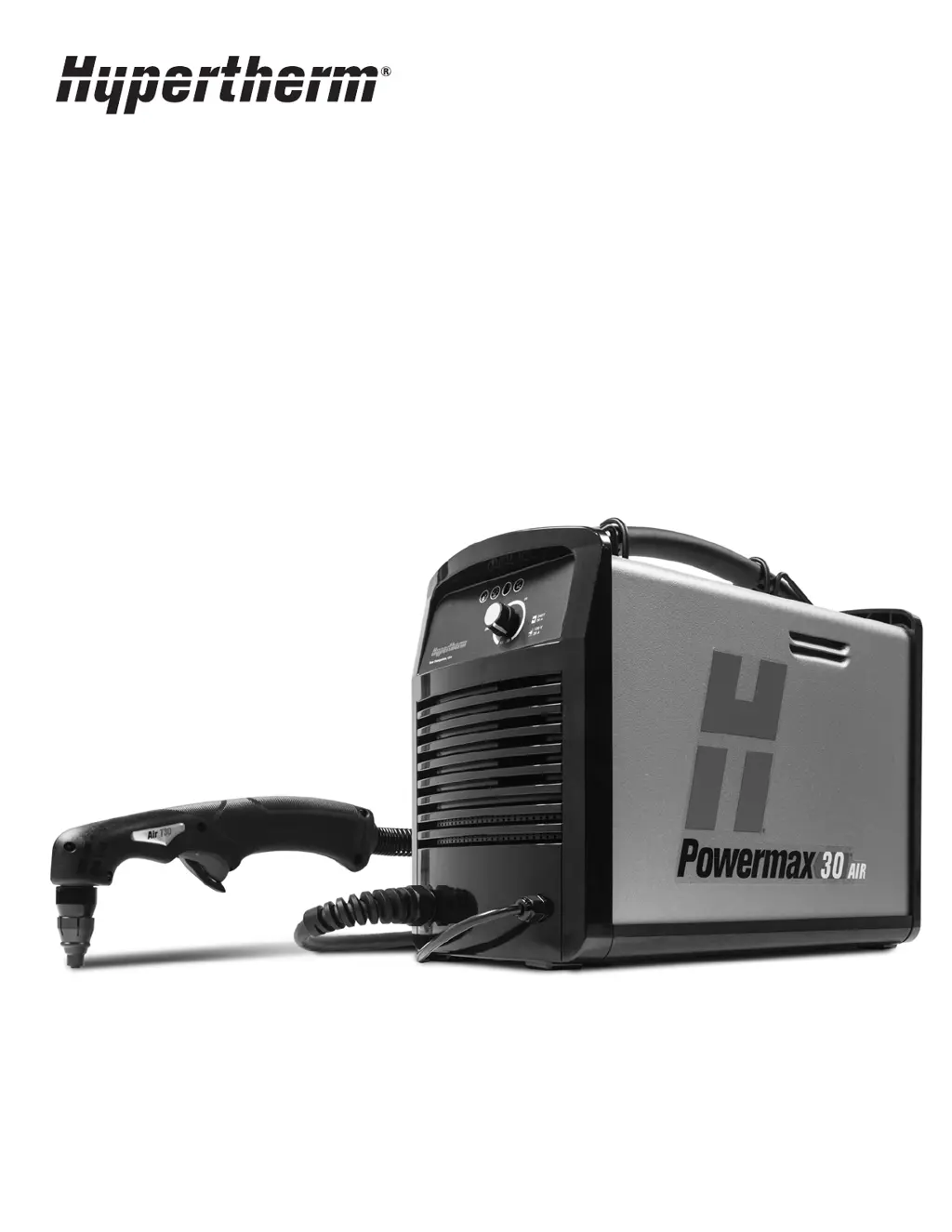
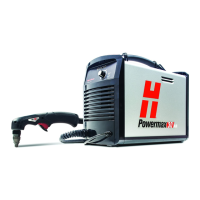
Overview of the Powermax30 AIR as a 30 A handheld plasma cutting system.
Physical dimensions of the power supply unit.
Total system weight for CSA and CE configurations.
Technical specifications and ratings of the Hypertherm system.
Physical dimensions of the Air T30 hand torch.
Weight of the Air T30 torch with and without lead.
Recommended and severance cut capacities for 240 V and 120 V operation.
Explanation of common symbols found on the power supply and controls.
Information on system noise levels and recommended hearing protection.
Explanation of various safety and compliance marks on the product.
Instructions for safely unpacking the plasma cutting system.
Procedures for reporting shipping damage or defective merchandise.
List of components typically included with the system.
Guidelines for placing the system for proper operation and ventilation.
Considerations for connecting the system to available electrical power.
How the system adjusts to different input voltages and amperage.
Proper grounding procedures for safety and EMC.
Information on power cord types and their use.
Details on CSA configuration power cords and adapters.
Information on CE configuration power cords and plug installation.
Steps for installing a plug on the CE power cord.
Guidance on selecting and using extension cords.
Recommendations for generators used with the system.
Explanation of how to set up and operate the Air T30 hand torch.
Identification of the parts of the Air T30 hand torch.
Factors affecting consumable lifespan and general expected life.
Proper use of consumables and associated warnings.
Guidance on selecting cutting current based on metal thickness.
List of components included in a complete set of consumables.
Familiarization with system controls and LED indicators.
Description of controls located on the rear panel.
Explanation of front panel controls and indicator lights.
Step-by-step instructions for operating the plasma system.
Procedure for installing consumables into the hand torch.
Instructions for connecting the system to the electrical power source.
How to set the amperage based on input voltage and circuit size.
Specific considerations and tips for cutting expanded metal.
Correct procedure for attaching the ground clamp to the workpiece.
Steps for powering on the plasma cutting system.
Verifying the status of system indicator LEDs before cutting.
Final checks and procedure to begin cutting.
Information on post-cutting operations and system behavior.
Explanation of the postflow function for cooling consumables.
Description of compressor and fan operation during and after cutting.
Explanation for the formation of water under the power supply.
Explanation of system duty cycle and overheating prevention.
Best practices for operating the system for optimal performance.
Detailed guidance on using the hand torch for cutting.
How to operate the torch's safety catch mechanism.
Techniques and tips for effective hand torch cutting.
Specific advice for operating the system on a 120 V circuit.
Method for starting cuts at the edge of the workpiece.
Technique for piercing material for interior cuts.
Identification and causes of common cutting issues.
Strategies for reducing dross formation during cutting.
Explanation of the system's functional principles.
Overview of the system's operational components.
Step-by-step process of the system's operation.
Safety precautions and pre-testing steps for troubleshooting.
Tools required for performing system tests.
General steps and references for troubleshooting.
Visual inspection of the exterior of the power supply.
Visual inspection of the interior components of the power supply.
Performing resistance checks before powering on.
Procedure to test the functionality of the power switch.
Diagram and labels for the power board components.
Common causes and solutions for system faults.
Troubleshooting steps when the Power ON LED does not illuminate.
Diagnosing issues indicated by the Temperature LED.
Troubleshooting faults related to the internal compressor LED.
Diagnosing issues indicated by the Torch Cap LED.
Identifying and resolving common problems during cutting.
Understanding diagnostic LEDs on the control board.
Using board LEDs for system failure diagnosis.
Information regarding the Reset LED and associated tests.
Interpretation of Error LED blinks for fault identification.
Detailed procedures for testing various system functions.
Instructions for removing and installing the power supply cover.
Steps to detach the power supply cover.
Steps to reattach the power supply cover.
Procedures for replacing the component barrier.
Steps to detach the component barrier.
Steps to install the component barrier.
Procedures for removing and reinstalling the front panel.
Steps to remove the front panel from the power supply.
Steps to reinstall the front panel onto the power supply.
Procedures for removing and reinstalling the rear panel.
Steps to remove the rear panel from the power supply.
Steps to reinstall the rear panel onto the power supply.
Instructions for replacing the power cord and strain relief.
Steps to remove the power cord and strain relief.
Information specific to CSA power cords.
Information specific to CE power cords.
Steps to install the power cord and strain relief.
Instructions for replacing the power switch.
Steps to remove the power switch.
Steps to install the power switch.
Instructions for replacing the control board.
Steps to remove the control board.
Instructions for replacing the compressor-driver board.
Steps to remove the compressor-driver board.
Instructions for replacing the power board.
Steps to remove the power board.
Instructions for replacing hoses and fittings.
Steps to remove hoses and fittings.
Steps to install hoses and fittings.
Instructions for replacing wire groups.
Steps for replacing twisted pair wires.
Steps for replacing the ground clip wire.
Steps for replacing ground wire to magnetics assembly.
Instructions for replacing the solenoid valve.
Steps to remove the solenoid valve.
Steps to install the solenoid valve.
Instructions for replacing the torch lead and strain relief.
Steps to remove the torch lead and strain relief.
Steps to install the torch lead and strain relief.
Instructions for replacing the air filter assembly.
Steps to remove the air filter assembly.
Steps to install the air filter assembly.
Instructions for replacing the air filter bowl and element.
Steps to remove the air filter bowl and element.
Steps to install the air filter element and bowl.
Instructions for replacing the fan.
Steps to remove the fan.
Steps to install the fan.
Instructions for replacing the heat exchange coil.
Steps to remove the heat exchange coil.
Steps to install the heat exchange coil.
Instructions for replacing the internal compressor.
Steps to remove the internal compressor.
Steps to install the internal compressor.
Instructions for replacing the air inlet filter.
Steps to remove the air inlet filter.
Steps to install the air inlet filter.
Instructions for replacing the front panel.
Steps to remove the front panel.
Steps to install the front panel.
Instructions for replacing the rear panel.
Steps to remove the rear panel.
Steps to install the new rear panel.
Instructions for replacing the base of the unit.
Steps to remove the base.
Steps to install the base.
Instructions for replacing the magnetics assembly.
Steps to remove the magnetics assembly.
Steps to install the magnetics assembly.
Instructions for replacing the work lead and ground clamp.
Steps to remove and install the work lead.
Steps to remove and install the ground clamp.
Diagram and list of the parts of the torch assembly.
Instructions for replacing the torch handle.
Steps to remove the torch handle.
Steps to install the torch handle.
Instructions for replacing the trigger assembly.
Steps to remove the trigger assembly.
Instructions for replacing the torch body.
Steps to remove the torch body.
Instructions for replacing the start switch.
Instructions for replacing the cap-sensor switch.
Instructions for replacing the torch lead.
Steps to remove the torch lead.
List and diagrams of external and internal power supply components.
Identification of front exterior parts of the power supply.
Identification of rear exterior parts of the power supply.
Diagram of interior components on the power board side.
Diagram of interior control board and power switch.
Diagram of the interior fan assembly.
Diagram of interior pneumatic components on the fan side.
Diagram showing interior wiring harnesses and connections.
Diagram of the power supply base and magnetics assembly.
List and diagrams of individual torch components.
Part numbers and diagrams for torch consumables.
List of optional accessory parts for the system.
Identification of safety-critical components requiring genuine parts.
List of spare parts recommended for service centers.
Information on available label kits for the power supply.
Description of the consumables label on the rear panel.
Explanation of CSA warning symbols and instructions.
Explanation of CE warning symbols and instructions.
Flowchart for diagnosing internal compressor and temperature fault LED issues.
Diagram illustrating the sequence and timing of torch start operations.
Detailed electrical schematic of the Powermax30 AIR system.


 To Next Page