Need help?
Do you have a question about the IPC IQ/MAX TOUCH and is the answer not in the manual?
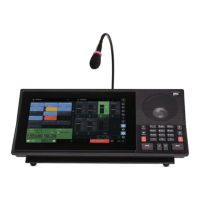
Details the IQ/MAX TOUCH turret, its features, and high-speed voice communication technology.
Describes the main areas of the touch screen interface: Application, Footer, and Navigation Bar.
Explains the Navbar's function for accessing applications and snapshots, and its display modes.
Details the Application area, its display sizes, and components like the Header bar.
Illustrates how applications are displayed: full screen, half screen, or third screen sizes.
Explains how the positioning guide helps place applications on the screen.
Describes Modal dialogs that request user input and overlay running applications.
Explains Selection mode where an application invokes another to make a selection.
Details how contextual menus provide additional options for tasks.
Describes the components of the Footer area on the Primary Module touch screen.
Explains the handset overlay (Contextual Call Display) and its controls.
Describes how call notifications pop up to display incoming calls.
Explains how to access functions via the User badge and menu popover.
Explains icons indicating button status and function, and call type icons.
Instructions on opening applications in full screen view on Primary and Expansion Modules.
How to add an application from the expanded Navbar.
Methods for closing applications using the Navbar or drag-and-drop.
How to arrange or rearrange applications on the screen.
Explains how to open multiple copies (clones) of certain applications.
How to change the order of application and snapshot items in the Navbar.
Provides visual information about user availability and contact status.
Steps to access voice mail services on the IQ/MAX TOUCH turret.
Details on saving and recalling application arrangements using snapshots.
Procedure to create a new snapshot by dragging applications.
Lists and describes various types of buttons that can be assigned in Favorites.
Details on programming line buttons for making and receiving calls.
Explains how line buttons display status information and call activity.
Describes error messages displayed due to compliance policy restrictions.
How to view the status of buttons in the Favorites application.
General procedure for assigning new buttons in the button sheet.
Detailed steps to add a line button with various preference options.
Steps to add speed dial buttons with number and descriptor.
Procedure to add buttons for initiating calls to contacts.
How to add conference or broadcast buttons in Favorites.
Steps to add diversion buttons for call routing.
Instructions on how to edit existing buttons in the button sheet.
How to create a copy of an existing button.
How to rearrange or swap buttons using Favorites Edit mode.
Procedure to delete a button assignment from the button sheet.
Explains function buttons for performing special actions via macros.
Enables editing settings for multiple line buttons simultaneously.
Steps to update settings for line buttons using Batch settings mode.
How to assign colors to buttons for easier identification.
Procedure to rename a sheet in Favorites for better identification.
Explains how CLI displays caller information for incoming calls.
Details on CLI lookup sources like Speed Dial, Personal, and Enterprise directories.
How to use a preprogrammed Get CLI button to display caller information.
How to control whether name or number of caller is displayed.
How to suppress calling party identification for outgoing calls.
Explains the search feature for finding stored call events.
Steps to perform a new search in Call History using the search field.
How to search Call History using previously saved search terms.
Instructions for browsing and sorting call events.
How to narrow down call events using filter options.
Making calls directly from events in Call History.
How to view detailed information about a Call History event.
Steps to create new or update existing contacts from Call History events.
How to create or edit Favorites buttons from Call History events.
Assigns a Favorites button as a fixed or floating button in Activity Monitor.
Rearranges or swaps fixed button assignments within Activity Monitor.
Removes a fixed button assignment from the Activity Monitor.
Explains the search feature for finding contacts within the Directory.
Instructions for browsing contacts and navigating directory categories.
How to narrow down contact lists using filter options.
Making calls directly from contact entries in the Directory.
How to view detailed information about a contact.
Creating or removing Favorites buttons for contacts.
How to set or change the preferred point of contact for a personal contact.
Steps to create a new personal contact record.
Procedure to remove a personal contact record from the Personal Directory.
Describes the general behavior expected for different types of lines and calls.
Explains the hunt feature for accessing available line appearances.
Steps to make a line call using automatic line selection (implicit hunt).
Enables users to make calls to other users without using a line.
Describes multiple ways to make a point-to-point intercom call.
Connects all members of a predefined internal user group simultaneously.
Steps to make an intercom group call for a listen-only group.
Explains group answer calls where the first user to answer becomes a point-to-point call.
Enables users to talk back on a group call using Push-to-Talk.
Steps to make an externally routed, switched call.
How to make a call over a private, dedicated line.
How incoming calls are indicated and answered.
Procedure for answering line calls from the handset.
How intercom calls are answered manually or automatically.
Procedure to answer speaker calls with the voice activity monitor feature.
How to terminate an active call on the turret.
Using the Redial button to redial previously dialed numbers.
Steps to redial the last number dialed on either handset.
Features available during an active call, like mute, privacy, and hold.
How to toggle the Record on Demand feature on or off.
How to mute or unmute a call on the handset or hands-free speaker.
Prevents other users from intruding during a call.
Steps to set privacy on a call to prevent other users from joining.
Enables calls on dial tone or private lines to be suspended and retrieved.
Procedure to place an active call on hold.
Describes exclusive hold when privacy is enabled on a call.
How the system handles new calls when a user is already on a call.
Lets you transfer a line call internally or externally.
Steps to transfer a call to another extension or line.
Allows joining a call in progress if privacy is not enabled on the line.
Procedure to join a call in progress (barge in).
Enables moving an established line call between handsets during a call.
How to use the Swap button to move a call to the idle handset.
Covers managing calls, including hands-free mode and audible alerts.
Enables use of the hands-free microphone and speaker for calls.
Steps to activate and use hands-free mode for calls.
Describes audible alerts for communication activities.
Notifies parties in a call when the session is being recorded.
Allows turning diversion on/off for calls using a single button.
Indicates when diversion is enabled on a button.
Steps to configure intercom diversion via Settings.
Steps to configure Direct Dial Inward diversion via Settings.
How to use one button divert to redirect calls based on criteria.
Explains the conference feature for adding lines to calls.
Procedure to make a conference call by adding lines to an existing call.
Describes conferences that continue without the initiator if placed on hold.
Explains feature interactions like barge in and unsupervised conference.
An instant conference for up to five parties with two-way audio.
An instant conference call broadcasting to up to 24 lines with one-way audio.
Steps to set up simplex broadcast buttons for multiple parties.
Describes dedicated, always-on connections for simultaneous audio.
Overview of the Speakers application and its channel support.
Describes the different states a speaker channel can have.
Provides information on status messages for speaker channels.
General instructions for using the Speakers application.
How to turn individual or all speaker channels on or off.
Instructions on how to talk using Push-to-Talk or Push-to-Latch.
How to adjust the overall and individual speaker channel volumes.
How to mute or unmute speaker channels.
How to move an active speaker call to a handset.
How to replay the last 20 seconds of audio for active speaker channels.
Navigating to speakers not currently visible on the screen.
Allows isolating incoming audio of a single channel.
Steps to turn on and adjust volume in speaker solo mode.
Provides a virtual audio experience to identify speakers.
How to display and change spatial audio positions for channels.
Configuring the device used to transmit or receive audio.
How to view and change media device settings for speakers and groups.
Allows reducing speaker channel size for better visibility.
Steps to display more speaker channels than in normal mode.
Explains how muting controls affect speaker users and call participation.
An audible alert indicating a user cannot speak.
Enables talking to active speaker channels in a group with one button press.
Steps to assign speaker channels to a speaker group.
How to remove a speaker channel from a speaker group.
How to set latch behavior for speaker groups to Push-to-Talk or Push-to-Latch.
How to talk to multiple speaker channels simultaneously.
Displays a list of lines that can be assigned to speaker channels.
How to view lines available for assignment to speaker channels.
Assigning lines to empty or replacing existing speaker channels.
Assigning or replacing speaker channels using Favorites.
Assigning or replacing speaker channels from an active call.
How to remove a speaker channel assignment.
Allows configuration of user preferences and system information.
Provides user information and allows password changes.
Steps to change your password via the Account Info option.
Explains call diversion to another resource when calls cannot be answered.
How to divert point-to-point intercom calls.
Steps to enable intercom diversion via the Settings application.
How to divert incoming dial tone line calls to another destination.
Steps to enable DDI diversion via the Settings application.
Set preferences for auto-answer, notifications, colors, and ringtones.
Allows specifying date and time format preferences.
Configure display language, font, brightness, and volumes.
View system details like network, zone, and software version.
Specify latch settings for speaker channels and groups.
How to enter characters based on the Latin alphabet using the soft keyboard.
Using the Romaji input method for Japanese characters.
Using the Pinyin input method for Chinese characters.
 General
| Brand | IPC |
|---|---|
| Model | IQ/MAX TOUCH |
| Category | Industrial Equipment |
| Language | English |

 To Next Page