Appendix for Lorrca® MaxSis
Page 198 Lorrca Maxsis User Manual
Version 5.04 MRN-231-EN
11.6.2. Principle of operation
Introduction
Tissue is provided with oxygen, nutrients etc. by virtue of the blood circulation, which also
transports metabolic waste products from these tissues to e.g. the kidney and lungs. The amount
of oxygen transported through the capillaries is directly proportional to the amount of oxygenated
hemoglobin present in the blood and inversely proportional to the flowing capacity i.e. the viscosity
of the blood. In the normal situation the latter is mainly determined by the concentration of red
blood cells (RBCs) (hematocrit), their property to deform in order to pass through capillaries with
diameters smaller than that of the RBCs and their potential to form aggregates (rouleaux) in low
flow regions, which could disturb the flow even more. Disturbances of either one or both of these
RBC properties have been described in a wide variety of diseases (References (on page 215).2-
4,7,8,14,21,26,32,42,43,61,63,64)
In order to evaluate the flowing capacity of blood in different parts of the body it is therefore
important to have a technique available for the accurate measurement of these RBC properties.
The LORCA is therefore an indispensable instrument for hemorheological laboratories in research
institutes, clinical departments of hematology, intensive care units etc. It uses a Couette geometry
with a static BOB and a rotating cylinder (CUP) to create a simple shear flow. The mean geometric
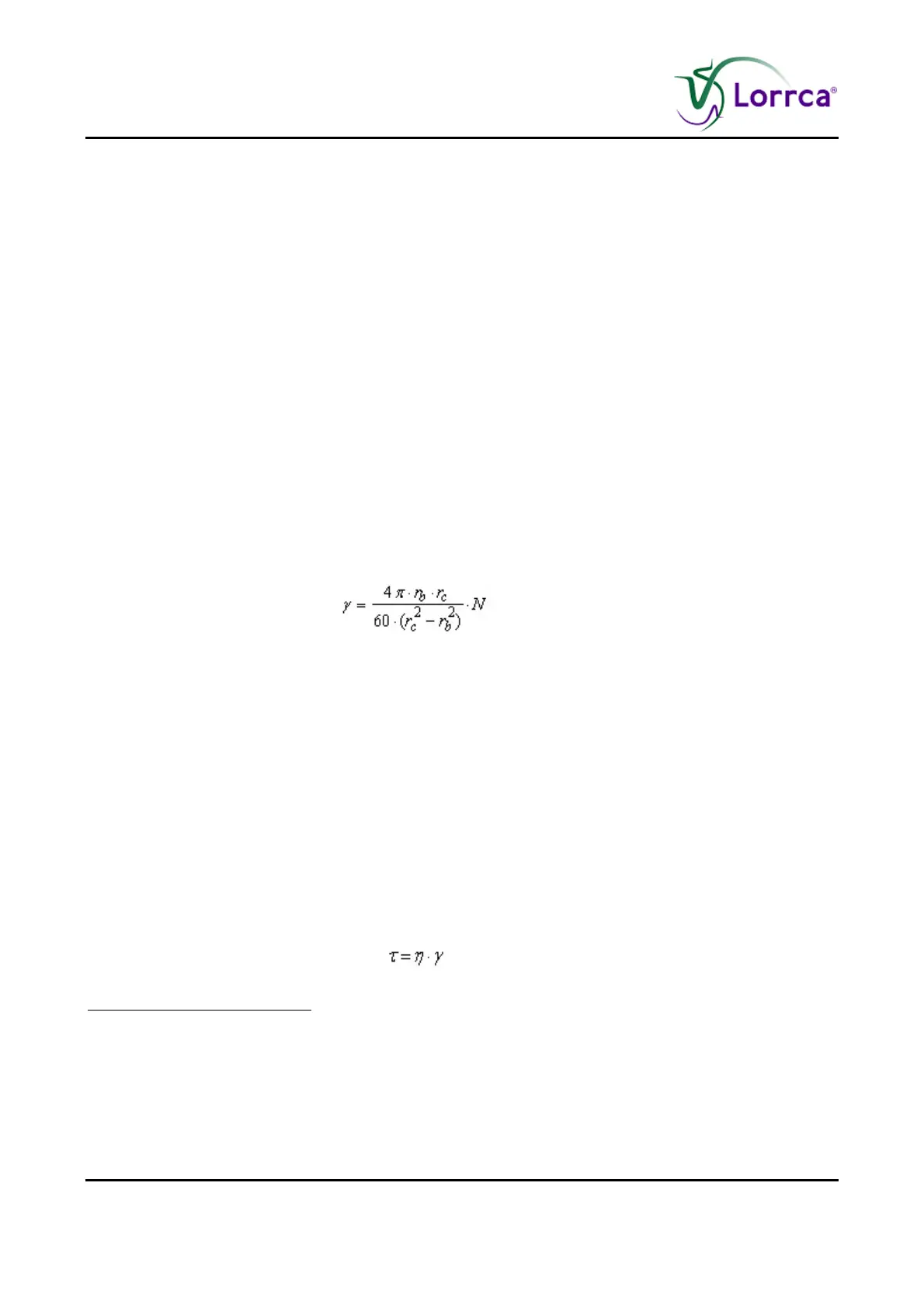
shear rate for small gaps, can be estimated as:(References 20
3
, 62
4
)
(Equation 1)
With:
Shear rate (1/s)
rb
Outer radius of the BOB (mm) (engraved on BOB)
rc
Inner radius of the CUP (mm) (engraved on the inside of the metal CUP
holder)
N
Revolution speed of the CUP (revolutions/min)
Red blood cells cause the blood to be non-Newtonian, which means that the viscosity changes
with the applied shear rate. (References 12
5
, 13
6
) During the deformability measurements, blood is
diluted in a high viscous medium (dilution 1:200) causing the suspension to behave nearly
Newtonian. The shear stress is calculated as:
(Equation 2)
3
Dognon A., Loeper J., Housset E., Etude optique de l'aggregation reversible des hematies, Comptes
Rendus Soc. Biol., vol. 143, pp. 769-771, 1949.
4
White F.M., Flow between long concentric cylinders, in: Fluid mechanics, McGraw-Hill, Fourth edition, pp.
261-263, 1999 (ISBN: 0-07-069716-7).
5
Chien S., Sung L.A., Physicochemical basis and clinical implications of red cell aggregation, Clin.
Hemorheol., vol. 7, pp. 71-91, 1987.
6
Chien S., Usami S., Dellenback R.J., Gregersen M.I., Nanninga L.B., Guest M.M., Blood viscosity:
Influence of erytrocyte aggregation, Science, vol. 157, pp. 829-831, 1967.


 To Next Page