Instrument description
Lorrca Maxsis User Manual Page 27
Version 5.04 MRN-231-EN
3.3.4.5. Introduction Oxygenscan
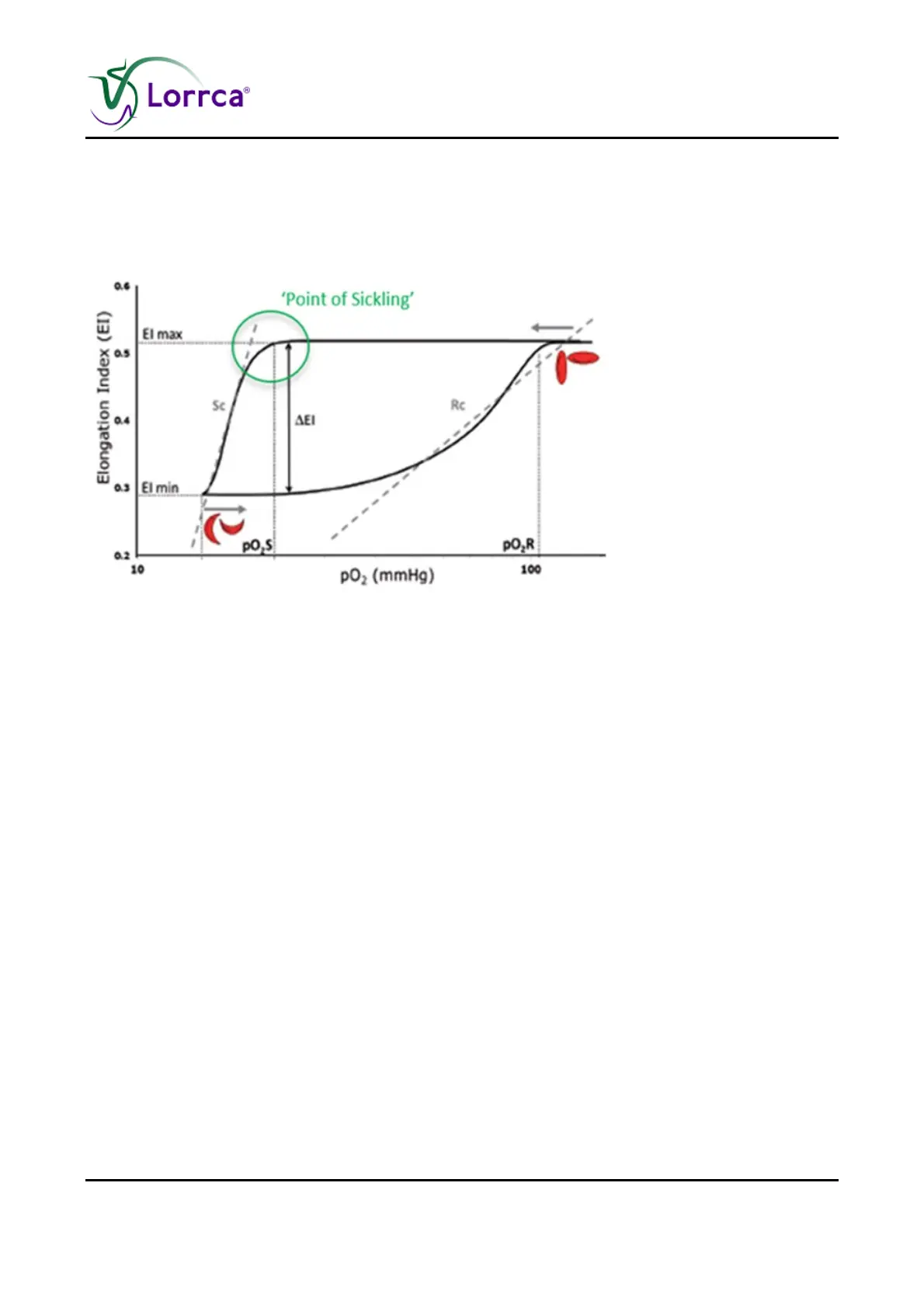
The Oxygenscan measures the relative oxygen pressure at the critical point the RBCs of a SCD
patient start to sickle. This so called "point of sickling" (see Figure. 1) quantitatively and
reproducibly describes the defined loss of deformability of sickle cell disease (SCD) RBCs.
Fig.1 Graphic representation of the measured loss of deformability, the point-of-sickling of SCD RBCs, as a result of oxygen-depletion in time, followed by subsequent gain of
deformability of RBC’s during reoxygenation, as is visualized on the Oxygenscan. It is described by pO2: Oxygen- pressure (controlled, in mmHg), and by EI: elongation index (of the
RBCs in shear rate), in SC RBCs: Sickle Cell patients Red Blood Cells.
Oxygenscan read out parameters are:
EImax, which represents RBC deformability at normoxia;
EImin represents deformability upon deoxygenation;
The point of sickling (PoS), the point at which a >5% decrease in EI is observed during
deoxygenation, reflecting the patient-specific pO2 at which sickling begins (Figure 1).
This PoS is the most characteristic parameters of this measurement. It is typical for each sickle cell
RBC sample (i.e. patient) and sensitive to its status; the PoS shifts due to alteration in treatment.
Supported by the (dynamics of) the change in cell deformability (Elongation index; EI), this
measurement of typical RBC behaviour directly reflects the status of the patients’ susceptibility to
oxygen depletion.
The Oxygenscan measurement represents the ‘whole population’ of RBCs (incl. HbS as well as
HbF containing cells).


 To Next Page