Appendix for Lorrca® MaxSis
Lorrca Maxsis User Manual Page 211
Version 5.04 MRN-231-EN
11.6.2.2.3. Iteration procedure
For diagnostic reasons it is often desirable to know the threshold shear rate. (Reference 6
38
) This
threshold is found from the back scatter vs. shear rate curve as the shear rate where a peak is
detected. At this point, the RBCs balance between aggregating and disaggregating. The threshold
shear rate is a sensitive parameter to demonstrate hyperaggregation and cannot be found from the
syllectogram. With the LORCA it is possible to search for the threshold shear rate in two ways:
With intermediate disaggregation (recommended).
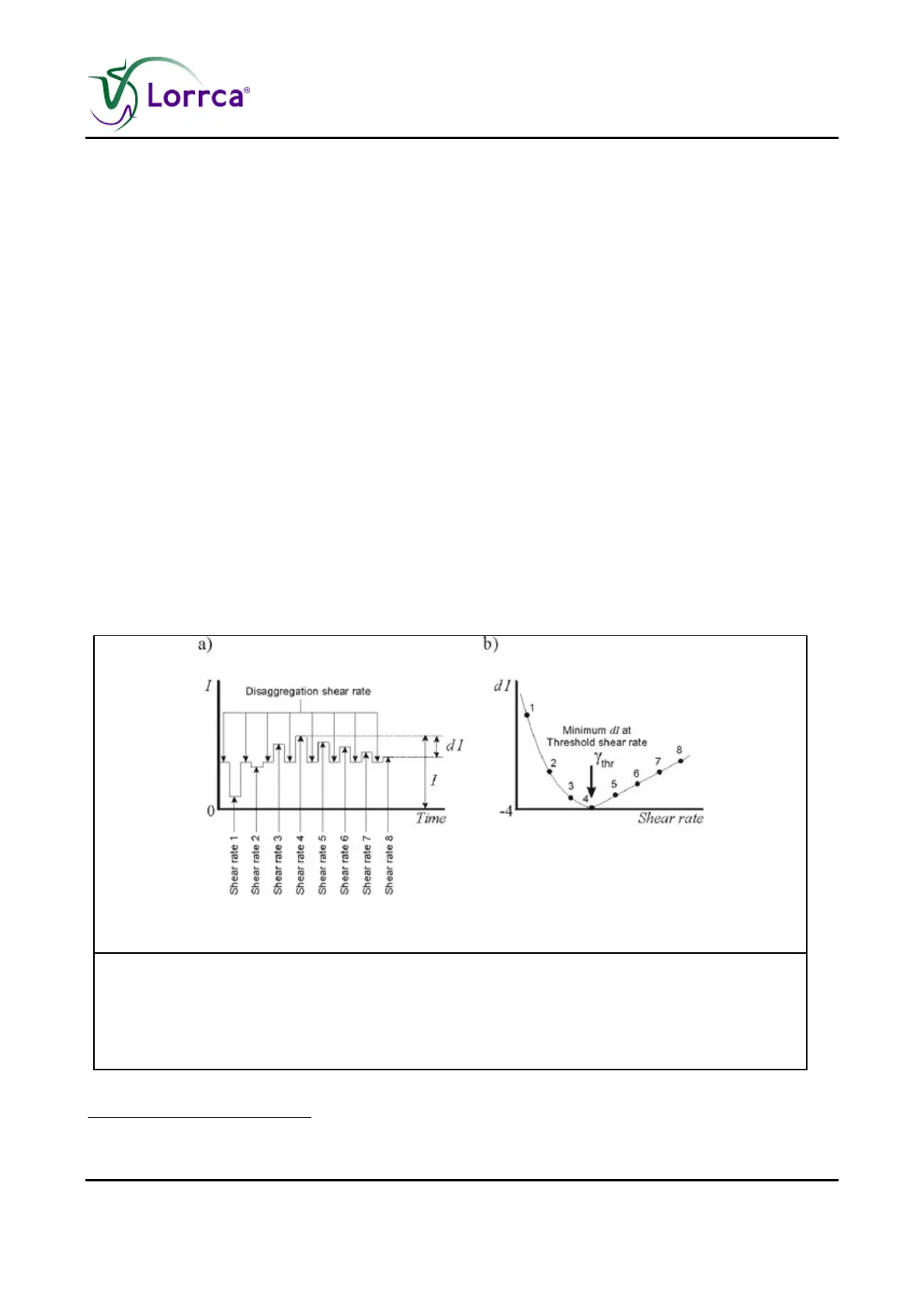
In this mode (see Figure 7) the program first disaggregates the RBC suspension before
measuring at each user defined (lower) shear rate. This may be favourable as the standard
procedure since potential aggregates will break down during disaggregation resulting in the
same starting point before each back scatter measurement at a given shear stress. A user-
defined list of shear rates is first processed to get a rough impression of the threshold shear
rate. When intermediate disaggregation is enabled, which is preferable, the difference between
the back scatter during disaggregation and that at each subsequent user defined shear rate
(dIsc) is determined vs. user defined shear rate. Next, a binary search algorithm is used to
automatically generate two more shear rates to fine-tune the rough procedure. Each binary
search step results in two more shear rates to measure the back scatter intensity. They are
chosen centered between the current optimum shear rate and next higher and lower shear
rates. The number of binary search steps that is used for optimization is also user defined.
From this so-called iteration procedure, the shear rate with the lowest dIsc is pointed out as the
threshold shear rate.
Figure 7: Iteration procedure with intermediate disaggregation
Figure 7. Iteration procedure with intermediate disaggregation. The
back scatter level during each disaggregation and that at each user
defined shear rate is measured (a) and the difference in Intensity
of each shear rate with that of the disaggregation shear rate is
plotted vs. shear rate (b).
38
Bauersachs R.M., Wenby R.B., Meiselman H.J., Determination of specific red blood cell aggregation
indices via an automated system, Clin. Hemorheol., vol. 9, pp. 1-25, 1989.


 To Next Page