Instrument description
Lorrca Maxsis User Manual Page 25
Version 5.04 MRN-231-EN
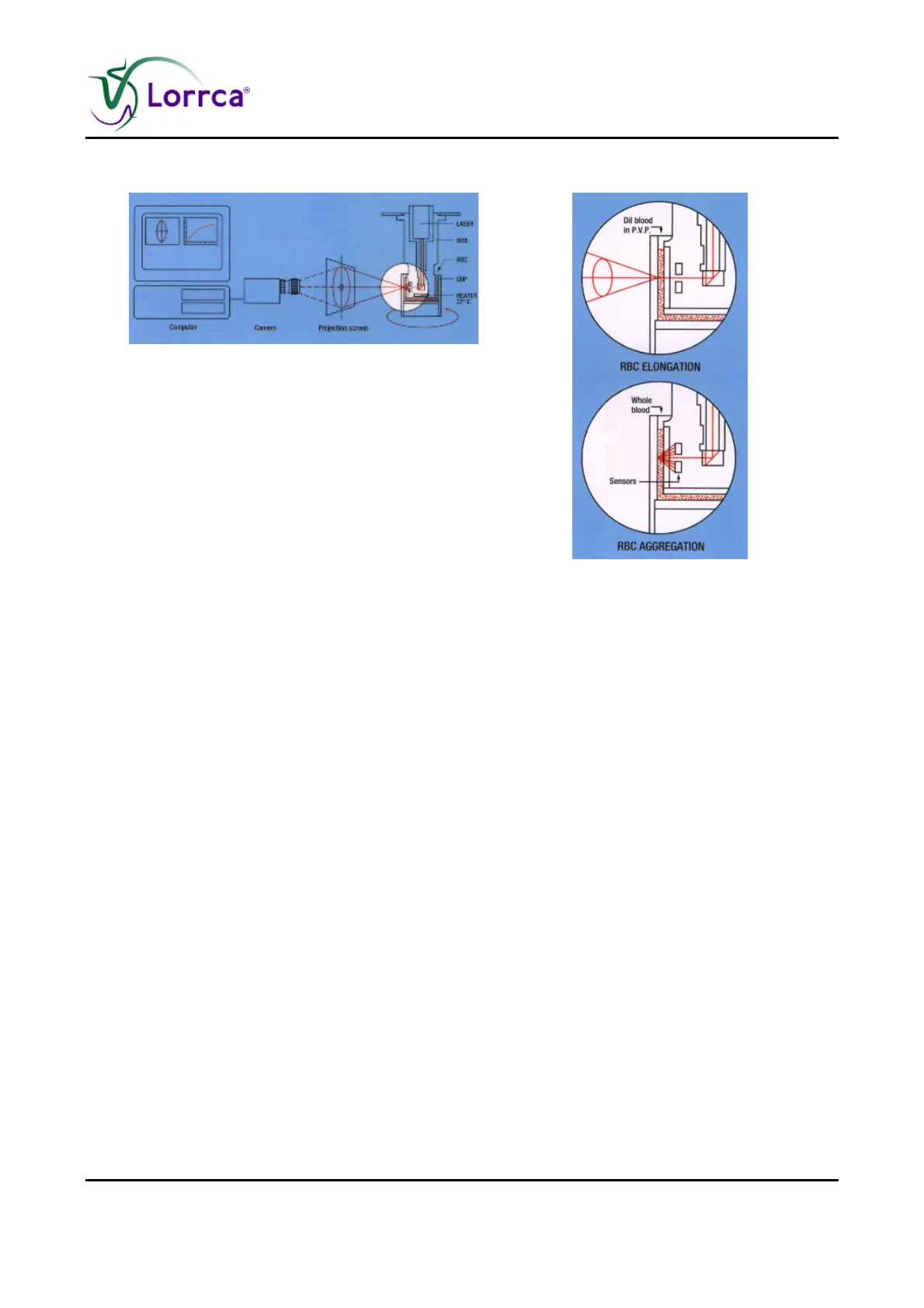
Cell deformability
A thin layer of red blood cell suspension is sheared
between two concentric cylinders. The rotation of the
outer cylinder (CUP), causes deformation (elongation)
of the red blood cells.
The software instructs the operator when to insert the
test suspension, shows the current temperature
during warming-up and performs fully automatic RBC
deformability and stability measurements.
The laser beam diffraction pattern is detected with a
video camera and analysed by a computer.
The RBC elongation program quantifies the following:
Stress dependent (Deformability curve)
Time dependent (Stability test) deformability of red
blood cells
Combination of both (Cell Membrane Stability
Test)
Cell aggregation
Various aggregation indices are determined in whole blood by means of reflection measurements.
The software instructs the operator when to insert the test suspension. A laser diode, mounted in
the BOB, serves as light source. The reflected light is sensed by a photodiode.
The RBC-aggregation software is written for creating the syllectogram and for measuring the
threshold shear rate at which RBC aggregation is just prevented.
The default setting is the tri-exponential model investigator is enabled to select a syllectogram-
fitting model containing one to three exponents, which describes the whole syllectogram, including
the upstroke. It is possible to change the settings:
The uni-exponential model is interesting to study, e.g., RBC-shape recovery in buffer solution
The conventional bi-exponential model describes the aggregation process while the tri-
exponential model includes both RBC-shape recovery and aggregation


 To Next Page