166
Rev. 2.0
07/27/2023
MBDV Hardware Manual
10.4.3 Servo system parameter description
The servo system is composed of current loop, speed loop and position loop.
When you need to improve your response
1) Increase the mechanical Stiness level
2) Increase the position loop gain
3) Increase the speed loop gain
4) Reduce the integral time parameter of the speed loop
when the system has overshoot and vibrations
1) Reduce the mechanical Stiness level
2) Reduce the position loop gain
3) Reduce the speed loop gain
4) Reduce the speed loop integral time parameter
5) Reduce the torque lter frequency
6) Appropriately adjust the dierential lter frequency
If one parameter is changed, other parameters also need to be re-adjusted. Please don't make
major changes to just one parameter. Generally, about 5 % is used as a rough standard, and
each servo gain is slightly adjusted. Regarding the procedure for changing the servo parameters,
generally observe the following.
10.4.3.1 Gain parameters of the position loop:
◆
Position loop gain
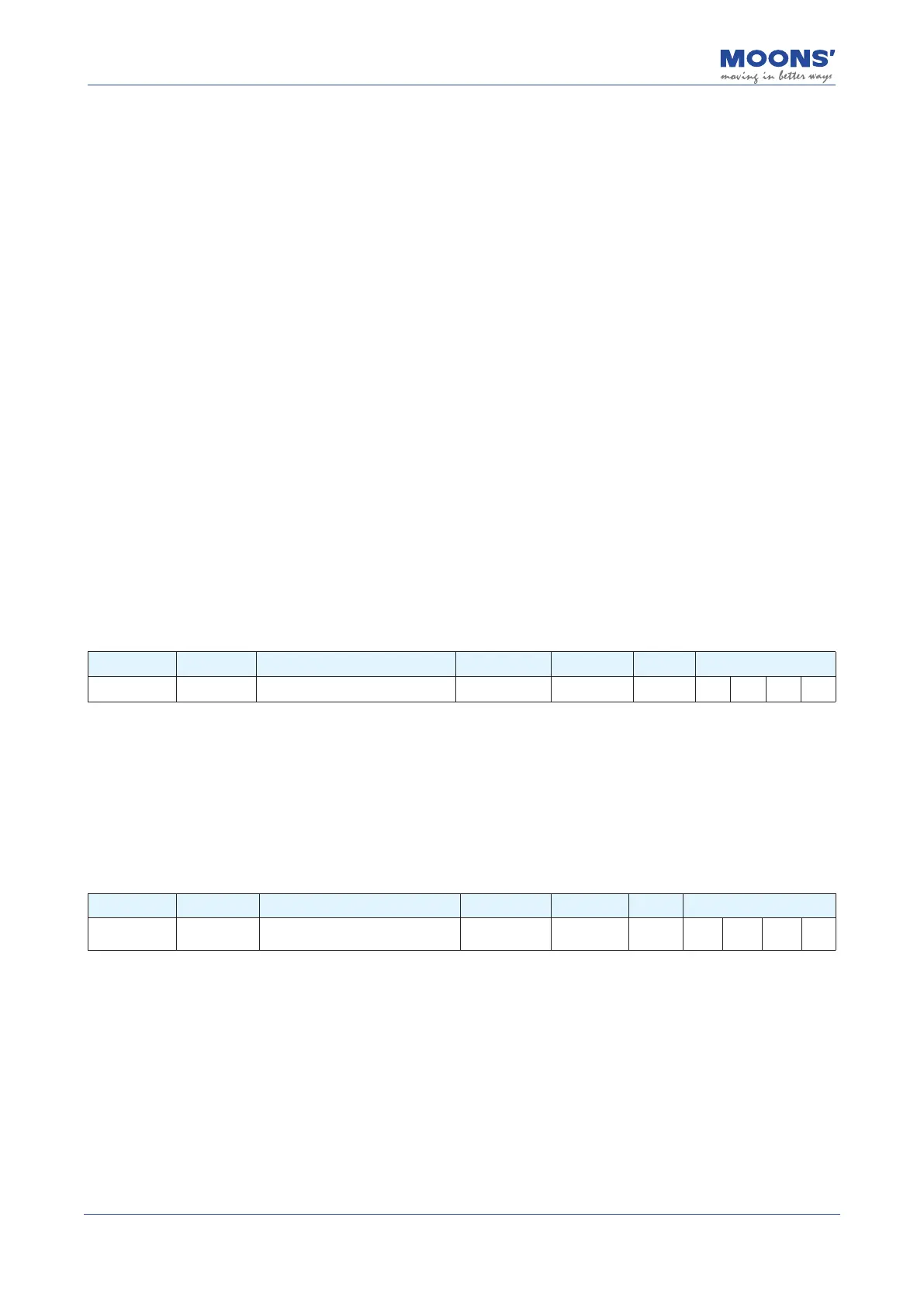
Parameter Instruction Name Defaults Range Unit Related Patterns
P0-05 KP 1st position loop gain 52 0 ~ 20000 0.1Hz P S T
Set the proportional gain for position control. Increasing this parameter can improve the
responsiveness of the system, reduce the position error, and shorten the positioning time. 0 means
not used, 20000 means the proportional eect is maximized. When the proportional gain of the
position loop is too small, the response of the system will not be fast enough, and the decreasing
trend of the position error will be slow. However, if the setting is too large, it may cause positioning
overshoot or machine vibration. Generally speaking, the position loop gain cannot be greater than
the velocity loop gain.
◆
Position loop dierential gain
Parameter Instruction Name Defaults Range Unit Related Patterns
P0-07 KD
1st position loop derivative time
constant
0 0 ~ 30000 ms P S T
Set the position loop dierential time constant for position control.
0 means no derivative eect, the smaller the set value, the stronger the eect of the derivative term.
Set value of the derivative time constant (KD) is too large, the system's ability to suppress vibration
is insucient, and obvious oscillation will occur during the acceleration / deceleration process, the
uniform speed process and after stopping, and there will be a trend of decreasing oscillation. nally
stabilized.
When the set value of the dierential time constant (KD) is reasonable, the system's ability to
suppress vibration is signicantly enhanced, and it tends to stabilize quickly. When the dierential
time constant (KD) is set too small, the motion system will be too sensitive, easily vibrate and
generate noise. When there is vibration in the system, the dierential time constant can be adjusted
appropriately, and the recommended initial value is 2000.




 To Next Page