12.11
Date Code 20090730 Instruction Manual SEL-734 Meter
Testing and Troubleshooting
Gain Adjustment
Gain Adjustment
To ensure that the SEL-734 meets ANSI Accuracy Class 0.2, SEL precisely
calibrates each meter before it is shipped. A calibration report is included with
each meter detailing the measured error over a variety of operating conditions.
Some customers require the ability to adjust, or zero-out, any error measured
by their test standard. The SEL-734 supports this requirement through the gain
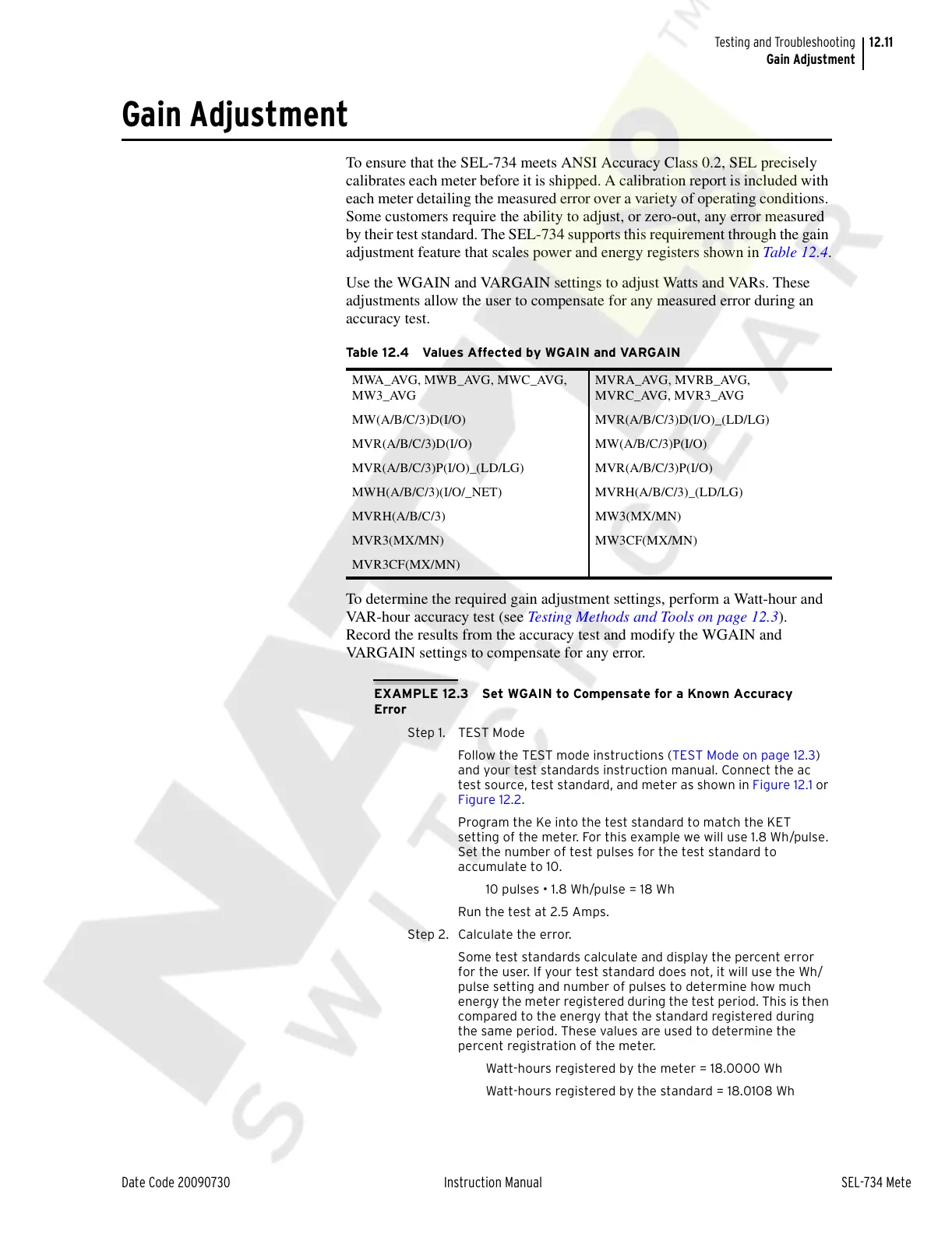
adjustment feature that scales power and energy registers shown in Table 12.4.
Use the WGAIN and VARGAIN settings to adjust Watts and VARs. These
adjustments allow the user to compensate for any measured error during an
accuracy test.
To determine the required gain adjustment settings, perform a Watt-hour and
VAR-hour accuracy test (see Testing Methods and Tools on page 12.3).
Record the results from the accuracy test and modify the WGAIN and
VARGAIN settings to compensate for any error.
EXAMPLE 12.3 Set WGAIN to Compensate for a Known Accuracy
Error
Step 1. TEST Mode
Follow the TEST mode instructions (TEST Mode on page 12.3)
and your test standards instruction manual. Connect the ac
test source, test standard, and meter as shown in Figure 12.1 or
Figure 12.2.
Program the Ke into the test standard to match the KET
setting of the meter. For this example we will use 1.8 Wh/pulse.
Set the number of test pulses for the test standard to
accumulate to 10.
10 pulses • 1.8 Wh/pulse = 18 Wh
Run the test at 2.5 Amps.
Step 2. Calculate the error.
Some test standards calculate and display the percent error
for the user. If your test standard does not, it will use the Wh/
pulse setting and number of pulses to determine how much
energy the meter registered during the test period. This is then
compared to the energy that the standard registered during
the same period. These values are used to determine the
percent registration of the meter.
Watt-hours registered by the meter = 18.0000 Wh
Watt-hours registered by the standard = 18.0108 Wh
Table 12.4 Values Affected by WGAIN and VARGAIN
MWA_AVG, MWB_AVG, MWC_AVG,
MW3_AVG
MVRA_AVG, MVRB_AVG,
MVRC_AVG, MVR3_AVG
MW(A/B/C/3)D(I/O) MVR(A/B/C/3)D(I/O)_(LD/LG)
MVR(A/B/C/3)D(I/O) MW(A/B/C/3)P(I/O)
MVR(A/B/C/3)P(I/O)_(LD/LG) MVR(A/B/C/3)P(I/O)
MWH(A/B/C/3)(I/O/_NET) MVRH(A/B/C/3)_(LD/LG)
MVRH(A/B/C/3) MW3(MX/MN)
MVR3(MX/MN) MW3CF(MX/MN)
MVR3CF(MX/MN)
Courtesy of NationalSwitchgear.com


 To Next Page