5.12
SEL-734 Meter Instruction Manual Date Code 20090730
Time-of-Use
TOU Glossary
MW/MVAR “Total”
Cumulative Demand
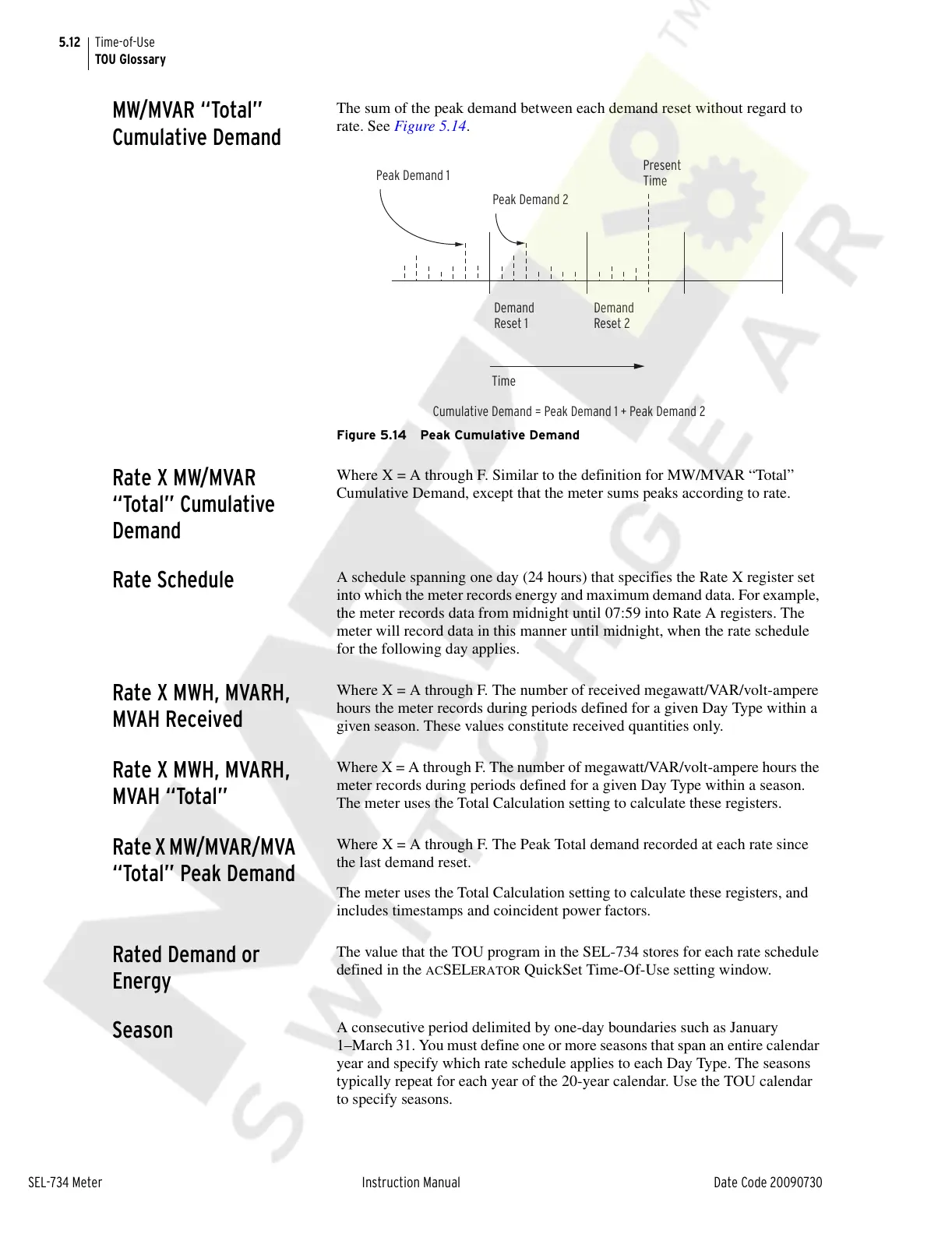
The sum of the peak demand between each demand reset without regard to
rate. See Figure 5.14.
Figure 5.14 Peak Cumulative Demand
Rate X MW/MVAR
“Total” Cumulative
Demand
Where X = A through F. Similar to the definition for MW/MVAR “Total”
Cumulative Demand, except that the meter sums peaks according to rate.
Rate Schedule
A schedule spanning one day (24 hours) that specifies the Rate X register set
into which the meter records energy and maximum demand data. For example,
the meter records data from midnight until 07:59 into Rate A registers. The
meter will record data in this manner until midnight, when the rate schedule
for the following day applies.
Rate X MWH, MVARH,
MVAH Received
Where X = A through F. The number of received megawatt/VAR/volt-ampere
hours the meter records during periods defined for a given Day Type within a
given season. These values constitute received quantities only.
Rate X MWH, MVARH,
MVAH “Total”
Where X = A through F. The number of megawatt/VAR/volt-ampere hours the
meter records during periods defined for a given Day Type within a season.
The meter uses the Total Calculation setting to calculate these registers.
Rate X MW/MVAR/MVA
“Total” Peak Demand
Where X = A through F. The Peak Total demand recorded at each rate since
the last demand reset.
The meter uses the Total Calculation setting to calculate these registers, and
includes timestamps and coincident power factors.
Rated Demand or
Energy
The value that the TOU program in the SEL-734 stores for each rate schedule
defined in the
ACSELERATOR QuickSet Time-Of-Use setting window.
Season
A consecutive period delimited by one-day boundaries such as January
1–March 31. You must define one or more seasons that span an entire calendar
year and specify which rate schedule applies to each Day Type. The seasons
typically repeat for each year of the 20-year calendar. Use the TOU calendar
to specify seasons.
Peak Demand 1
Peak Demand 2
Present
Time
Demand
Reset 1
Demand
Reset 2
Time
Cumulative Demand = Peak Demand 1 + Peak Demand 2
Courtesy of NationalSwitchgear.com


 To Next Page