4.1.5 Measuring the brake output voltage
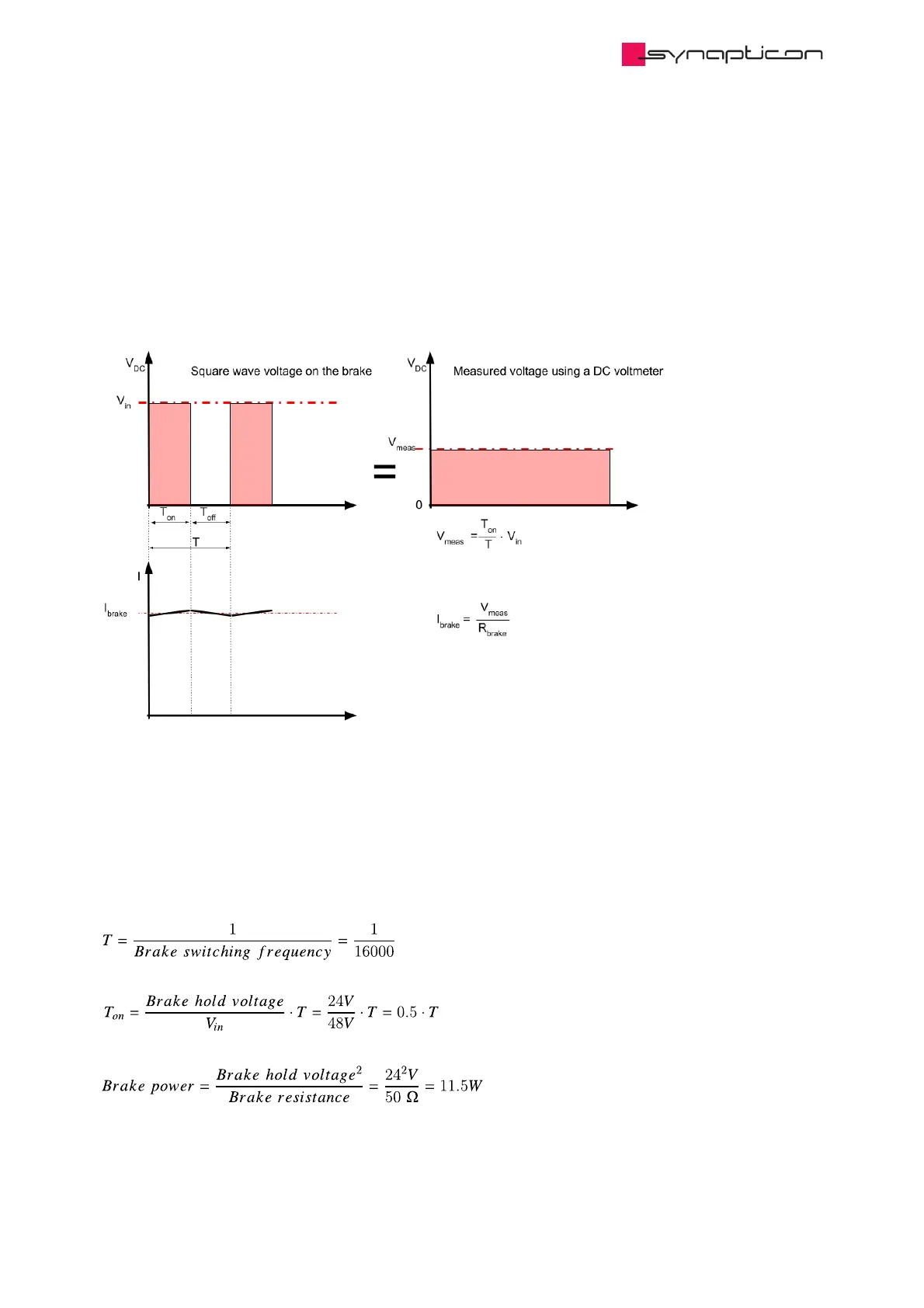
The brake voltage is a square wave signal 16 kHz, 32 kHz or 64 kHz (configurable in subitem 2004:11). A PWM
method is used for applying the appropriate voltage to the brake output.
The brake output voltage does not have a negative component. It is connected to an inductor which results in
a constant current.
Example
V (Input DC voltage) = 48 V
Brake switching frequency = 16 KHz
Brake hold voltage = 24 V
Brake resistance = 50 Ω
in DC



 To Next Page