6.3 Tuning fuel 6 TUNING THE MS3PRO
Required Fuel.
• Time or Ignition Events: Allows you to specify the pulse width in either time or the number of ignition events.
• Accel duration (events): If using ignition events, the number of ignition events where you will receive full
acceleration enrichment pulse width.
• Accel taper (events): If using ignition events, the acceleration enrichment will taper off to the specified end
pulse width amount over this number of ignition events after the accel duration is complete.
• Accel time: The amount of time the full pulse width adder is applied, in seconds, when set to time mode.
• Accel taper time: The amount of time after the accel time over which the pulse width adder tapers off to the
end pulse width number, if set to time mode. After this time, the amount of added pulse width drops back to
zero.
• Accel TPSdot threshold: The minimum TPS rate of change needed to trigger TPS driven acceleration
enrichment. As with MAPdot threshold, this has similar trade-offs between setting it too sensitive and not
sensitive enough.
• Decel Fuel Amount: A multiplier that is applied whenever the TPSdot or MAPdot threshold is crossed down
instead of up. 0% would trigger a total fuel cut, while 100% means no change would be applied. The firmware
will allow using values over 100% to add fuel in this situation, although this is usually not a desirable effect.
We recommend starting with 100% for a manual transmission or 90% for an automatic transmission.
• Cold Accel Adder: This is applied whenever warmup enrichment is active, and is added to the standard PW
adder. The MS3Pro applies the full amount of added pulse width when coolant temperature is at the lowest
temperature point in the warmup enrichment curve. It tapers off in a linear fashion to zero when you reach
the point on the warmup enrichment curve where WUE equals 100% and there is no enrichment.
• Cold Accel Multiplier: This is applied whenever warmup enrichment is active, and is applied to scale the
pulse width by a multiplied amount before the cold accel enrichment number is added. It tapers off in the
same way as the Cold Accel Enrichment.
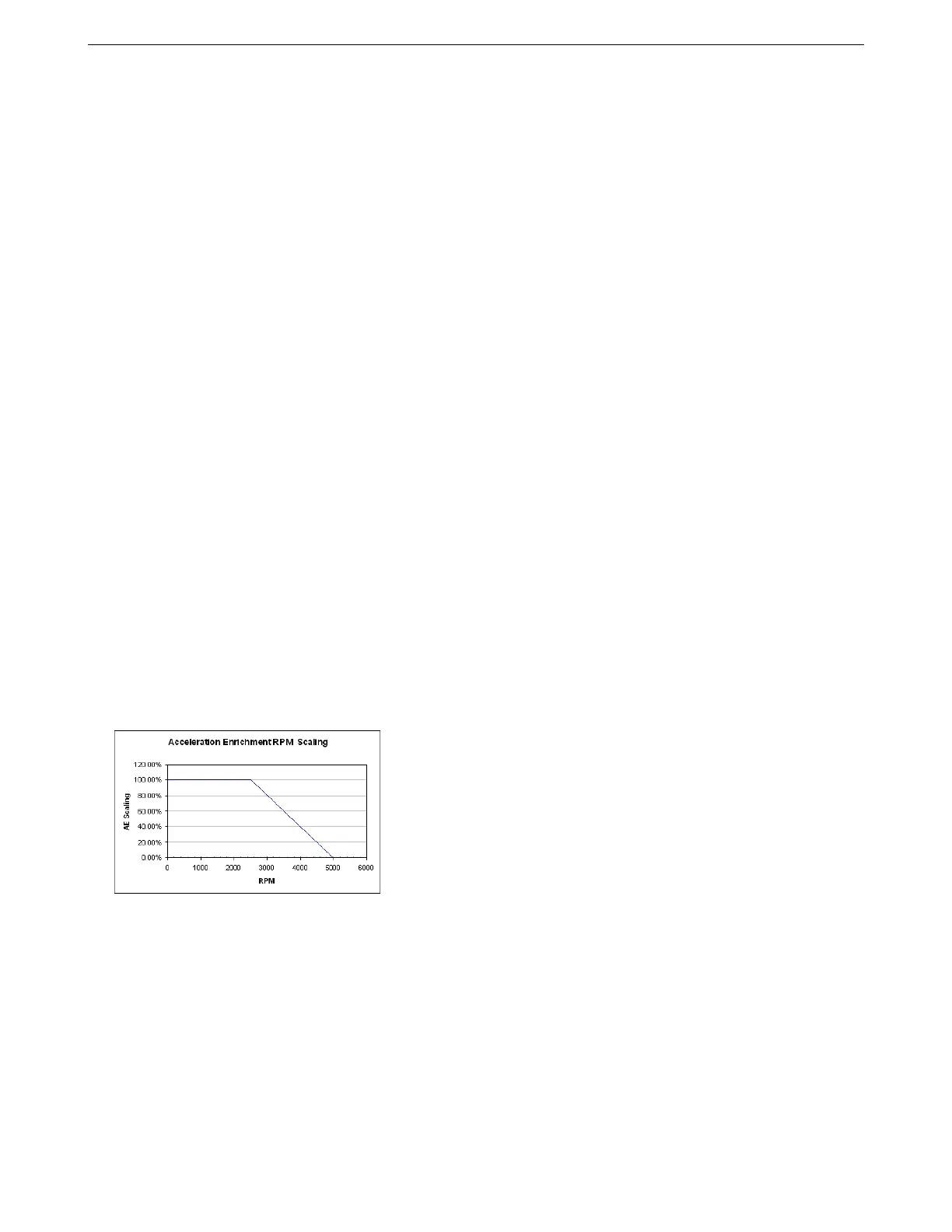
• Full accel below: Below this number, you will get full acceleration enrichment.
• Zero accel above: Above this number, the acceleration enrichment is completely off. In between these two
numbers, the acceleration enrichment will taper off in a linear fashion.
The curve below illustrates how this works.
6.3.5.4 Getting it dialed in Regardless of which of the two settings you use, many of the aspects of acceleration
enrichment tuning will be the same. Before you start tuning the acceleration enrichment, make sure your VE tables
are dialed in. Adding a correctly tuned amount of acceleration enrichment to an incorrectly tuned fuel table is still
going to result in an incorrect amount of fuel. Since the acceleration enrichment is stacked on top of the fuel the
ECU is commanding based on the VE table, you’ll want to tune AE last, after your VE table is fully tuned.
The standard AE can be thought of like the accelerator pump on a carb, which shoots in some extra fuel when
you suddenly hit the throttle to compensate for the massive influx of air when you open the throttle blades. The
goal is to compensate for this influx of air for an instant during that transient until the the transient is over and the
VE tables are again providing the proper amount of fueling. If your background is tuning carburetors, you can think
of this as a very powerful fully adjustable/tunable accelerator pump that lets you compensate for more than one
rate of throttle position change. Slow "tip-in" can be adjusted with a certain PW adder, medium with another larger
PW shot, mid-fast with another size PW squirt, and very fast throttle movements with another.
AMP EFI MS3Pro manual version 1.202, firmware 1.5.0, 4/21/2017 Page 117



 To Next Page