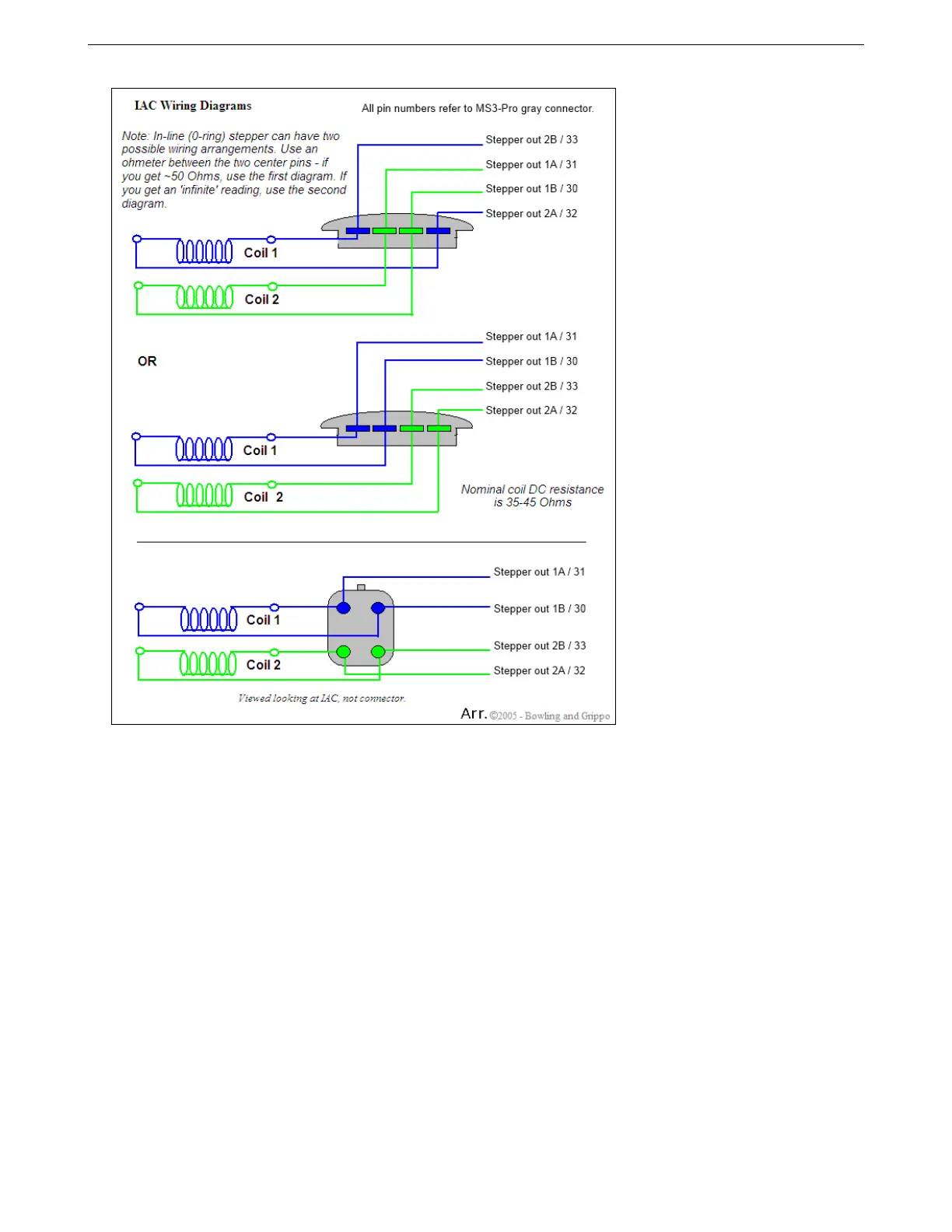
4.7 IAC valves 4 WIRING
There’s no such thing as a stepper motor with less than four wires. If your IAC valve has two or three wires, it
is probably a PWM style valve, described below.
4.7.2 PWM IAC valves
A PWM style valve uses a solenoid that opens or closes the valve, and the ECU controls its position by pulsing
the solenoid coil off and on rapidly. These can sometimes be simpler to set up than a stepper IAC valve, as the
position is just a function of how much current flows through the coil. These come in two varieties. One uses a
single coil, which pushes the valve open (or, rarely, closed) when the coil energizes. Another design has two coils,
one of which pushes the valve open and the other pushes it closed. The MS3Pro can drive both sorts.
A single coil IAC valve will have two wires. One connects to switched 12 volt power; the other connects to the
MS3Pro PWM / Idle Out 1 wire. Sometimes these valves, like injectors, have no polarity. Other valves have a
built in diode, and it is important with such a valve to make sure you do not wire it backwards. Consult the wiring
diagram for the car the valve came on if you aren’t sure which terminal should receive power.
Two coil IAC valves have three wires. One terminal is for 12 volt switched power; the other two connect to the
MS3Pro PWM outputs, one of which should be PWM / Idle Out 1 (you can specify in the software which output
closes the valve and which opens it). Usually, the center wire on the connector gets 12 volt power. If you’re not
sure which is the power wire, check with an ohm meter. The resistance from the ECU connections to power will be
one half the resistance from one ECU connection to the other.
Note that PWM IAC valves must be wired in such a way that they do not receive 12 volts with the key off.
AMP EFI MS3Pro manual version 1.202, firmware 1.5.0, 4/21/2017 Page 48



 To Next Page