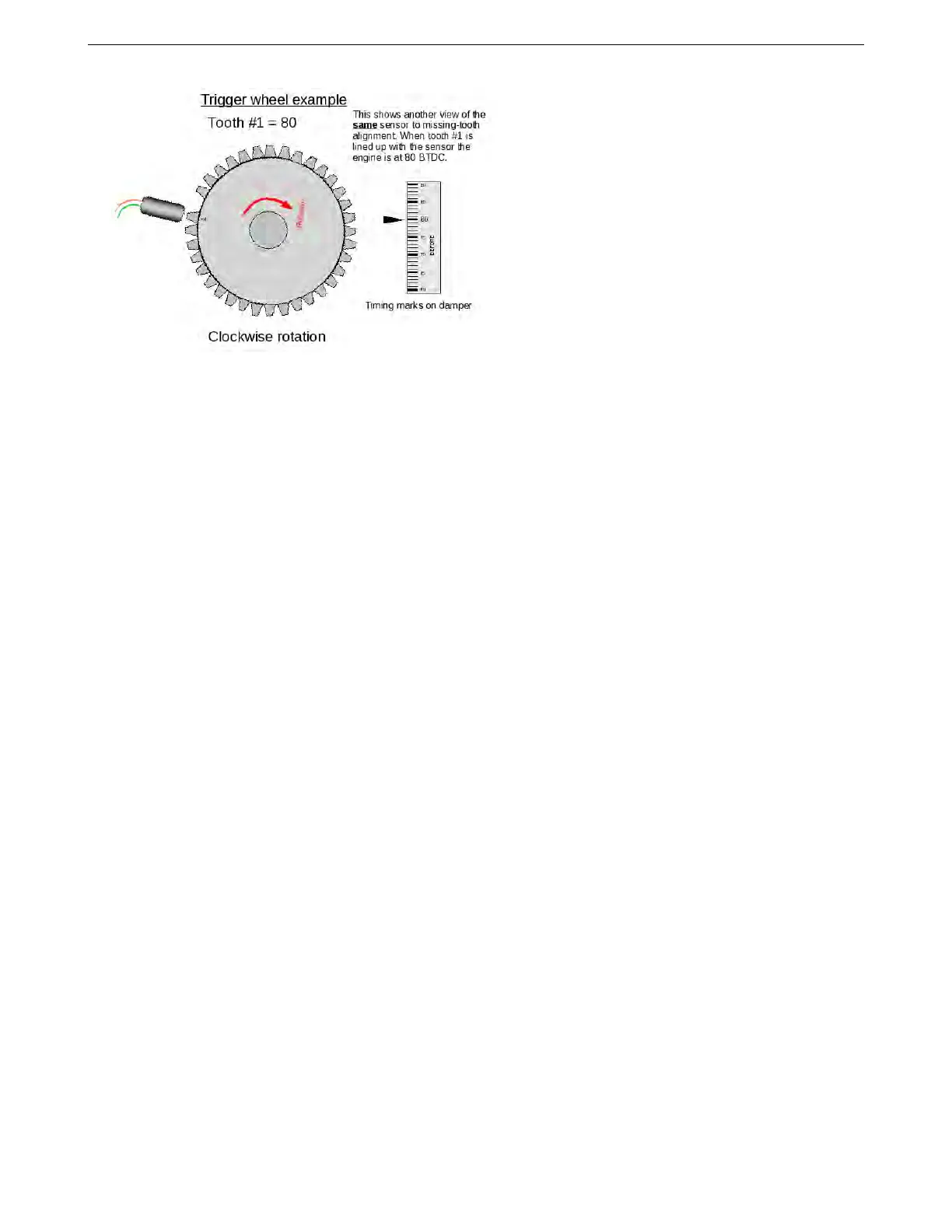
5.3 Ignition settings 5 SETTING UP A BASIC CONFIGURATION
Critical settings include:
• Spark Mode = Toothed Wheel
• Trigger Angle / Offset = 0
• Trigger wheel arrangement = Single wheel with missing tooth
• Trigger wheel teeth = number of teeth including missing teeth
• Missing teeth = set according to your trigger wheel
• Tooth #1 Angle (deg BTDC) = set as above
• Main wheel speed = Crank wheel
Typical settings:
• Ford 4 cylinder = 36-1, 80° tooth #1
• Ford 6 cylinder = 36-1, 50° tooth #1
• Ford 8 cylinder = 36-1, 40° tooth #1
• Bosch 4 cylinder (Peugeot, Vauxhall) = 60-2, 114° tooth #1
• Bosch 6 cylinder (many BMWs) = 60-2, 89° tooth #1
A note about VR sensors and missing tooth wheels If using a variable reluctor type sensor with a high
tooth count (usually 24 or more teeth), missing tooth wheel, you may experience a loss of sync at high RPM. If
this happens, the first thing to try is to put a 10K resistor in parallel with the VR sensor; this can often improve
operation with this particular input.
5.3.4.7 Missing tooth cam wheel This arrangement is not commonly used by OEMs, but does support full
sequential with a single wheel and sensor. Cam triggering is less accurate than crank triggering due to timing belt
or chain stretch.
The MS3Pro code benefits from a reasonable number of teeth (hence 36 or 60) for best ignition timing accuracy.
Low tooth count wheels such as 8-1 are not advised.
The previous section on missing tooth crank wheel generally applies when the wheel is mounted to the cam,
but remember that one rotation of the cam is 720 crank degrees. The settings are in crank degrees. So a tooth #1
that is 8 gaps earlier than the sensor on a 36-1 wheel would give a 160° tooth #1 angle (8 * 10 * 2 [for cam] ) .
Critical settings include:
• Spark Mode = Toothed Wheel
• Trigger Angle / Offset = 0
AMP EFI MS3Pro manual version 1.202, firmware 1.5.0, 4/21/2017 Page 68



 To Next Page