6.3 Tuning fuel 6 TUNING THE MS3PRO
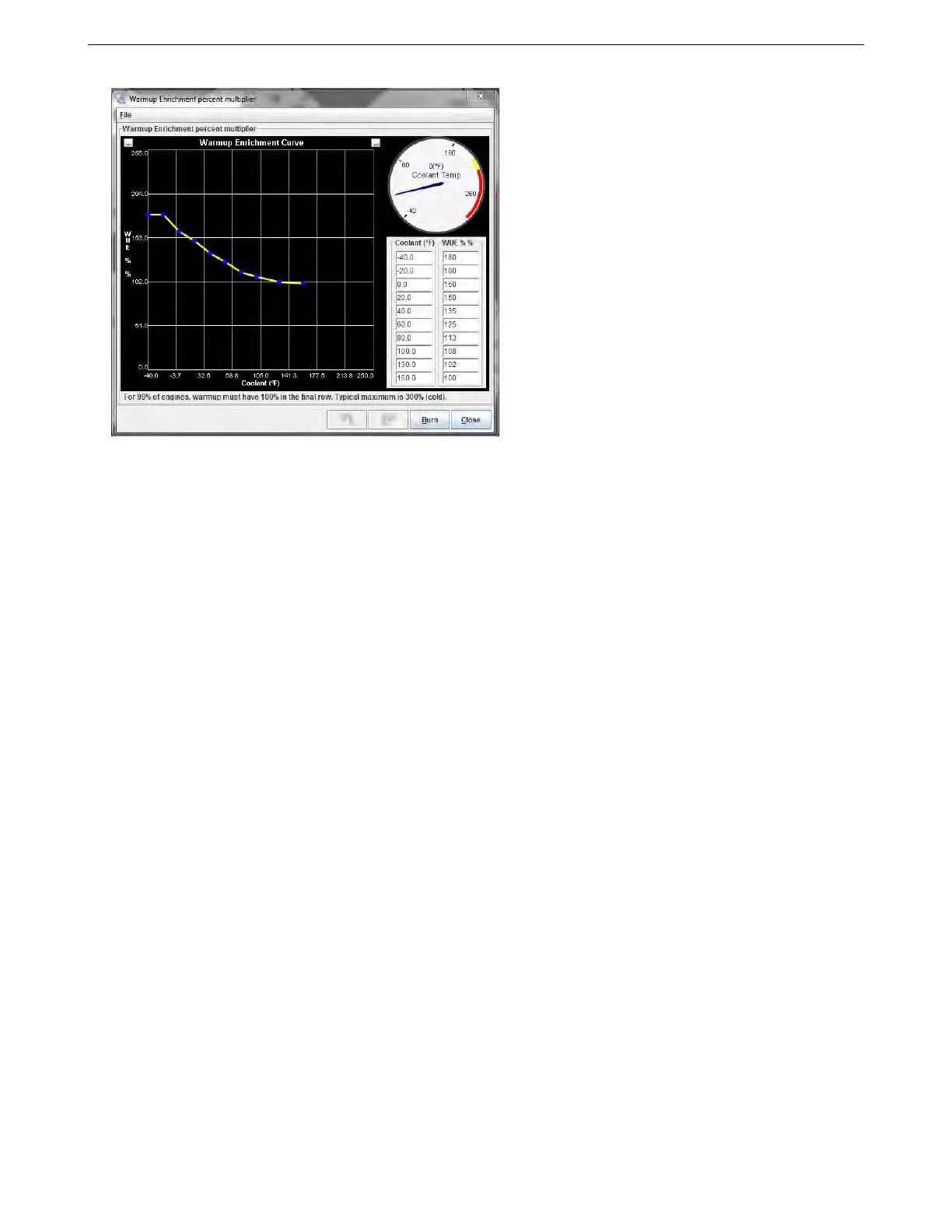
On the left side, you have a graphic representing the amount on the Y axis and the temperature on the X axis.
The right side of the screen provides a handy temperature gauge and a table representation. (Click the “...” button
in the upper right hand corner to hide or show the table.) You can either edit the numbers in the table or drag the
nodes in the curve. Note that the entries must be set up so that the temperature data points on the table are in
order, from the coldest at the top to warmest at the bottom. Accidentally setting the numbers in reverse order will
result in incorrect operation.
6.3.6.2 Priming pulse This curve allows you to specify an initial pulse, in milliseconds, that is fired on the first
turn of the key to clear air from the fuel lines. You can set the pulse width as a function of coolant temperature.
6.3.6.3 Afterstart (ASE) percentage This is a curve of percentage multiplier versus time. The MS3Pro will
apply the full amount immediately after RPM climbs past cranking RPM and then taper it off linearly through the
ASE taper time. This number is added to the WUE number and then the combined number is multiplied by the
number the main fuel loop calculates. 0% is no afterstart enrichment.
6.3.6.4 Afterstart (ASE) taper This curve is used to specify the amount of time that ASE is applied, in either
cycles or tenths of a second. You specify which unit to use under Cranking / Startup settings.
6.3.6.5 Warmup enrichment This curve is a percentage used to scale the fuel as a function of engine temper-
ature. 100% is no enrichment; lower numbers will take away fuel. This is not quite the same behavior as ASE,
which cannot be set to take away fuel. Just remember that ASE is an added number, while WUE is a multiplier.
Note that if the top number on this curve is not 100%, the engine will not come out of warm up enrichment.
6.3.6.6 Putting it all together If the engine isn’t starting, pay attention to the RPM it runs through. If the engine
does not catch, but cranks at a steady RPM, you will need to adjust the cranking pulse width. If the engine fires
up, but then stalls in a few seconds, you will need to adjust the afterstart enrichment. You cannot rely on an O
2
sensor feedback for cranking, but here are some rules of thumb you can use.
• It’s better to start off at a point you expect to be lean and add fuel in small increments, to avoid flooding the
engine.
• If giving the engine a small bit of throttle helps, you probably have too much fuel. Conversely, if this makes it
worse, you probably have too little.
• You can pull a spark plug and check if it’s wet with fuel, in which case you need to reduce the fueling at the
point where it stalled, or dry, in which case you need to add more fuel.
AMP EFI MS3Pro manual version 1.202, firmware 1.5.0, 4/21/2017 Page 120



 To Next Page