5.3 Ignition settings 5 SETTING UP A BASIC CONFIGURATION
Critical settings include:
• Spark Mode = Toothed Wheel
• Trigger Angle / Offset = 0
• Trigger wheel arrangement = Dual wheel with missing tooth
• Trigger wheel teeth = number of teeth including missing teeth
• Missing teeth = set according to your trigger wheel
• Tooth #1 Angle (deg BTDC) = set as above
• Main wheel speed = Crank wheel
• Second trigger active on = Set as above
The “and every rotation of” setting is grayed out as this mode only allows the second trigger to be on the cam
wheel.
This wheel decoder mode has a limp home feature: If the camshaft position sensor works OK during startup,
but the MS3Pro subsequently loses the cam wheel, it will “remember” what phase the cylinders are on, and keep
running as if nothing happened.
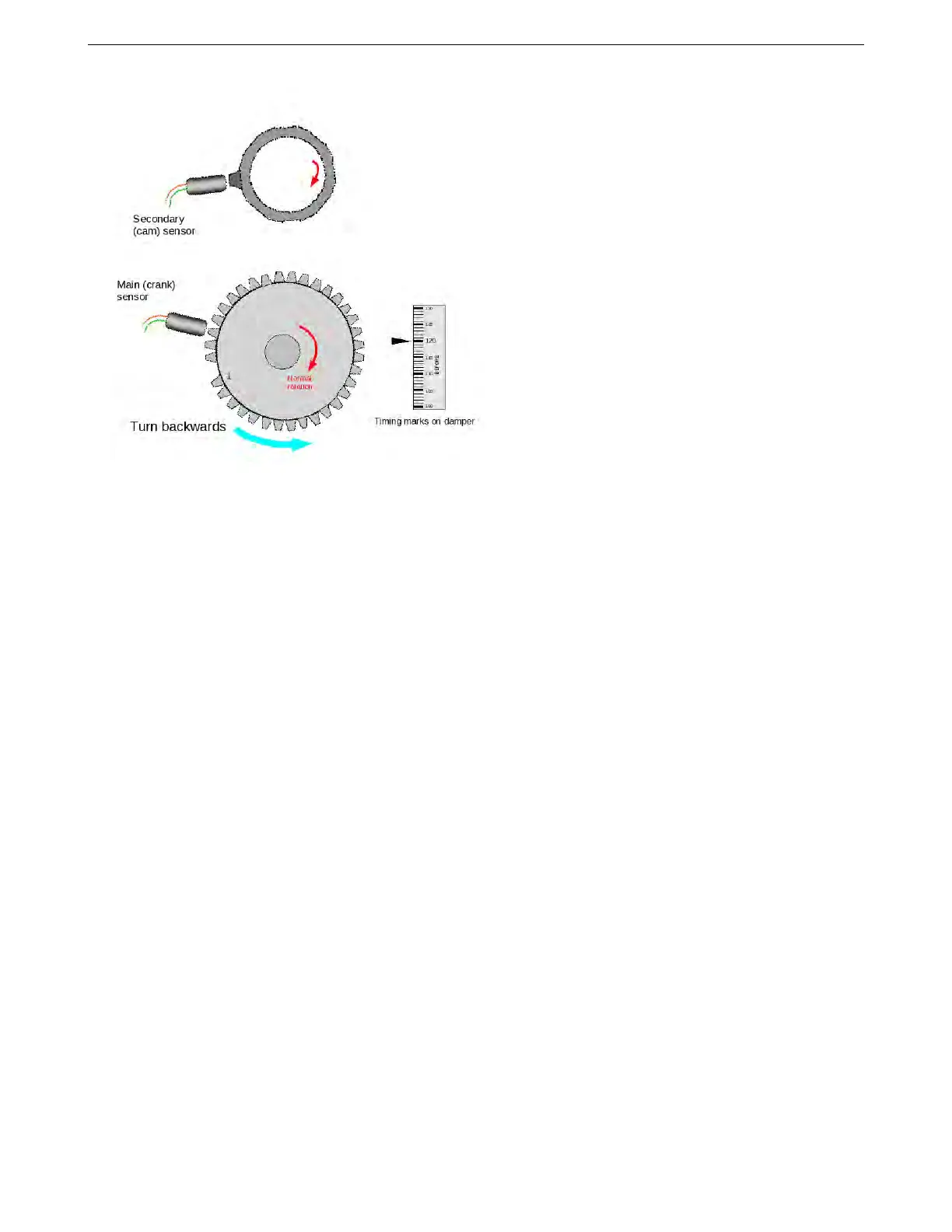
5.3.4.9 Missing tooth crank wheel and polled (50/50 or half moon) cam wheel This is an fairly common
arrangement that supports full sequential and coil on plug. Here, a missing tooth wheel is used on the crank in
the common way, and a hall-effect or gear tooth sensor is used on the cam with a long tooth or window or vane.
The MS3Pro first checks for a missing tooth in the crank wheel sensor, then checks the voltage coming from the
cam signal to determine if the cylinder is on the compression or exhaust stroke, without waiting for the cam sensor
to reach an edge. This gives you the ability to have full sequential, but the engine syncs up as fast as a regular
missing tooth crank wheel without the cam sensor. Different OEM implementations exist - some engines use a
50/50 cam pattern, Vauxhall red-top engines use a window in the distributor rotor that spans the missing tooth
region. As far as the code is concerned, these are equivalent because it only “looks at” (polls) the cam just after
the missing tooth.
While this code normally checks at the missing teeth, the “Check at Tooth #” setting allows for it to delay this
checking and look for a pulse on a later tooth. By default, this is set to tooth zero for the missing tooth. Some
engines use multiple teeth on the cam wheel, with one tooth present on one rotation of the crank but not the next
but no cam teeth over the missing tooth on the crank wheel. In this case, you can set “Check at Tooth #” to a crank
tooth that lines up with a cam tooth on one rotation but not on the next rotation.
AMP EFI MS3Pro manual version 1.202, firmware 1.5.0, 4/21/2017 Page 71



 To Next Page