7.1 Basic / Load Sections 7 ADDITIONAL ITEMS: BEYOND BASIC FUEL AND IGNITION CONTROL
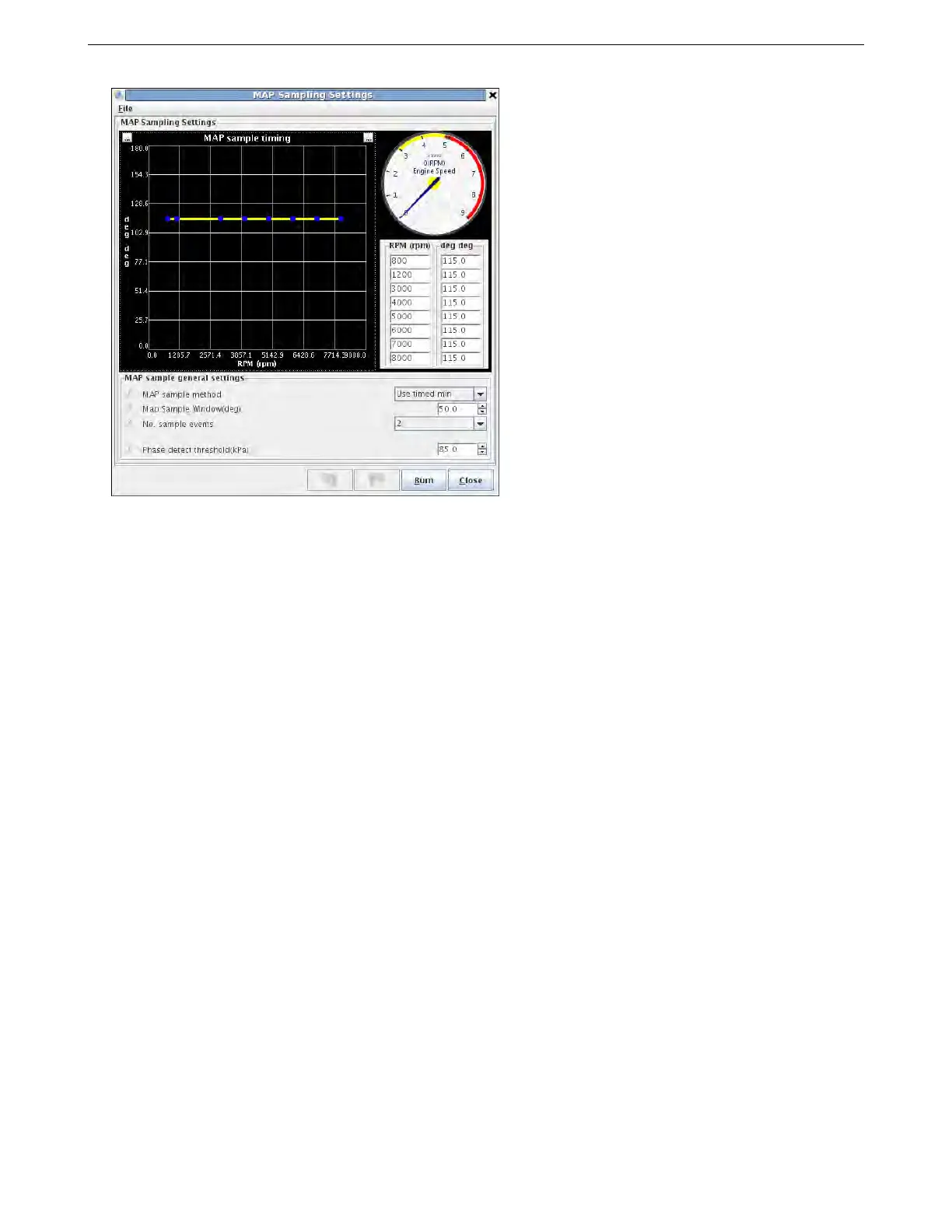
• MAP sample method - whether to use the Event Average or Timed Minimum method. When Event Average
is selected, no other settings on this page are required.
• MAP Sample Window - how wide the sampling window should be in degrees.
• No. Sample Events - how many windows to take the minimum across. For 1,2 cylinder 4-stroke engines
this should typically be set to 2 - more details below. For 2-stokes or larger numbers of cylinders set to 1.
• Phase detect threshold - when using a MAP sensor in place of a Cam sensor (on 1cyl or V-twin), this is
used to detect the intake stroke.
• MAP sample timing - this curve sets the start of the sample window in degrees BTDC for each ignition
event. The number must always be less than the number of degrees per event. (720 divided by the number
of cylinders: for a 4 stroke i.e. for 4cyl there are 180deg per event, for 8cyl there are 90deg.)
7.1.10.1 Event Average For the majority of engines, this scheme is proven to give the most consistent results.
The multiple runners and overlapping intake events on a multi-cylinder engine lead to resonance and pulsations in
MAP that vary across the RPM range and load. Taking an average over the cycle sidesteps these problems and
gives a useable MAP reading for the fuel calculations and other table lookups. Once this mode is enabled, the
other settings on the MAP sampling page are not needed or used.
7.1.10.2 Timed Minimum For some engines, particularly 1 and 2 cylinder four stroke engines, where there are
fewer and more intermittent intake events it is necessary to specify where MAP sampling will occur in order to get
a repeatable reading. Here is a MAP log from a 1 cylinder 4-stroke engine.
AMP EFI MS3Pro manual version 1.202, firmware 1.5.0, 4/21/2017 Page 140



 To Next Page