7.3 Ignition Settings 7 ADDITIONAL ITEMS: BEYOND BASIC FUEL AND IGNITION CONTROL
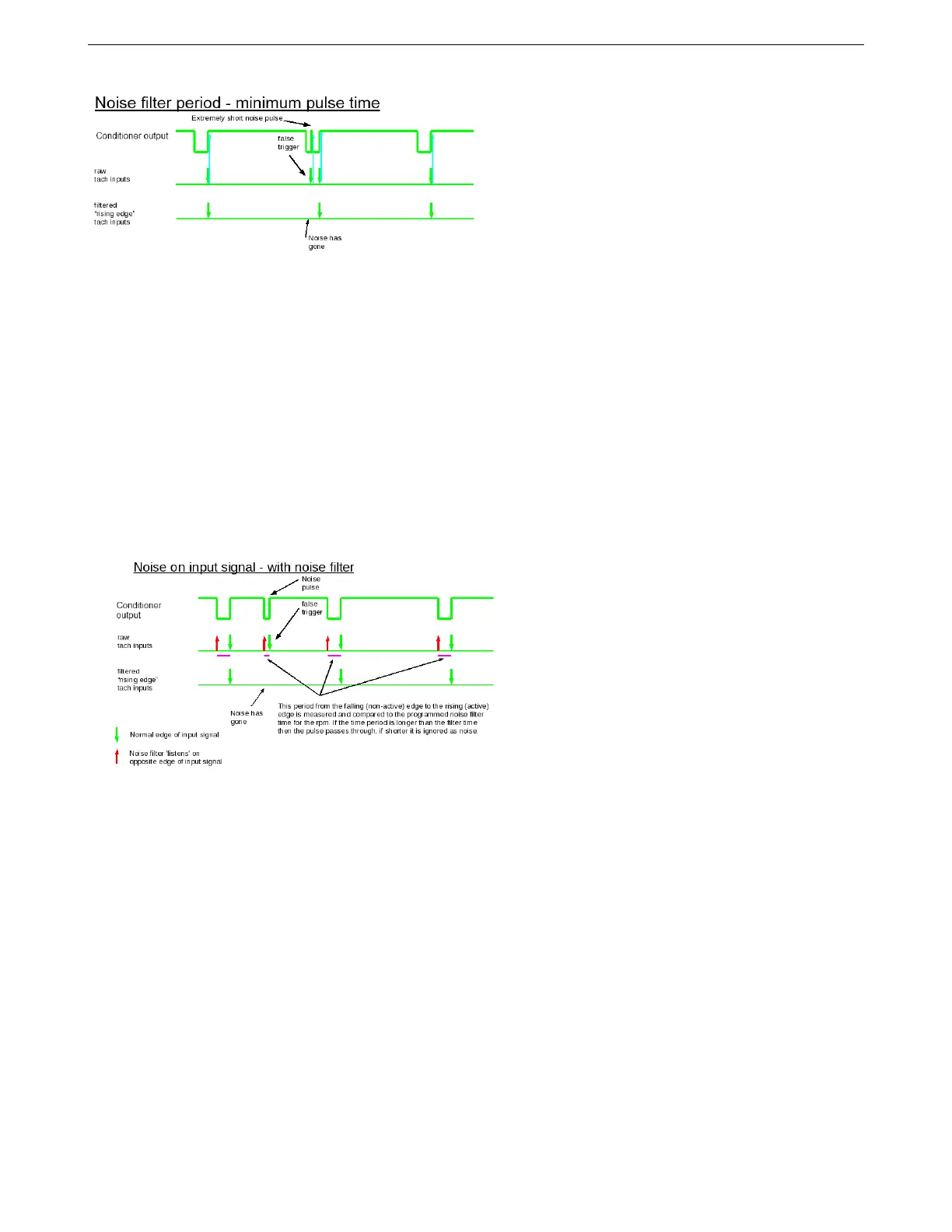
Any pulse shorter than this time is considered to be noise and thrown out.
Primary Tach settings apply to the crankshaft position (CKP) input.
• Nippon Denso Crosstalk filter - This setting is enabled if the spark mode is set to “Toothed wheel” and the
trigger wheel arrangement set to “Dual wheel”. It is intended to handle Nippondenso cam angle sensors that
incorporate two separate VR sensors with a common ground. This setting checks the status of the CKP input
when it detects a signal on the CMP line. If the MS3Pro has received a pulse from the CKP signal and the
CMP signal at the same time, it considers the CMP signal to be a piece of noise induced by the CKP signal,
and ignores the CMP signal.
• Noise filter enabled - enables noise filter curve on primary/crank tach input. This sets a minimum pulse
time versus RPM curve (the noise filter curve to the right)
The noise filter works on the principle that the noise is likely to be of short duration, far shorter than a genuine
tooth. If all inputs conditioners are setup correctly, we should be able to detect this condition by measuring the
width of the input pulse. A "long" pulse is real, a "short" pulse is noise. The width can vary with RPM, so the curve
allows you to set a minimum time.
With Hall effect or optical sensors, it’s fairly easy to calculate how long a real pulse should be. Take the tooth
width in crank degrees (or double the tooth width in cam degrees), multiply it by 50, and divide by 3 times the
engine RPM. This will give you the length of a real pulse. Setting the noise filter curve to a value of 1.2 to 1.5 times
this value at each RPM point will give you some extra tolerance. If using a VR sensor, you will need to measure
the time between zero crossings with an oscilloscope to determine a good value.
• Tach period rejection - ignores pulses shorter than time/percentage
This is a different approach: It ignores any pulse that comes in within either a timeframe or percent of the spacing
between the tach pulses. This goes off the timing of the pulse, rather than the length. Note that the spacing used is
between the smallest teeth, so this method works best on wheels where most of the pulses are a similar distance
apart. Modes like the Subaru 6/7 have several closely spaced pulses (at least on the cam wheel), rendering this
method less effective.
AMP EFI MS3Pro manual version 1.202, firmware 1.5.0, 4/21/2017 Page 169



 To Next Page