7.6 Boost / VVT 7 ADDITIONAL ITEMS: BEYOND BASIC FUEL AND IGNITION CONTROL
Most continuously variable VVT systems use a single solenoid where a duty near 50% holds the cam in position.
More than 50% causes it to advance or retard. Less than 50% moves it in the opposite direction. Since the
duty cycle controls the direction the cam moves and not the absolute position, continuously variable valve timing
requires closed loop control. The MS3Pro uses a missing tooth wheel (or otherwise irregular pattern) on the
crankshaft compared to a sensor on the moving cam to determine camshaft position, and uses this to adjust the
solenoid duty cycle.
Note that outside of the V10 applications, BMW’s Double VANOS is a bit of an oddity - it uses separate solenoids
to advance and retard the cam, much like a 3 wire PWM idle control valve.
If you are controlling more than one cam, you will need to use the digital frequency input circuits for cam input.
These can read most Hall effect sensors with no modification. If your engine uses VR type camshaft position
sensors, you will need external VR conditioner circuits to read the additional sensors.
If you find you have run out of PWM outputs, you can use the high current outputs to control a VVT oil control
valve. However, these outputs will cause a valve to close faster, making it harder to “park” the valve in an interme-
diate position. You can enable the same slow closing as on PWM outputs by connecting a 1N4001 diode across
the VVT valve, with the banded end connected to the 12 volt supply.
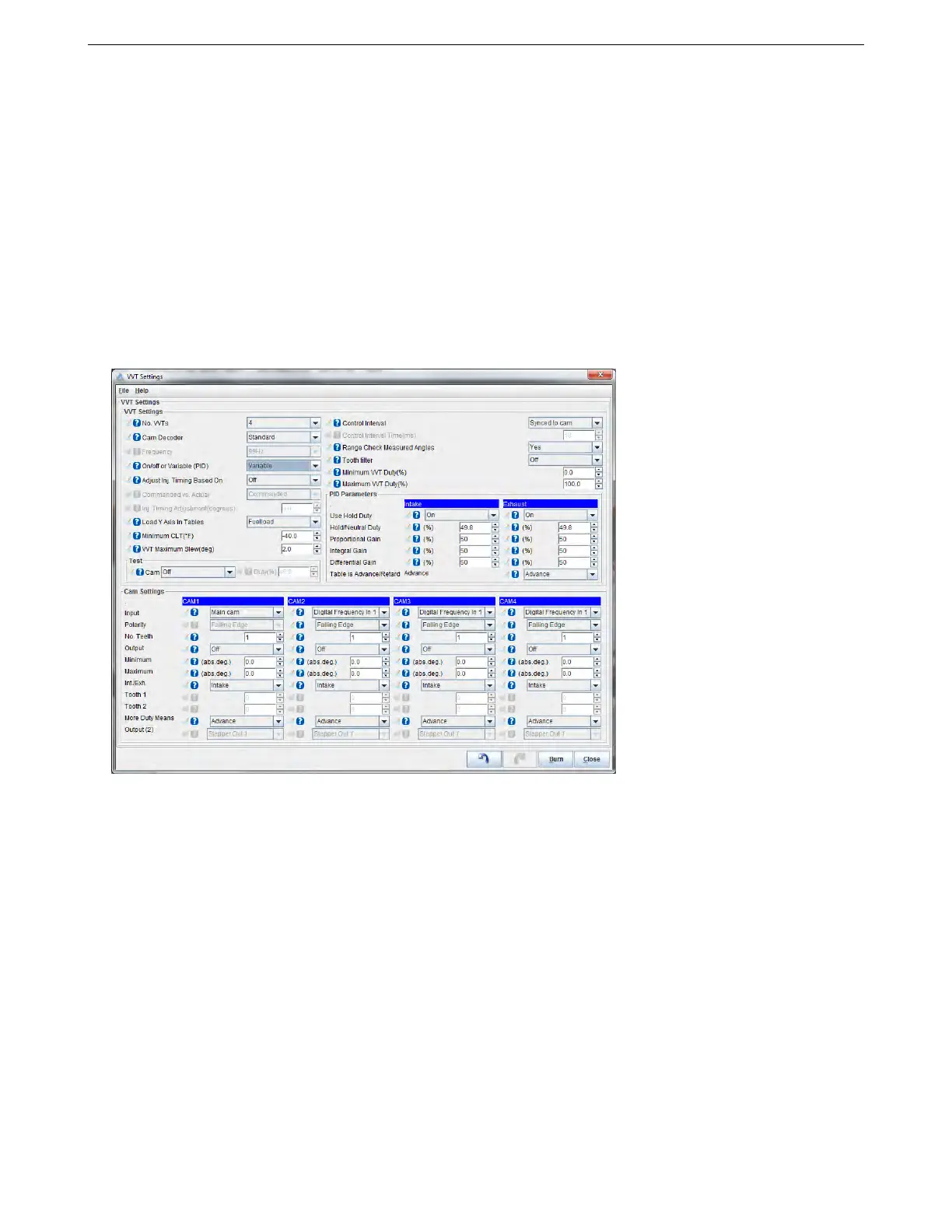
• No. VVTs - the number of VVT actuators to be controlled
• Cam Decoder - Standard mode works with either cam teeth that are all equally spaced, or a hard coded
spark mode. Nonstandard cam decoders work with engines that use Toothed Wheel mode with an unusual
cam wheel. Currently supported modes include BMW V10s, the BMW S54’s double VANOS setup, Chrysler
VVT Hemi engines, Ford Coyote V8, and Ford Duratec 4 cylinder. BMW and Chrysler modes use a 60-2
crank trigger, while Ford modes use a 36-1.
• Frequency - the PWM output frequency. Adjust to suit your solenoids.
• On/Off or PID - the mode of operation. Full variable systems should use PID.
• Adjust inj. timing based on - whether the Injector Timing for sequential injection should be adjusted as the
cams are moved.
• Commanded vs Actual - If the injection timing adjustment is on, this specifies whether the commanded or
actual timing is used to make the adjustment.
• Inj. Timing Adjustment - for on/off mode, this specifies the Injector Timing adjustment when VVT is on.
• Test output - during initial setup the test mode is used to confirm solenoid operation and learn the cam
range of movement. The output specifies which cam should be altered.
AMP EFI MS3Pro manual version 1.202, firmware 1.5.0, 4/21/2017 Page 213



 To Next Page