260
Annex B: Informative
B.1. UE DL-SCH RX
It is important to consider the following settings when the UE is receiving using DL-SCH from the BTS (MT8821C).
UE Category
Code Rate
B.1.1. UE Category
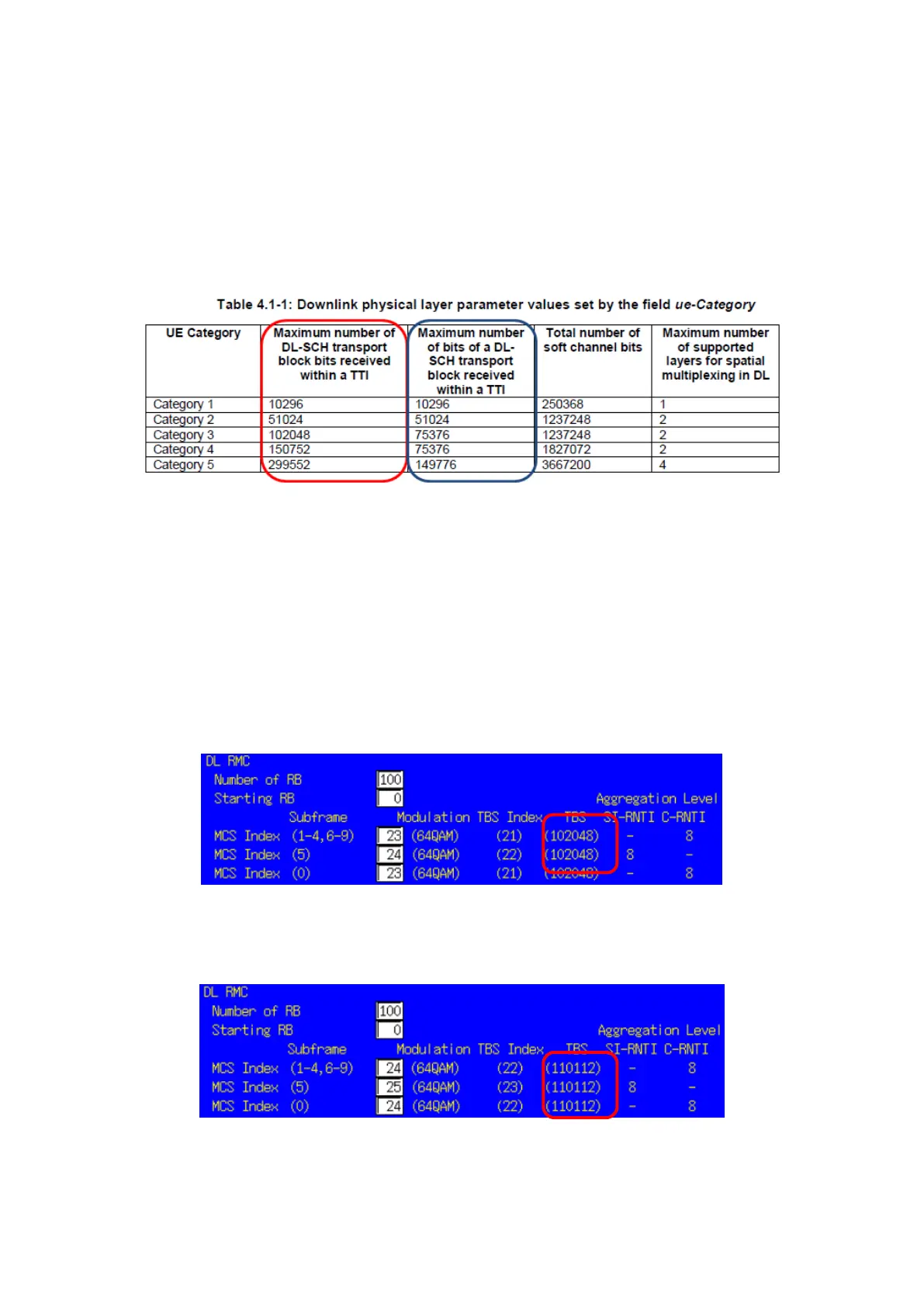
TS36.306 defines the DL-SCH Rx performance as shown in the table below for each UE Category.
The blue encircled part in the above table indicates the maximum bit count per one DL-SCH (one Codeword) that
the UE can receive in one TTI (one Subframe). For UE Category 3, if the DL-SCH Transport Block Size (TBS) for one
DL-SCH exceeds 75376 bits, the UE cannot receive DL-SCH normally.
In addition, the red encircled part in the above table indicates the maximum bit count for the DL-SCH (total of two Codewords
for Transmission Mode3 and Transmission Mode4) that the UE can receive in one TTI (one Subframe). For UE Category 3, if the
DL-SCH Transport Block Size (TBS) for one DL-SCH exceeds 102048 bits, the UE cannot receive DL-SCH normally.
The TBS of the DL-SCH sent by the MT8821C is determined by the Common Parameter Antenna Configuration, the
DL RMC Number RB and the DL RMC MCS Index (0) to (3), so it is necessary to perform setting by considering the
above-described UE category Rx restrictions.
For example, for UE Category 3 with a Channel Bandwidth of 20 MHz and a 2x2 MIMO (Open Loop) or 2x2 MIMO
(Closed Loop Multi Layer) Antenna Configuration, as shown in Fig. 1, at DL RMC, the UE can receive DL-SCH
normally because the TBS is 102048 bits and does not exceed the "Maximum number of DL-SCH transport block
bits received within a TTI" shown in the above table.
Fig. B.1.1-1. MCS Index Setting for DL RMC and TBS Value (when UE can decode)
On the other hand, at the DL RMC setting shown in Fig. 2, since TBS is larger than 102048 and exceeds the Rx
restriction described in "Maximum number of DL-SCH transport block bits received within a TTI" above, the UE
cannot decode DL-SCK and returns an error (NACK).
Fig. B.1.1-2. MCS Index Setting for DL RMC and TBS Value (when UE cannot decode)
B.1.2. Code Rate
The LTE using data Tx channel (PDSCH-DLSCH) performs channel encode processing and adds the error correction






 To Next Page