64 CHA NGE PARA METERS
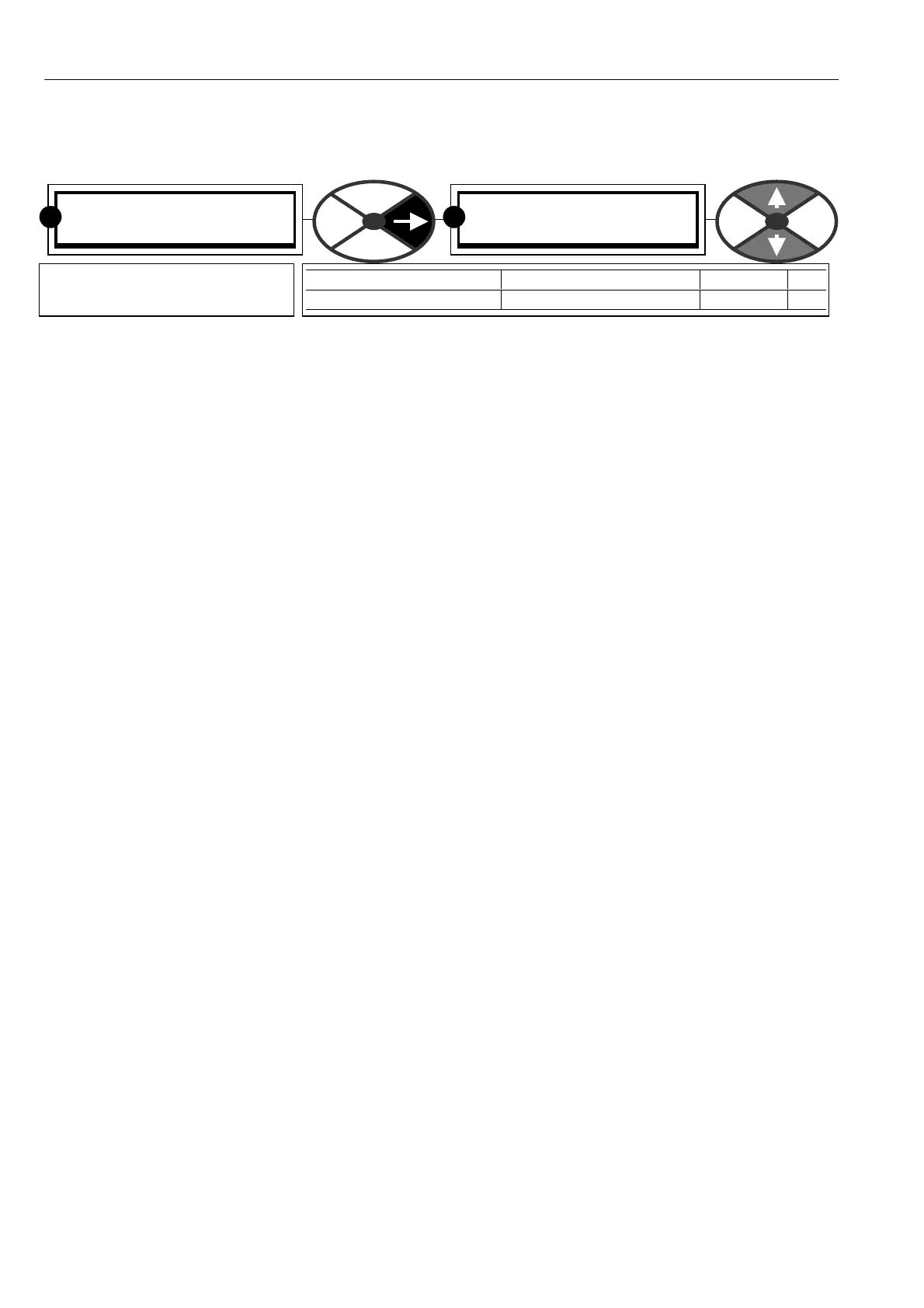
6.1.9 C ALIBRA TIO N / Speed feedback type PIN 9 QUICK ST ART
The speed feedback can be derived from 1 of 3 fundamental sources or a combination of them.
All 3 sourc es may be independently monitored. See 7.1 DIAGNOSTICS / SPEED LOOP M ONIT OR.
0) ARMATURE VOLTS (AVF). Internal isolated signal always available. The 100 % speed feedback volts
must be calculated and entered into PIN 18 RA TED ARM V OLTS. Note. 130)MOT OR RPM M ON will only be
accurate when 18)RA TED ARM V OLTS corresponds to 6)DESIRED MA X RPM, for 100 % speed.
WARNING. Do not use this feedba ck mode with field weakening systems.
See 6.9.6 FIELD CONTROL / FLD WEAKENING MENU for a note about A V F / field w eakening trip.
A V F feedback contains more ripple than tacho feedback. It may be necessary for smooth operation to reduce
the SPEED CONTROL loop gain with A VF. See 6.7.4 SPEED CO NTROL / Speed proportional gain PIN 71.
The accuracy of A VF is about 2% of full speed, it can be improved in 2 ways.
a) By applying IR compensation to the feedback. This IR drop is an element within the A VF that is
created by the armature current flo wing through the armature resistance. This element is not part of the back
EMF of the motor and therefore if it is removed from the A V F signal, the feedback is more accurate.
See 6.1.11 C ALIBRA TION / IR compensation PIN 14.
b) By running the field control in CURRENT mode. This forces the field current (and hence flux) to
remain constant which in turn makes the relationship between speed and A VF more accurate.
See also 8.1.1 MO T OR DRIVE ALARMS / Speed feedback mismatch trip enable PIN 171.
When the drive is first being commissioned it is recommended that the A V F mode be used initially. This
allows any other speed feedback transducers to be examined for correct outputs prior to relying on them for
control safety. For systems employing a DC contactor you must use T41 and T43 for remote AVF.
1) ANALOG TACHO. This transducer provides a DC voltage proportional to speed.
The 100 % speed feedback volts must be calculated and entered into 8)M A X TA CHO V OLTS.
Note. 130)MOT OR RPM MO N will only be accurate w hen 8)M A X T A CHO V OLTS corresponds to 6)DESIRED
M A X RPM, for 1 00 % speed. See also 3.4.4 Analogue tachogenerator input.
Note. With an additional bi-directional shaft mounted encoder it is possible to lock and/or orientate the shaft
at zero speed. See 6.10.9 ZERO INTERLO CKS / SPINDLE ORIENTATE.
There is a tacho failure detection system that may be configured to either trip the drive, or automatically
switch to A VF. See 8.1.1 MOT OR DRIVE ALARMS / Speed feedback mismatch trip enable PIN 171.
2) ENCODER. This shaft-mounted transducer provides a stream of pulses with a frequency proportional
to speed. The pulses can be a single stream with a separate direction logic output. (Lo w for reverse, high for
forward), or a dual stream of pulses in phase quadrature. The quadrature information is decoded by the PL/X
to determine the rotation direction. Either type may be selected for use in the ENCODER sub menu.
Note. Low frequencies give poor performance. The lower limit for reasonable performance is a 100 % input
frequency (ie. at full speed of encoder) of 15Khz (450 lines at 2000 rpm single pulse train or 225 lines at
2000 rpm for quadrature type). With more lines performance improves, with less, dynamic stability degrades.
The 100 % speed feedback RPM is determined from 6)DESIRED MA X RPM. For lower full scale frequencies
see type 3 or 4 feedback modes below.
Note. With bi-directional encoder feedback it is possible to lock and/or orientate the shaft at zero speed. See
6.10.9 ZERO INTERLOCKS / SPINDLE ORIENTATE.
Note. DIP3 (T16) and DIP4 (T17) are designed to accept bi-directional encoder pulse trains. The encoder
outputs must be able to provide a logic lo w belo w 2 V, a logic high above 4V, may range up to 50 V max and
up to 100KHz. These 2 inputs are single ended and non-isolated. For other types of encoder electrical output,
C ALIBRA TIO N 3
9)SPEED FBK TYPE
9)SPEED FBK TYPE
ARMATURE V OLTS
PARA METER RANGE DEF A ULT PIN
SPEED FBK TYPE 1 of 5 TYPES (0 to 4) (A VF) 9
Selects the source of speed
feedback from 1 of 5 types.
R R



 To Next Page