INTRODUCTION
30
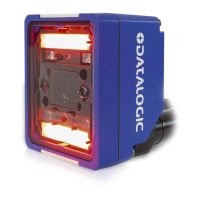
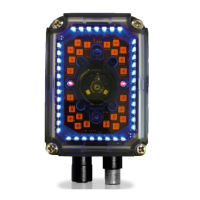
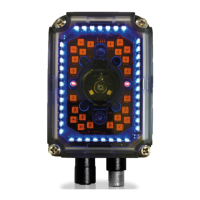
MATRIX 220
Programmability
If your requirements are not met by the Standard Application Program, Custom Applica-
tion Programs can be requested at your local Datalogic distributor.
Some of the main features of this reader are given below:
Excellent Performance
• 1.2 MPixels (960x1280)
• Electronic Adjustable Focus through software control
• Powerful Internal Lighting Systems
• Outstanding decoding capability on 1D, 2D, Stacked, Postal symbologies
• Excellent performance on DPM applications
• Omni-directional reading
• Frame Rate up to 45 frames/sec
• Image Cropping for higher frame rate
Ease of Setup
• Quick installation without PC by using X-PRESS interface for easy and intuitive
setup
• LED pointers for aiming
• Automatic Imager calibration and Code Settings
• Visual Feedback to verify exact code positioning in the Field of View and to maxi-
mize the reading performance
• Windows-based DL.CODE software to configure the reader parameters via PC
Et
hernet interface
• User-defined database of Image Acquisition Settings (parameter sets)
Ease of Use
• X-PRESS interface LEDs provide operational and performance feedback
• Green Spot and beeper for immediate Good Read feedback
• Different operating modes to suit various application requirements
• Multi Image Acquisition Settings for higher reader flexibility
• Image saving and storage with buffering capability
• Diagnostic software tools
Flexible Solution
• Complete set of Accessories like mounting brackets, connection boxes, cables and
photocells
• Ethernet Connectivity with TCP/IP socket for reader parameter configuration, data
and imag
e transfer, FTP client, etc.
• On-board Ethernet supports EtherNet/IP, PROFINET I/O, Modbus TCP, and OPC UA
pr
otocols
• 3 serial communication interfaces (Main, Auxiliary, ID-NET)
• 2 General purpose optocoupled Inputs
• 3 General purpose optocoupled Outputs (when using the CBX connection box)



 To Next Page
