System Control: Vacuum System
C O N F I D E N T I A L – FEI Limited Rights Data 2-13
stage eucentric position and the collection point of the EDX detector. The cone height is 5.5 mm and restricts a
field of view. See Chapter 5 for the cone mounting procedure.
The longer profile of this cone minimizes the low voltage beam dispersion and skirting of
the primary beam in the gaseous environment of the chamber, allowing more electrons to
interact with the specimen when focused and increasing the signal to noise ratio.
• GAD Cone (option – 500 µm aperture, see Chapter 7). The cone height is 5.5 mm.
Note
The PLA also acts as a final or objective aperture so the pressure over it is considered to be very low.
Any pollution that accumulates on the aperture edge greatly affects the imaging. If astigmatism is
not possible to correct, it is usually a sign that this aperture needs to be cleaned or replaced (see Chapter 6).
Warning!
Applying a cone or a detector with an integrated cone scales down the space between the top sample surface and the
cone (at the particular working distance) by the value equivalent to a cone height.
Using Gas
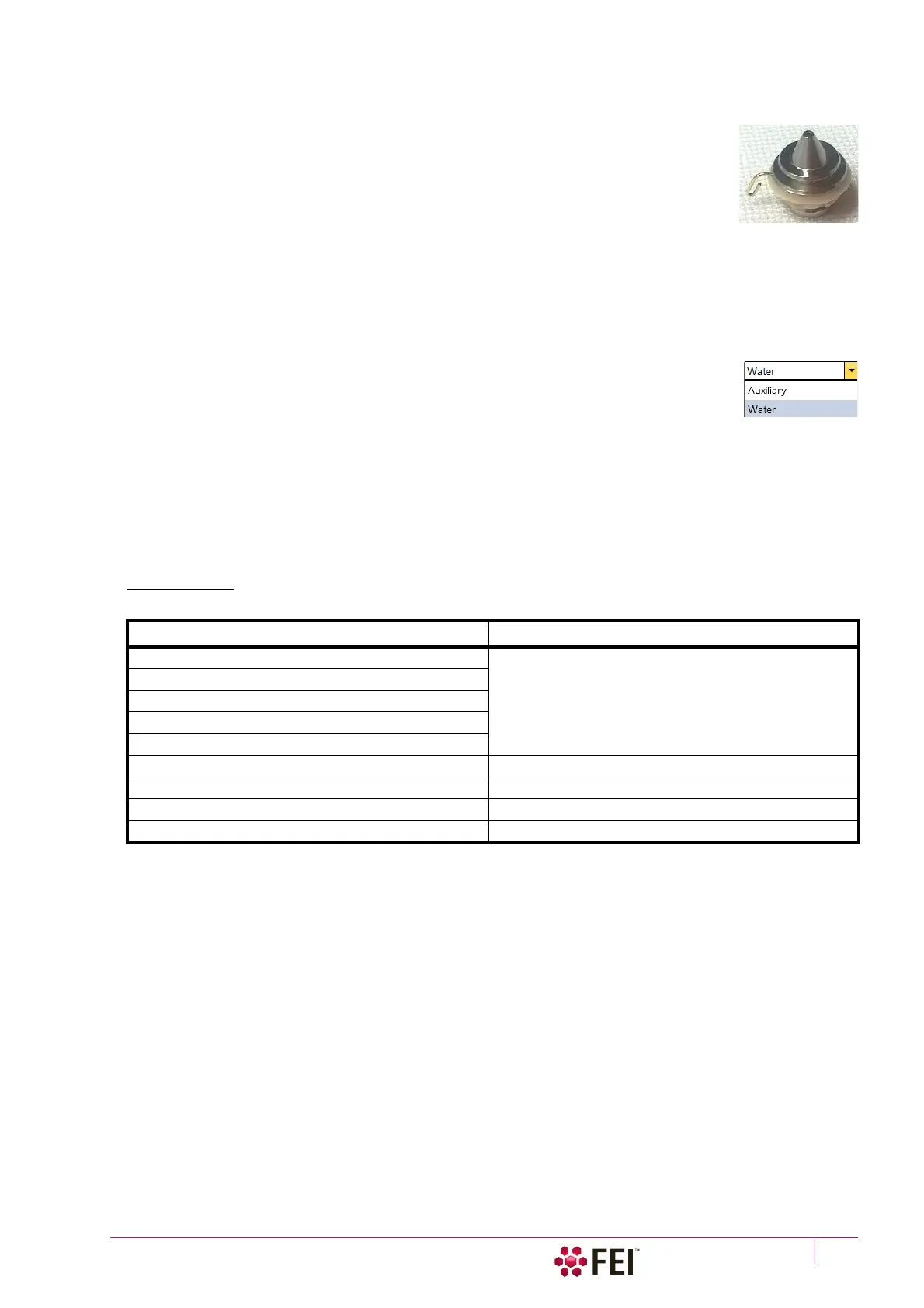
The Low Vacuum mode allows a user to image samples in a gaseous atmosphere, which can
be selected in the drop down list box:
• Auxiliary gaseous environment supplied via the inlet placed on the back of the console.
• Water vapour from a built-in water reservoir located on the left side of the microscope
console.
Note
On occasion the water reservoir needs to be filled (see Chapter 6).
Caution!
Maximum overpressure for the Auxiliary gas and Nitrogen inlets is 10 kPa (0.1 bar).
The Nitrogen inlet is used only for
venting the chamber with air or the nitrogen preferably.
When using a particular pressure limiting aperture, there are pressure limits for different gasses.
Caution!
The system doesn’t watch the limits and higher overpressure (especially for gasses not listed) set by a user! It could
switch off the emitter! In some cases the system needs to be started up by a FEI authorized service engineer.
Note
*) Combustible gases (acetylene for instance) must always be used with respect to safety issues.
**) The argon use should be minimized to a short time, because the IGP’s are not optimized for pumping of it at all.
Purging
During this procedure the specimen chamber is automatically pumped down to a lower pressure to remove the old
gas, then it is flooded with the new gas (selected in the Vacuum module) to a higher pressure. This takes place
several times, until the old gas is removed and the chamber is mostly filled with the new gas. This is applied when
the system is in the LoVac mode and the Purge button is pressed (see the Preferences… dialogue / Low Vacuum
section).
The procedure is also started automatically with factory preset in these situations:
• when the LoVac mode was not used for 1 week and more;
• after the Water bottle venting when refilling the water level (see Chapter 6).
Note
The automatic procedure can take a while (up to 10 minutes). Wait until Vacuum status indicates Pumped, because
detectors do not start operation till desired pressure is reached.
Table 2-1
Maximal Chamber Pressure [Pa (Torr)] under Different Gaseous Environment
Working Gas Maximum Chamber Pressure [Pa] (Torr)
Water – H
2
O 50 (0.4)
Nitrogen – N
2
Air
Carbon Dioxide – CO
2
Nitrogen Dioxide – NO
2
Helium – He 25 (0.2)
70 % He + 30 % H
2
20 (0.15)
Argon – Ar
**)
16 (0.1)
C
x
H
y
*)
50 (0.4)


 To Next Page