Configuring Spanning Tree Protocol (STP) and IronSpan Features
December 2005 © Foundry Networks, Inc. 7 - 37
Convergence After a Link Failure
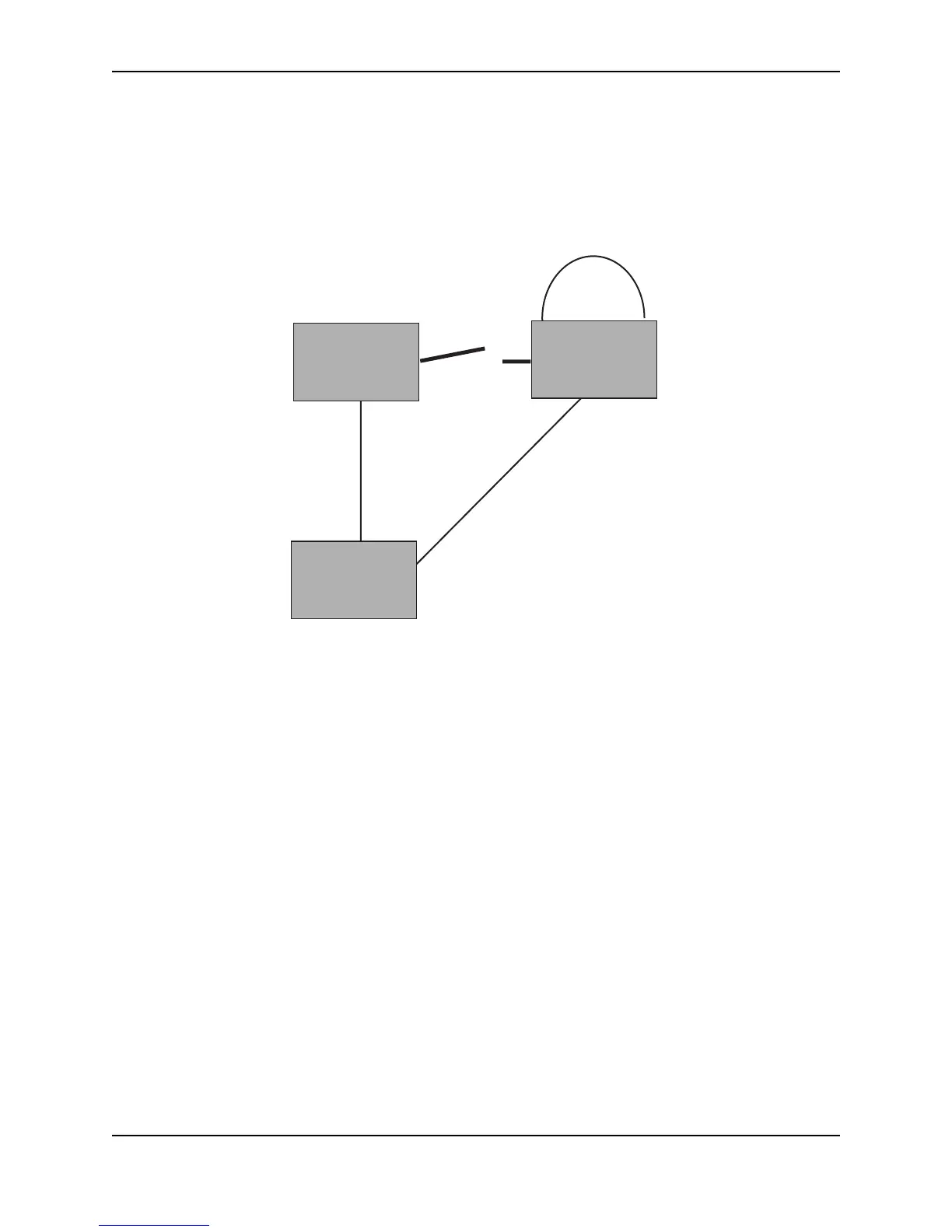
What happens if a link in the 802.1W topology fails?
For example, Port2/Switch, which is the port that connects Switch 2 to the root bridge (Switch 1), fails. Both Switch
2 and Switch 1 notice the topology change (Figure 7.17).
Figure 7.17 Link Failure in the Topology
Switch 1 sets its Port2 into a discarding state.
At the same time, Switch 2 assumes the role of a root bridge since its root port failed and it has no operational
Alternate port. Port3/Switch 2, which currently has a Designated port role, sends an RST BPDU to Switch 3. The
RST BPDU contains a proposal flag and a bridge ID of Switch 2 as its root bridge ID.
When Port3/Switch 3 receives the RST BPDUs, 802.1W algorithm determines that they are inferior to those that
the port can transmit. Therefore, Port3/Switch 3 is given a new role, that of a Designated port. Port3/Switch 3 then
sends an RST BPDU with a proposal flag to Switch 2, along with the new role information. However, the root
bridge ID transmitted in the RST BPDU is still Switch 1.
When Port3/Switch 2 receives the RST BPDU, 802.1W algorithm determines that it is superior to the RST BPDU
that it can transmit; therefore, Port3/Switch 2 receives a new role; that of a Root port. Port3/Switch 2 then sends
an RST BPDU with an agreed flag to Port3/Switch 3. Port3/Switch 2 goes into a forwarding state.
When Port3/Switch 3 receives the RST BPDU that Port3/Switch 2 sent, Port3/Switch 3 changes into a forwarding
state, which then completes the full convergence of the topology.
Convergence at Link Restoration
When Port2/Switch 2 is restored, both Switch 2 and Switch 1 recognize the change. Port2/Switch 1 starts
assuming the role of a Designated port and sends an RST BPDU containing a proposal flag to Port2/Switch 2.
When Port2/Switch 2 receives the RST BPDUs, 802.1W algorithm determines that the RST BPDUs the port
received are better than those received on Port3/Switch 3; therefore, Port2/Switch 2 is given the role of a Root
port. All the ports on Switch 2 are informed that a new Root port has been assigned which then signals all the
ports to synchronize their roles and states. Port3/Switch 2, which was the previous Root port, enters a discarding
state and negotiates with other ports on the bridge to establish its new role and state, until it finally assumes the
role of a Designated port.
Port2
Port2
Port3 Port5
Port4Port3
Port3
Port4
Bridge priority = 1000
Bridge priority = 2000
Bridge priority = 1500
1Switch
2Switch
Switch 3


 To Next Page