

 Need help?
Do you have a question about the INVT SV-DA200 Series and is the answer not in the manual?
 General
| Brand | INVT |
|---|---|
| Model | SV-DA200 Series |
| Category | Servo Drives |
| Language | English |
Details safety symbols, recycling information, and general precautions for safe operation.
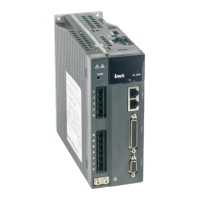
Describes the SV-DA200 series AC servo drive, its functions, and interface details.
Details the physical dimensions and diagrams for various drive sizes (A/B/C, D, F/F2, G, H).
Covers the methods for installing the servo drive, including base and bracket installations.
Specifies the required installation space and orientation for optimal ventilation and performance.
Provides outline and installation dimensions for various servo motor bases (40, 60, 80, 110, 130, 180, 200, 263 mm).
Provides instructions for powering on the system, checking connections, and performing initial operations.
Details the steps and checks required before the initial power-on of the servo drive.
Guides on configuring and running the servo drive in speed control mode using simple connections.
Provides instructions for operating the servo drive in torque control mode with simple connections.
Outlines the necessary parameter settings before the servo drive can be operated.
Explains how to enable the servo via terminal or parameter settings and its operational effects.
Describes conditions and methods for stopping the servo motor, including coasting and normal stopping.
Covers basic control parameters, including motor model, encoder type, and control mode selection.
Explains parameters like motor model, encoder type, and forward rotation settings.
Details parameters related to position control, including command selection and pulse input.
Covers parameters for speed command selection and torque limit settings.
Explains how to perform online and offline inertia identification for automatic gain adjustment.
Covers parameters for self-adaptive vibration control, including resonance detection and notch filters.
Explains parameters for setting speed, position, and torque gains, and their impact on system performance.
Details parameters and operation modes for the JOG function, including movement amount and speed settings.
Covers parameters and modes for homing operations, including automatic homing and step settings.
Explains parameters for Point-to-Point (PTP) control, including control words and position settings.
Explains parameters related to fault records, including codes, power-on time, and motor speed during faults.
Details the procedures for both online and offline inertia identification.
Explains general methods for adjusting servo system parameters, including rigidity and loop gains.
Covers techniques for suppressing mechanical resonance using notch filters and their parameters.
Explains how gain switching operations are performed and their benefits in different states.
Explains the RS485 communication protocol, including frame structure, command codes, and error checking.
Details the CANopen protocol, including hardware configuration, software configuration, and functions.
Covers the PROFIBUS-DP protocol, its introduction, hardware configuration, and software configuration.
Details fault codes, their associated causes, and recommended countermeasures for resolution.
Lists CANopen communication fault codes and their respective countermeasures.
Provides fault codes and countermeasures for PROFIBUS-DP communication issues.
Details EtherCAT communication fault codes and their corresponding solutions.
Provides a summary of fault codes, their names, and whether they are recordable, clearable, or disableable.


 To Next Page
