
 Need help?
Do you have a question about the LMI Technologies Gocator Series and is the answer not in the manual?
Defines conventions used in the documentation for clarity and consistency.
Covers safety precautions related to the laser emission from Gocator sensors.
Provides guidelines to prevent electrical shock and equipment damage during operation.
Details safe practices for handling, cleaning sensor windows, and general maintenance.
Addresses considerations for ambient light and environmental conditions affecting sensor performance.
Introduces Gocator system configurations: standalone, dual-sensor, and multi-sensor.
Explains the setup and configuration for systems using two Gocator sensors.
Describes how to connect multiple sensors using a Master network controller.
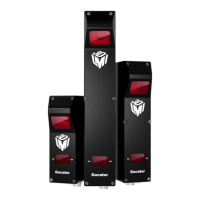
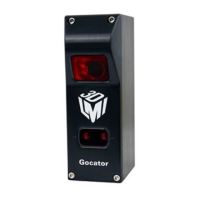
Details the Gocator sensor and its associated cordsets, including connectors and function.
Introduces Master 100, 400, 800, 810, 2410, and 1200/2400 for sensor networking.
Explains the use of calibration targets for alignment and encoder calibration.
Covers essential installation aspects: grounding, mounting, and orientation.
Outlines the steps for setting up a typical Gocator 2375 multi-sensor system.
Details the default network configuration and steps for changing PC network settings.
Provides step-by-step instructions for configuring a single Gocator sensor.
Guides on configuring a system with two Gocator sensors, including IP address management.
Explains the fundamental process of capturing 3D data using laser triangulation.
Defines key concepts for sensor setup and results interpretation: CD, FOV, MR.
Describes X Resolution, Z Resolution, and Z Linearity for sensor measurement capabilities.
Details how Gocator represents profiles and the different coordinate systems used.
Covers concepts like surface generation, part detection, and sectioning for scan data.
Explains how to match scanned parts to models using edge detection, bounding boxes, or ellipses.
Describes how to take measurements and use anchoring for robustness against variations.
Details how Gocator outputs results and uses digital tracking for control.
Provides a breakdown of the main elements and functions of the Gocator web interface.
Guides on managing sensor configurations by creating, saving, and loading job files.
Introduces the Manage page as the central hub for system and maintenance tasks.
Details network settings for connecting Gocator sensors to a network.
Covers configuration of alignment reference, encoder resolution, and travel speed.
Outlines tasks like firmware upgrades, backups, factory resets, and sensor resets.
Introduces the Scan page for sensor configuration and alignment procedures.
Describes the available scan modes: Video, Profile, and Surface.
Explains how triggers initiate frame capture and lists available trigger sources.
Covers sensor-specific settings like Active Area and Tracking Window.
Explains alignment states, types, and procedures for compensating inaccuracies.
Details post-processing filters: Gap Filling, Median, Smoothing, and Decimation.
Covers analyzing 3D point clouds to identify discrete objects for measurement.
Introduces the Model page for setting up part matching and sections.
Explains matching scanned parts to models using edge detection, bounding boxes, or ellipses.
Describes how to extract profiles from surfaces or parts using defined lines.
Introduces the Measure page for adding and configuring measurement tools.
Details how to add, configure, and manage measurement tools and their parameters.
Explains how to compare measurement results against thresholds to generate pass/fail decisions.
Explains how to track part movement and compensate for variations using anchors.
Describes TCP/UDP commands and data formats for communicating with Gocator sensors.
Explains PLC interaction with Gocator using Modbus TCP commands and data formats.
Describes EtherNet/IP messages and data formats for bidirectional data transfer with PLCs.
Details the ASCII protocol for serial or Ethernet output, including connection settings.
Explains commands for retrieving measurement values, decisions, and health indicators.
Introduces the Gocator Software Development Kit for programmatic sensor access and control.
Describes the Gocator Development Kit for creating custom measurement tools.
Software for discovering sensors and restoring factory defaults or changing network addresses.
Explains the industry standard for controlling imaging devices and configuring system variables.
Guides on resolving issues with connecting to the sensor via web browser or login.
Troubleshoots problems related to laser emission, safety signals, exposure, and triggering.
Addresses issues related to sensor CPU usage and optimizing performance.
Provides detailed specifications for Gocator 2100 & 2300 Series sensors.
Lists general specifications applicable to all 2x00 series models.
Provides detailed specifications for Gocator 2400 Series models.
Details the specifications for the Gocator 2880 sensor.
Defines pins and electrical specifications for the Power/LAN connector.
Describes the two optically isolated digital outputs and their configurations.
Details the connection and specifications for external encoder input signals.
Defines the analog output interface and configuration for current and voltage modes.
Details the Master 100's functions, connections, and pinouts.
Covers Master 400/800 controller functions, connectors, and electrical specifications.
Details Master 810/2410 controller functions, mounting, and compatibility.
Provides dimensional drawings for the Master 1200/2400 controllers.
Lists part numbers for Master network controllers.
Lists part numbers for various Gocator cordsets.
Provides contact information for technical support via Help Desk, phone, and email.
Lists contact information for LMI Technologies' Americas offices.
Lists contact information for LMI Technologies' Europe, Middle East, and Africa offices.
Lists contact information for LMI Technologies' Asia Pacific offices.
 General
| Manufacturer | LMI Technologies |
|---|---|
| Technology | Laser triangulation |
| Category | 3D Smart Sensor |
| Applications | Inspection, Measurement |
| Accuracy | Varies by model |
| Laser Class | Class 2 (varies by model) |
| Output Interface | Ethernet |
| Power Requirements | 24V DC |
| Operating Temperature | 0°C |
| Dimensions | Varies by model |
| Weight | Varies by model |



 To Next Page