Appendix: Stack-Up
AC393 Application Note Revision 14.0 91
7 Appendix: Stack-Up
A good stack-up leads towards better performance. The number of layers in the stack-up is dependent
on many factors such as form factor of the board, number of signals to be routed, and power
requirements. Therefore, the designer chooses how many layers the board requires. The SmartFusion2
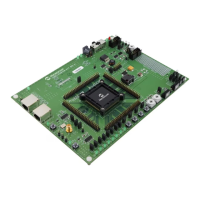
Development Kit/IGLOO2 Evaluation Kit has 16-layer stack-up, as shown in Figure 88, page 92.
Note: All the guidelines in this document are with respect to 16-layer board stack-up.
Utilizing upper power layers should be used for high priority supplies. High-switching current supplies
should be placed vertically closer to the devices to decrease the distance the currents need to travel
through vias. Ground planes are placed adjacent to the high transient current power planes to reduce
inductance and couple the high-frequency noise.
It is good to have power and ground layers on side-by-side layer. The benefits of this inter-plane
capacitance provide better decoupling at high frequencies. The effect of via on power pins is reduced by
having a power plane near the device.
Signal integrity depends on how well the traces have controlled impedance, so it is always recommended
to have controlled impedance.
Microsemi recommends that all critical high-speed signals like DDR and PCIe signals need to have
ground reference. All signal layers should be separated from each other by ground or power planes. This
minimizes crosstalk and provides balanced and clean transmission lines with properly controlled
characteristic impedance between devices and other board components.
Best performance is obtained when using dedicated ground plane layers that are continuous across the
entire board area. Power planes can provide adequate reference, however, the power planes should be
related to the signals they serve to reference.
Note: Refrain from using unrelated power planes as a signal reference.
Slots should not interrupt the planes, or else they can possibly force current to find an alternate return
path. This undesired return path could cause a localized bounce on the power or ground plane that can
possibly be capacitive coupled to all signals adjacent to the planes.



 To Next Page