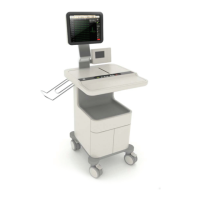
The Philips ST80i Stress Test System
ST80i Stress Test System Instructions for Use xix
The Philips ST80i Stress Test System
Intended Use
The Philips ST80i Stress Test System is a PC-based diagnostic tool intended to acquire,
process, and store ECG data of patients undergoing stress exercise testing. The software
records ECG, heart rate, and ST data, creates summary tables, trends, and produces a final
report regarding a variety of cardiac data indices. The cardiac data provided by the Stress
system is intended to be reviewed, confirmed, and used for diagnostic purposes by trained
medical personnel to assist in the diagnosis of CAD and the patient's physiological condition
during stress exercise testing. The arrhythmia detection portion of the ST80i Stress Test
System is provided to the user for the convenience of automatic detection of arrhythmias but
does not provide alarms.
Indications for Use
The Philips ST80i Stress Test System is indicated for use in exercise ECG testing where the
clinician decides to evaluate the electrocardiogram of patients at 10 years or older, as part of
decisions regarding possible diagnosis, potential treatment, effectiveness of treatment, or to
rule out causes for symptoms of CAD. The Philips ST80i Stress Test System is not intended to
be used as a physiological monitor.
The CAlg-STR Exercise ECG Analysis Algorithm
Intended Use
The intended use of the CAlg-STR Exercise ECG analysis algorithm is to analyze multi-
channel ECG waveforms acquired from a patient and produce measurements such as heart
rate, detect ventricular arrhythmias, form representative beats, and calculate ST segment
deviation (elevation or depression) and ST slope for review by a trained physician or clinician
in determining a diagnosis. The measurements should not be used as a sole means for
determining a patient’s diagnosis.
Indications for Use
The analysis algorithm is indicated for use in those situations where the clinician decides to
evaluate the electrocardiogram of patients at 10 years old and older, as part of decisions
regarding possible diagnosis, potential treatment, effectiveness of treatment or to rule out
causes for symptoms. The analysis algorithm is not intended to be used as a physiological
monitor.


 To Next Page