102 PI-MAX/PI-MAX2 System Manual Version 5.F
Procedure for Setting up and Performing a Single Shot Experiment
A single shot experiment offers only one chance to capture an event. As in any gated
experiment, the "time budget" of the experiment is crucial. If there is no pre-trigger from
the experiment, a photodiode can be used to generate an electrical trigger from the laser
light. In this situation, light has to be delayed by optical means (fiber-optic cable or
mirror reflections) to allow sufficient time for the electronics to be activated after
receiving the trigger. Another important thing to note in single shot experiments is that
the CCD is set in "Continuous Cleans" mode so that there is no dark charge accumulation
while it is waiting for the trigger.
The following experiment is an attempt to capture a 60 nsec fluorescence generated by a
single shot laser. The time budget of the experiment is shown in Table 6 below. This
information is important in order to choose the correct length fiber-optic cable.
Photodiode (light -> TTL pulse)
A minimum of 38 ft
of fiber-optic cable is
required.
Photodiode -> PTG (2 ft BNC cable)
PTG -> PI-MAX (6 ft cable)
Table 6. Single Shot Experiment Time Budget
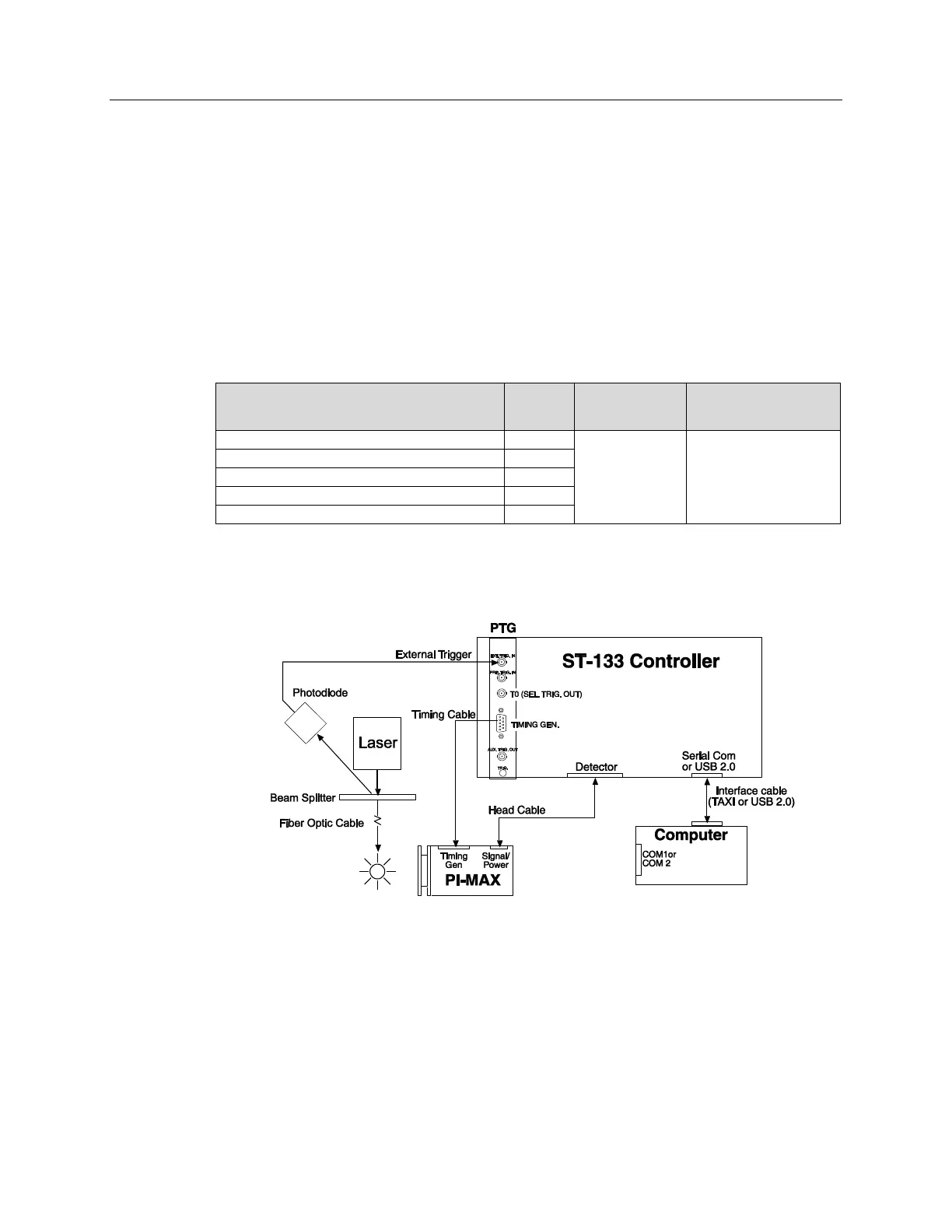
In this experiment, the cables are kept as short as possible to minimize the length of the
fiber-optic cable required.
Figure 54. Single Shot: Hardware Setup
After setting up the appropriate hardware, as shown in Figure 54, default values for
"Cleans and Skips" are loaded (Figure 55). If the CCD has to wait more than a few
seconds for the external trigger, it is advisable to increase the number of cleans.



 To Next Page