24 PI-MAX/PI-MAX2 System Manual Version 5.F
Manual Organization
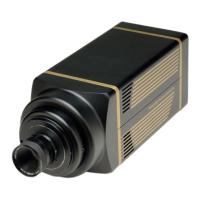
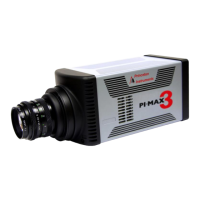
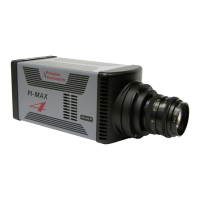
This manual provides the user with all the information needed to install a PI-MAX
Intensified CCD camera and place it in operation. Topics covered include a detailed
description of the camera, installation and setup, first time data acquisition, tips and
tricks, microscopy applications, temperature control and more. A brief description of
each of the chapters follows.
Notes:
1. The general identifier "ST-133" is used for both the ST-133A Controller and the
ST-133B Controller. Where there is a difference, the specific identifier is used.
2. "WinX" is a generic term for WinView/32, WinSpec/32, and WinXTest application
software.
Chapter 1, Introduction provides an overview of the PI-MAX camera. Topics
include a description, theory of operation, and specifications.
Chapter 2, Installation Overview cross-references system setup actions with the
relevant manuals and/or manual pages. It also contains system layout diagrams.
Chapter 3, System Setup provides detailed directions for installing and setting up
the PI-MAX for both spectroscopy and imaging.
Chapter 4, First Light provides abbreviated directions for getting your PI-MAX
into operation as soon as possible.
Chapter 5, General Operation Factors provides information about experiment
setup, temperature control, background subtraction, array readout, binning, and
digitization. These are factors that should be considered whether you are setting
an experiment in shutter or gate mode.
Chapter 6, Shutter Mode Operation discusses issues specific to operating the
PI-MAX system in shutter mode.
Chapter 7, Gated Operation with a PTG discusses issues specific to operating
the PI-MAX system in gate mode with an installed PTG.
Chapter 8, Gated Operation with a DG535 discusses issues specific to
operating the PI-MAX system in gate mode with a Stanford Research DG535.
Chapter 9, Kinetics Operation describes the Kinetics option and includes
example experiments.
Chapter 10, PI-MAX2 DIF Camera describes the operation of the PI-MAX2 DIF
system.
Chapter 11, Tips and Tricks discusses a number of issues that can have a bearing
on getting good experimental results.
Chapter 12, Microscopy Applications discusses how to mount the PI-MAX
Camera to a microscope. Includes discussion of various adapters, focusing
considerations and sensitivity to damage from EMF spikes generated by Xenon
or Hg arc lamps.
Chapter 13, TTL Control discusses the purpose and operation of the TTL In/Out
Function.



 To Next Page