Chapter 5 General Operation Factors 55
Notes:
1. Do not be concerned about either the DC level of this background noise or its shape
unless it is very high, i.e., > 1000 counts with 16-bit A/D. What you see is not noise.
It is a fully subtractable readout pattern. Refer to "Background Subtraction",
page 59, for more information.
2. Offset and excess noise problems are more likely to occur if the controller and
camera weren't calibrated and tested as a system at the factory.
If you observe a sudden change in the baseline signal you may have excessive humidity
in the camera's vacuum enclosure. Immediately turn off the controller. Then, contact
Princeton Instruments Customer Support for further instructions. See page 232 for
contact information.
Clean Cycles
As stated before, dark charge integrates on the array whenever the camera is on, whether or
not data acquisition is occurring. To minimize the dark charge and other noise in the pixel
wells when data acquisition is idle, the Clean Cycles function shifts accumulated charge in a
predefined number of rows to the shift register and then discards it.
Clean cycles start when you turn the controller on and a clean pattern is programmed into the
ST-133. At the end of a cycle, the ST-133 checks to see if a Start Acquisition command has
been received. If it has been received, the user-defined number of cleans (typically 0) will
be then performed before the exposure time starts. If a Start Acquisition has not been
received, the next clean cycle begins.
The number of rows that are shifted and discarded during a clean cycle are defined in the
application software (for example, on the WinView/WinSpec Hardware Setup|Cleans/
Skips tab page). The most effective cleaning occurs when the number of rows equals the
number of rows on the CCD. However, you need to keep in mind that a clean cycle must be
completed before a Start Acquisition command will be implemented. The more rows in a
cycle, the greater the delay between the command receipt and the beginning of an exposure.
Because of this timing issue, the number of rows per clean cycle is usually much smaller than
the number of rows on the array.
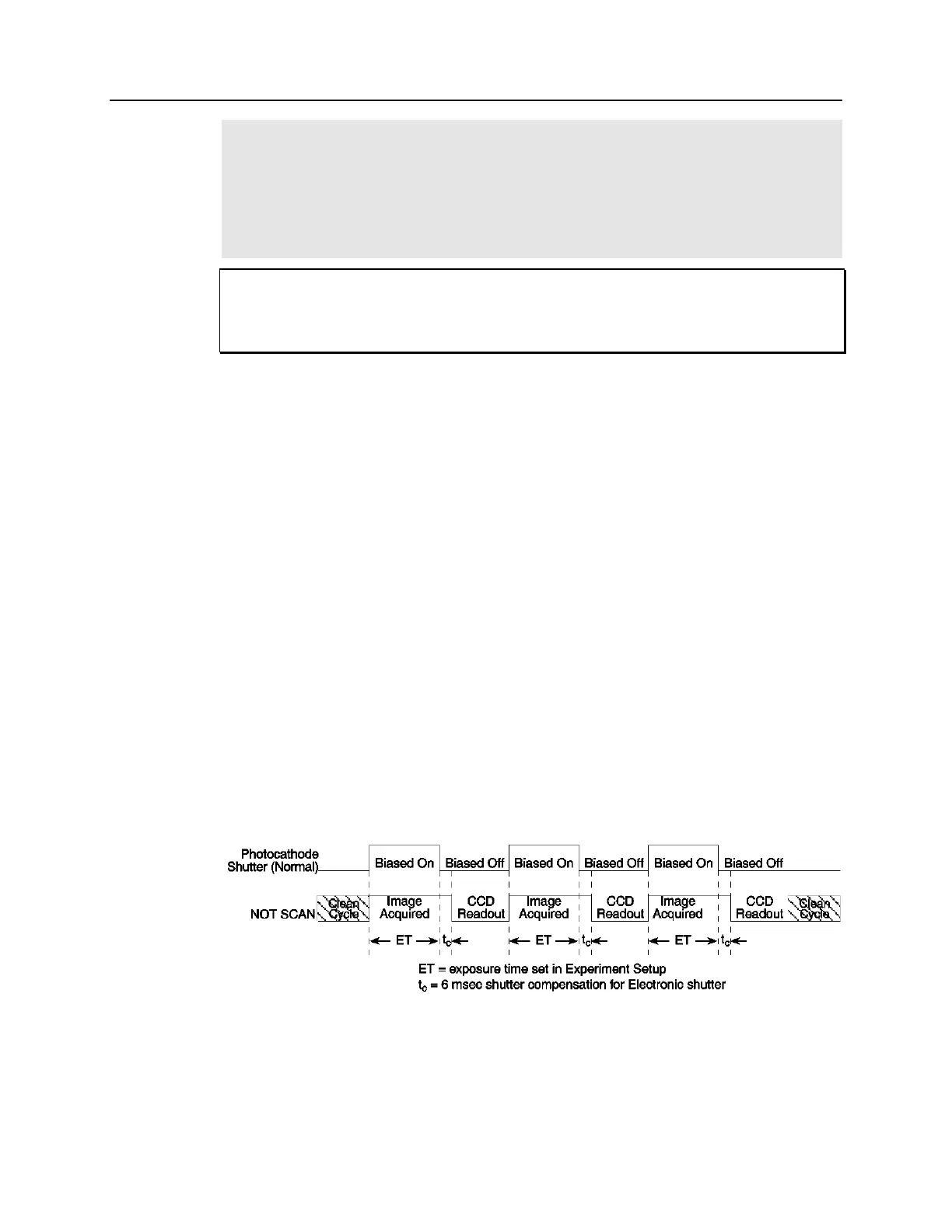
The timing diagram below is for an experiment set up to acquire three (3) images in Free
Run timing mode with normal shutter operation selected. In this diagram, clean cycles
occur before the first exposure and after the last readout period. They do not need to occur
between exposures since each readout cleans the array before the next exposure starts.
Figure 15. Clean Cycles in Free Run Operation



 To Next Page