Chapter 5 General Operation Factors 59
well. Once charge accumulates for the exposure time (set in the application software), the
pixels are read out serially.
Because CCD arrays are always sensitive to light, light must not be allowed to fall on the
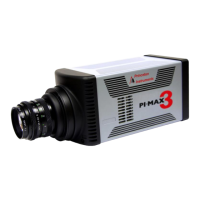
array during readout (with a few exceptions). Intensified cameras such as the PI-MAX
rely on gating the intensifier off, to prevent light from reaching the array. During each
data acquisition, the intensifier is gated on for the duration of the exposure time, allowing
the pixels to register light, and is then gated off for the readout period.
Exposure with an Image Intensifier
PI-MAX cameras use an image intensifier both to gate light on and off and to greatly
increase the brightness of the image. In these cameras the image intensifier detects and
amplifies the light, and the CCD is used for readout.
The exposure programmed by software in this case refers to duration of gating of the
intensifier. For shorter exposures, a PTG or a DG535 timing generator is required.
The MCP (microchannel plate) of the intensifier is composed of more than 10
6
individual
miniature electron multipliers with an excellent input to output spatial geometric
accuracy. Intensifier gain is varied by adjusting the voltage across the MCP or the voltage
across the MCP output and the phosphor. This second parameter is a factory adjustment,
as it affects both the gain and the resolution of the intensifier.
Detection of extremely weak Continuous Wave (CW) signals, e.g., luminescence and Raman
scattering from solid state samples, is typically limited by the dark current of the intensifier's
photocathode, usually referred to as the equivalent brightness intensity (EBI). All standard
intensified cameras made by Princeton Instruments have the lowest EBI values possible.
Saturation
When signal levels in some part of the image are very high, charge generated in one pixel
may exceed the "well capacity" of the pixel, spilling over into adjacent pixels in a process
called "blooming." In this case a more frequent readout is advisable, with signal
averaging to enhance S/N (Signal-to-Noise ratio) accomplished through the software.
For signal levels low enough to be readout-noise limited, longer exposure times, and
therefore longer signal accumulation in the CCD, will improve the S/N ratio
approximately linearly with the length of exposure time. There is, however, a maximum
time limit for on-chip averaging, determined by either the saturation of the CCD pixels
by the signal or the loss of dynamic range due to the buildup of dark charge in the pixels.
Background Subtraction
Each CCD has its own dark charge pattern or background that can be subtracted from the
total acquired signal. By subtracting this background, you can eliminate the dark charge,
which might otherwise hide low-intensity signal.
When setting up for background subtraction, set up the experiment conditions for
acquiring the actual image (camera temperature, exposure time, region of interest, timing
mode, etc.) and then, while blocking the incoming signal from the array, acquire a dark
charge "background image" under those conditions. Once the background image is
acquired, save it to disk.
After storing the background data to disk, you have two choices for background
subtraction: automatic or post-processing.



 To Next Page