154 PI-MAX/PI-MAX2 System Manual Version 5.F
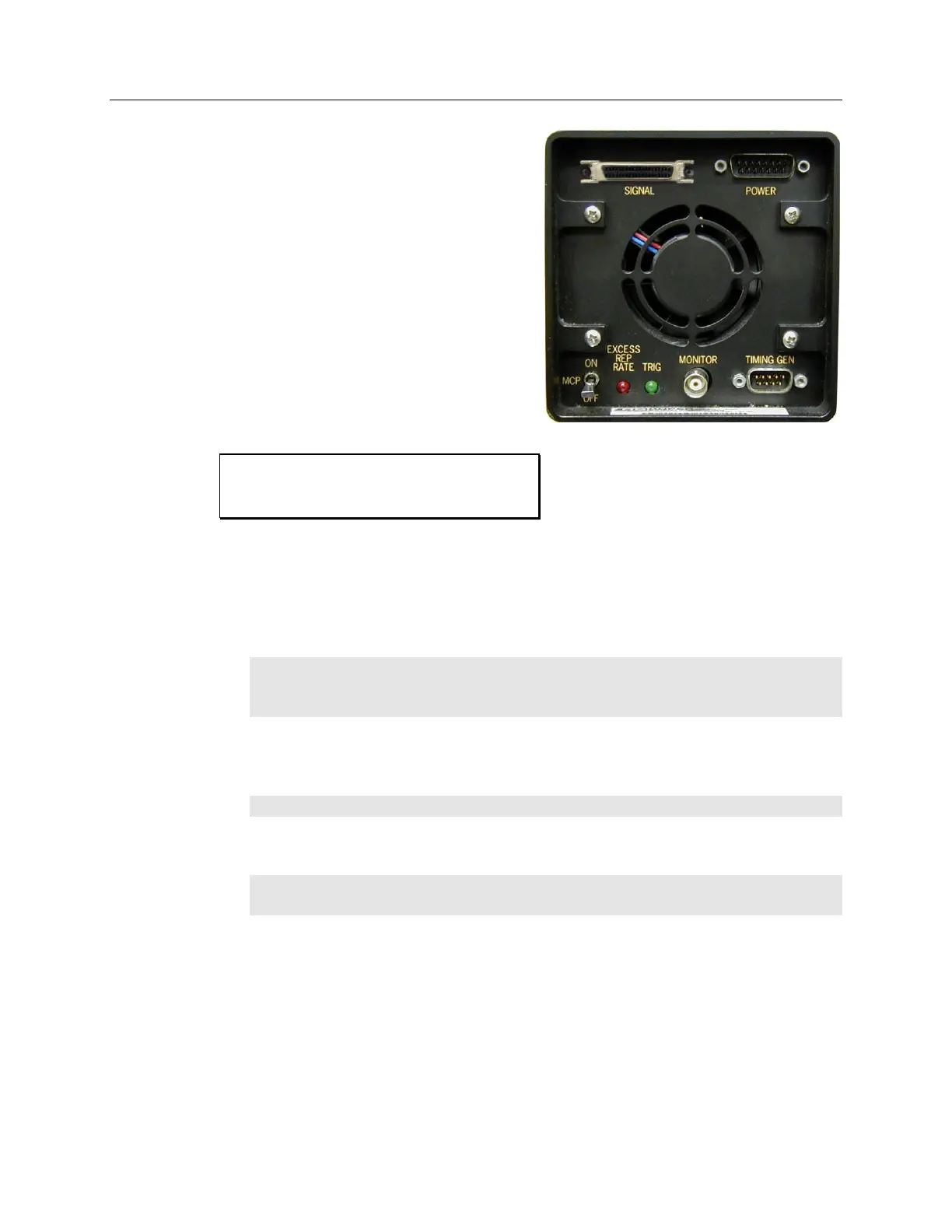
Signals applied through this cable
control the photocathode gating and
MCP bracket pulsing.
MCP On/Off switch: This switch biases
the intensifier photocathode ON or OFF.
When the MCP On/Off switch is set to
ON, the photocathode can be gated ON.
Exception: Selecting SAFE on the
Experiment Setup Main screen overrides
control and will prevent the photocathode
from being biased on regardless of the
MCP On/Off switch setting.
When the MCP On/Off switch is set to
OFF, then the photocathode cannot be
turned on from software.
It is advisable to set the MCP On/Off switch
to OFF as a fail-safe measure if the PI-MAX
is left ON but unused for a period of time.
Figure 89. PI-MAX2 Rear Panel
Water ports: (standard PI-MAX) Two standard ¼ size brass fittings for circulating
water coolant are located on the back panel. Either port may be used as the inlet. The
water cannot be chilled. A closed circulator such as the PI model CC-100 circulating
water at laboratory ambient temperature should be used. See "Temperature
Control", page 57 for additional information.
Note: Although circulating water will extend the PI-MAX’s cooling capabilities, it is
not necessary. Most of the PI-MAX cooling is provided by the fan. With regard to the
procedures in this chapter, there is no need for circulating water coolant.
Monitor connector: BNC port for TTL logic 1 pulse delayed 4-6 ns with respect to
photocathode gating. Delay in 2 ns mode is not specified. Cable delay, ~1.5 ns/ft, will
be in addition to the delay at the connector.
Note: Operation of Monitor output with 6 ns gating cannot be guaranteed.
Excess Rep Rate: Red LED lights to warn of excessive repetition rate. Must be off for
proper operation.
Note: Excess Rep Rate LED is not activated by MCP bracket pulsing; MCP bracket
repetition rate limit is 5 kHz.
Trig: Green LED flashes each time PI-MAX is triggered. Glows steadily at high
repetition rates.



 To Next Page