17
Chapter 1
Introduction
The Princeton Instruments PI-MAX
®
Intensified CCD camera is designed for general
macro-imaging and microscopy imaging applications. It is ideal for applications
involving ultra low light measurements, or measurements of transient effects. PI-MAX
uses a proximity-focused microchannel plate (MCP) image intensifier (Gen II and Gen III
intensifiers available) fiber-optically coupled to a CCD array. The fastest intensifiers can
be gated in as little as 2 ns or less with an exceptionally high on/off light-transmission
ratio. The CCD array provides a low noise, high dynamic range readout device that can
be scanned at a variety of pixel rates. A number of different arrays are available to match
the PI-MAX to the widest possible range of experimental requirements. In operation, data
acquired by the camera is routed to the computer for processing and display. The
computer controls both the system configuration and data acquisition via software, of
which Princeton Instruments WinView/32 is an example.
Unless otherwise indicated, PI-MAX will be used to refer to both the standard PI-MAX
and the 5 MHz PI-MAX2™ cameras.
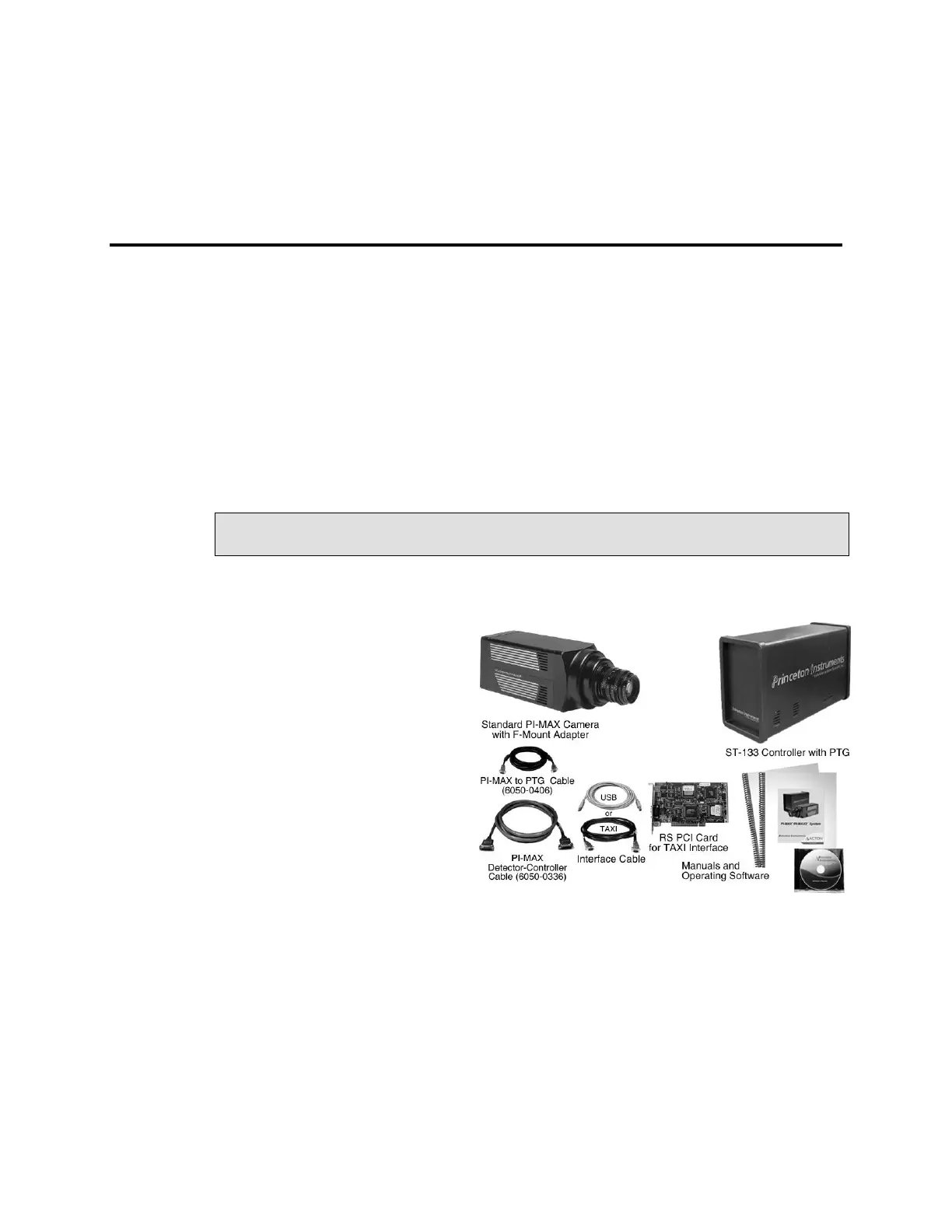
PI-MAX System Components
All PI-MAX systems consist of
standard hardware and software as
well as the appropriate interface
hardware for your computer
system. Some PI-MAX systems
also include an optional PTG or
DG535 pulser.
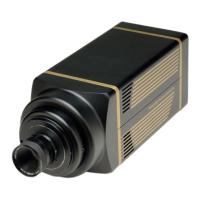
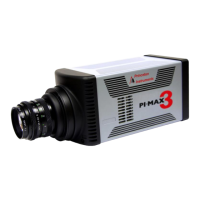
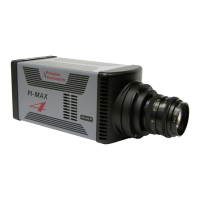
Camera Head
The PI-MAX camera head houses
the CCD and intensifier and it
supplies all of the high voltages
needed to operate the intensifier
(see Chapter 3 for more info).
Cooling within the camera head is
performed by a cooling fan and a
multi-stage Peltier cooler that is
Figure 1. Typical Standard PI-MAX System Components
thermally coupled to the CCD (liquid coolant circulation can also be used for the standard
PI-MAX camera). C-, F-, and spectroscopy mount adapters are available.
The camera can be operated in one the following three modes: Safe mode, Shutter mode, and
Gate mode. In safe mode, all the high voltages in the camera head are disabled so high
intensity light will not damage the intensifier. In Shutter Mode, the intensifier's photocathode
is biased ON for the set Exposure Time and OFF during each readout of the array. In Gate
mode, the photocathode is biased on only during the time each gate pulse is applied.



 To Next Page