88 PI-MAX/PI-MAX2 System Manual Version 5.F
first pulse to pulse period), and then anticipate each of the subsequent external
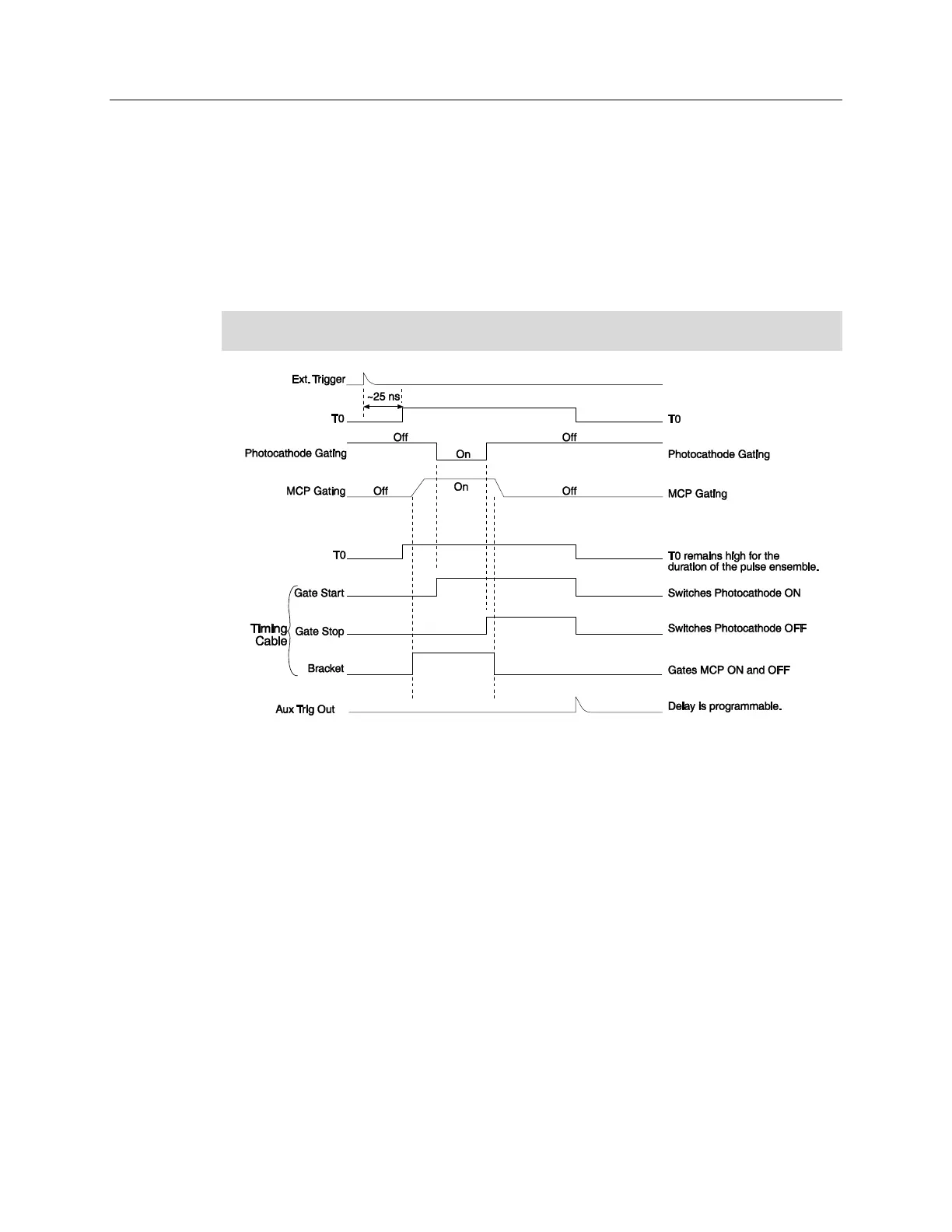
triggers in the series. In this way, the bracketing pulse is timed to lead the
photocathode gate pulse by the anticipate time entered in the Anticipate By field.
The on/off ratio in the UV is retained.
For proper operation, the bracketing pulse must begin at least 500 ns before the
gate pulse. The minimum Anticipator Time is 500 ns (or the minimum PI-MAX
bracket lead-time from EEPROM) minus the minimum Gate Delay time. For
example, with a minimum Gate Delay time of 200 ns, the minimum Anticipator
time would be 300 ns.
Note: Because Gen III Intensifiers do not respond in the UV, bracket pulsing is not
available for these intensifiers.
Figure 35. PI-MAX Timing for MCP Bracket Pulsing with PTG Timing Generator
MCP Gating
Introduction
MCP gating is only available with the PI-MAX
MG
system. This gating mode (not to be
confused with MCP bracket pulsing) provides you with a unique combination of
nanosecond-scale gating speed and high ultraviolet QE. Normally, such high UV QE is
only available in so-called slow gate intensifiers (i.e., those without a nickel underlay).
The PI-MAX
MG
applies the primary gating pulse to the MCP portion of the tube and, if
chosen by the user, applies the bracket pulse to the photocathode. Consequently, it
provides the full benefit of bracket pulsing along with enhanced QE.
The main limitations with this option are that there is a somewhat larger propagation
delay and larger optical FWHM than a standard fast gate PI-MAX. Quantitatively, the
propagation delay of the PI-MAX itself is in the 40 ns range compared to 10-12 ns for a
standard PI-MAX. Note that the PTG propagation delay is in addition to the 40 ns.
Minimum FWHM for a PI-MAX
MG
system is in the 8 to 15 ns range, compared to 1.5 ns
to 2 ns for a standard PI-MAX. Pulse repetition rate is limited to 1 kHz.



 To Next Page