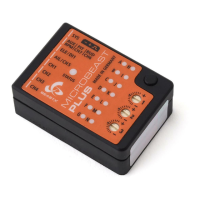
Parameter explanation
transmitter. If the value is set too low, pirouettes will be inconsistent during fast forward
flight or in crosswind conditions and the helicopter will slowly drift on the vertical axis
when in stationary hovering flight with crosswinds. If on the other hand the setting is too
high, the tail gyro will respond delayed to fast directional changes and the rudder stick
control feels very inprecise. Additionally the tail might make a slow bounce after stopping
from a rotational movement and commute gently while hovering or flying around. So only
adjust this parameter as high as necessary.
Parameter menu point D only adjusts some part of the tail gyro control loop. First of
all, you must adjust the tail gyro gain in the transmitter and use it to switch the gyro
to HeadingLock mode.
• Before adjusting the rudder rate consistency always try to find the maximum amount
of tail gyro gain by flying around and using the tail gyro in HeadingLock mode.
• After adjusting the rudder rate consistency it might be necessary to readjust the tail
gyro gain! Both parameters interact to each other.
Status-LED Rudder rate consistency
purple very low
red flashing low
red medium
blue flashing high
blue very high
Additional information
Please note that poor tail performance very often may be a sign of a stiff tail mechanics,
slop in the tail linkage or an inadequate rudder servo! The tail rotor system in this case
does not react as precise as necessary and hinders the tail gyro from working properly.
If you cannot increase the rudder rate consistency further than “very low“ or “low“
without the tail rotor starting to slowly oscillate or bounce after doing a full stop, it is
very likely that there is a mechanical issue. Also if on the other hand the tail does not
turn constantly at high speeds or doesn't turn around at all, even with setting „very
high“, again this may be due to a mechanical cause.
Make sure that the maximum blade pitch at the tail rotor neither is too large nor
too small. A large pitch angle can lead to a stall of the tail rotor blades. Then
the tail rotor produces hardly any thrust, similar to a very small angle. Also check
240


 To Next Page