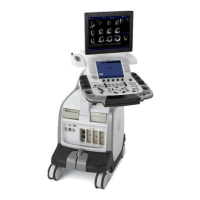
9100c
3-6 M1207026
3.4 Flow control tests
If the system includes O
2
monitoring, complete the flow control
tests in Section 3.4.1, “With O
2
monitoring”.
If the system does not include O
2
monitoring, complete the flow
control tests in Section 3.4.2, “Without O
2
monitoring”.
3.4.1 With O
2
monitoring
WARNING Nitrous oxide (N
2
O) flows through the system during this
test. Use a safe and approved procedure to collect and
remove it.
1. Set up the gas scavenging system.
• Attach a patient circuit and plug the patient port.
• Attach a bag to the bag port (or plug the bag port).
• Adjust the APL valve to minimum.
2. Connect the pipeline supplies or slowly open the cylinder valves.
3. Turn all flow controls fully clockwise (zero flow).
4. If equipped, set the ACGO selector switch to Breathing System.
5. Set the system switch to On and set the Bag/Vent switch to Bag.
6. Adjust O
2
flow to 0.5 L/min.
7. Confirm that the O
2
sensor measures 21% in room air and 100%
in pure O
2
. If not, calibrate the O
2
sensor.
8. Set the flow controls to mid range of each flowtube the flowtube.
Note If the system does not include N
2
O, skip steps 9 and 10.
9. Check the proportioning system concentration (increasing N
2
O
flow). Observe the following precautions:
• Start with all valves at the minimum setting.
• Adjust only the N
2
O flow control.
• Increase the N
2
O flow as specified in the following table and
make sure the O
2
concentration is in range.
Note: Allow the O
2
monitor to stabilize. At the lower flows, the
O
2
monitor may take up to 90 seconds to stabilize.
• If you overshoot a setting, turn the O
2
flow control clockwise
until the N
2
O flow decreases to the previous setting before
continuing the test.
M1207027 004 MANUAL−DOC, Technical Reference Manual, Technical Reference Manual for 9100c, English−default
Reproduced from the electronic master in MATRIX


 To Next Page