3-52
Chapter 3 Settings and Measurement
Contents General Description
Checks and Preparation
Settings and Measurement
Example of Use Specification
4. ALARM settings
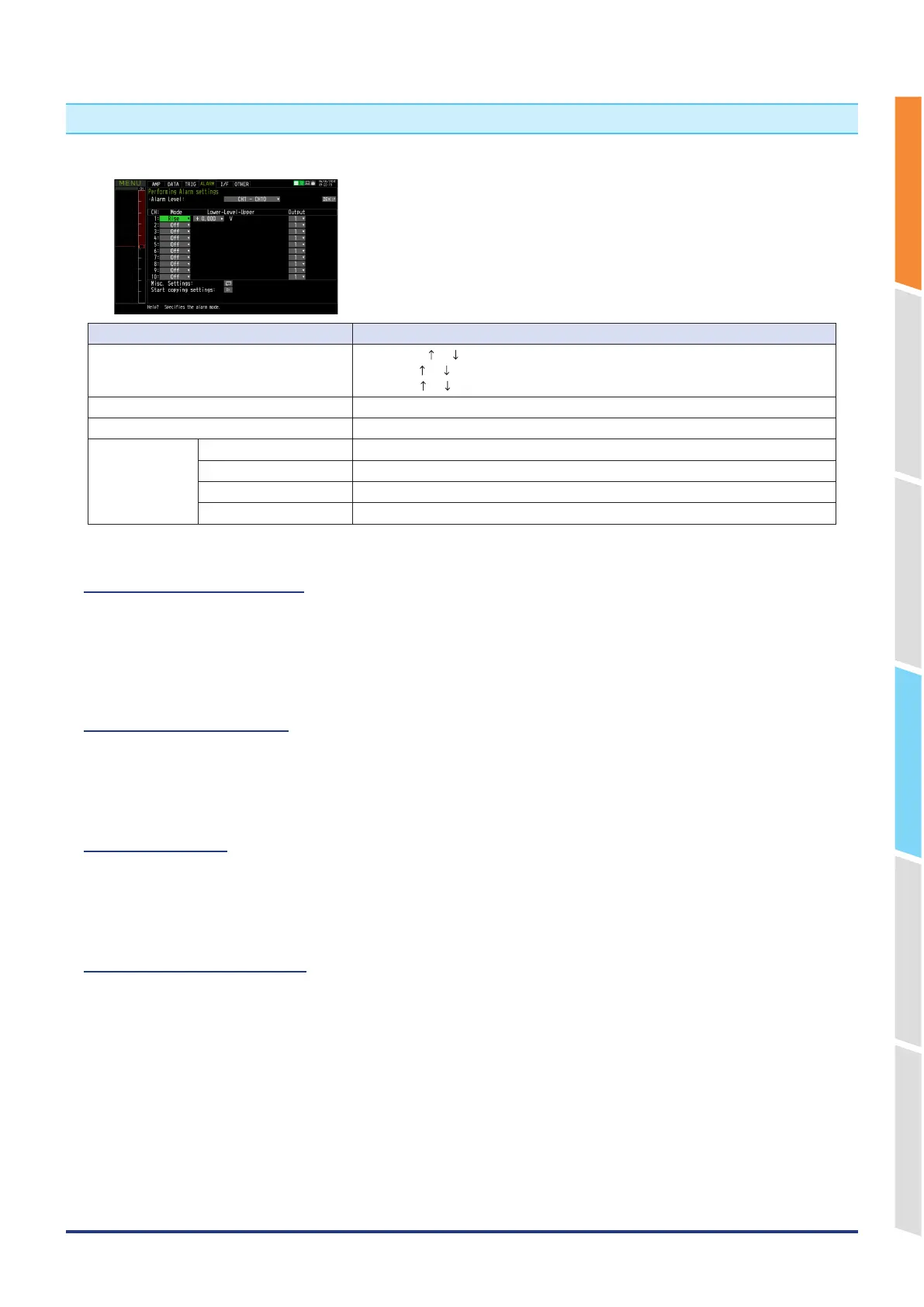
Make alarm settings.
Setting Selections available
Mode Analog: Off, H, L, Window In, Window Out
Logic: Off,
H,
L
Pulse: Off,
H,
L, Window In, Window Out
Level Set numeric value
Output 1, 2, 3, 4
Misc. Settings Detection Method Level, Edge
Alarm Hold Held or Not held
Send Burnout Alarm Sent or not sent
Alarm History Off, On
4-1. Alarm level settings
This is used to set alarm generation conditions, output destination, etc.
When the conditions specified here are met, the alarm output terminal (for which an output destination number must be
selected for each channel) outputs an alarm.
Refer to “Trigger Level Settings/Alarm Level Settings” described below for the CH condition settings.
4-2. Detection method
Sets the alarm detection method.
Select the alarm detection method from Level or Edge.
For details on operation, refer to “Trigger Level Settings/Alarm Level Settings” described below.
4-3. Alarm hold
If "Alarm retention" is selected here, once the established conditions have been met the alarm status will not be
cleared, regardless of whether or not the conditions continue to be met (Clear the alarm by pressing the FUNC key and
selecting "Alarm Clear".).
4-4. Send burnout alarm
The alarm is output from the alarm output terminal by selecting "Sent" when the burnout occurs (Refer to "6-1-3.
Burnout) described below.







 To Next Page